I've written before about Sidney J. Phillips' unsuccessful attempts to secure an amendment to the original BTW half dollar legislation that would have authorized a new coin to be struck in 1956 in recognition of the centennial of BTW's birth. The attempts failed, however, as did a commemorative medal bill for the same anniversary.
You can check out these stories here:
-
What If? 1956 Booker T Washington Coin #3-
What If? 1956 Booker T Washington Centennial - Phillips Memo - Part I-
What If? 1956 Booker T Washington Centennial - Phillips Memo - Part II-
What If? 1956 Booker T. Washington MedalBooker T. Washington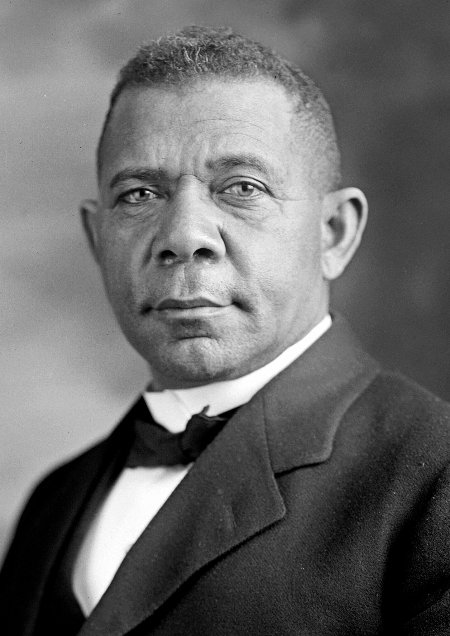 (Image Credit: Public Domain.)
Time to flesh out the stories a bit...
By the time the bills referenced in the above posts were introduced, the Booker T. Washington Birthplace Memorial, the sponsor of the 1946-51 BTW Birthplace Memorial coins (and co-sponsor of the 1951-54 George Washington Carver - Booker T. Washington coins), was bankrupt. Though initially enough to support the establishment of the Birthplace Memorial and to acquire property for its use, the lower-than-expected coin sales - often at reduced premiums over face value - did not generate enough net proceeds for the Memorial to cover ongoing expenses and enable it to remain solvent.
The property and assets of the Birthplace Memorial were put up for auction in February 1955; the site was auctioned as three separate tracts. Sidney Phillips, with the financial assistance of Portia Washington Pittman (BTW's daughter), was able to buy back the "Birthplace Tract" which included the primary buildings of the Memorial - the purchase prices was $16,000. The purchase was made on behalf of the Booker T. Washington National Monument Committee, with Phillips as its Chairman.
The Committee was organized to establish a "suitable and lasting monument" to BTW at his birthplace. Phillips arranged a first and second mortgage on the property and then organized the Booker T. Washington National Monument Foundation ("Foundation") to take over the birthplace property and assume the mortgages; the Foundation was chartered on April 18, 1955.
The goal of the Foundation was "...to establish a perpetual memorial in commemoration of the life and character of Booker T. Washington in promoting legislation which will provide for the establishment of the Booker T. Washington National Monument located at his birthplace in Franklin County, Virginia." (The "perpetual memorial" language is essentially the same as that in the charter of the previous Booker T. Washington Brithplace Memorial non-profit organization.) The Committee transferred its property and assets to the Foundation in July 1955.
The Foundation was much more focused on its primary objective (i.e., a "perpetual memorial") vs. the Birthplace Memorial group and its myriad of supplementary educational and industrial objectives, and convinced six US Representatives and one US Senator to introduce bills in the 84th Congress that called for the establishment of a Booker T. Washington National Monument; the bills were introduced between June 20 and August 1, 1955.
The bills looked "to provide for the establishment of the Booker T. Washington National Monument." They authorized the Department of the Interior "to acquire, on behalf of the United States, by gift, purchase, or condemnation, all right, title, and interest in and to the real property located at Booker Washington Birthplace, Virginia."
Representative Clair Engle's (D-CA) bill, introduced on June 20, 1955, was the one that moved forward. It was reported favorably by Committee and was passed by the House of Representatives and Senate.
Sidney J. Phillips, and the Foundation, were very willing to turn over the birthplace property to the Interior for $17,000 - its indebtedness on the property. The Commonwealth of Virginia agreed to pay the $17,000 and to then turn over the property to the US Government for "the establishment of a Booker T. Washington National Monument to serve as a symbol of the opportunities which America offers to all its people" once the Federal Government had signed on to the plan.
On April 2, 1956, US President Dwight David Eisenhower signed the bill into law and formally established the Booker T. Washington National Monument (Public Law 84-464). The new law transferred ownership of the BTW Birthplace Memorial to the US Government and placed it under the authority of the Department of the Interior; it took a bit more than a year for the full transfer to take place. Sidney J. Phillips, the lead player in the years-long effort to honor Booker T. Washington at his birthplace, was no longer to be in charge once the Department of the Interior took over the property.
Note: The Department of the Interior and National Park Service were not originally on board with the idea of a National Monument at BTW's birthplace, they believed that the Tuskegee Institute in Alabama - a school which BTW helped build (literally), taught at, convinced others to come and teach (including George Washington Carver) and served as principal, was a more fitting location. They were "overruled," however, by popular opinion and the desires of Congress - Phillips worked hard to drive this support.Today, the 199-acre Booker T. Washington National Monument on Booker T. Washington Highway in Hardy, Virginia, continues to operate under the administration of the National Park Service. (You can learn more about the site here:
Booker T. Washington National Monument,)
With President Eisenhower's signature on the Booker T. Washington National Monument legislation, the primary mission of the Monument Foundation was achieved, and what remained on its agenda was the celebration of the centennial of BTW's birth in 1956. And that completes the circle begun with the coin stories linked above. Phillips tried to get one more half dollar authorized by Congress to help fund the BTW Centennial, but Congress did not provide the fundraising tool for which he was hoping.
1946 Booker T. Washington Birthplace Memorial Half Dollar

For other of my posts about commemorative coins and medals, including more Booker T. Washington Birthplace Memorial half dollar stories, see:
Commems Collection.




 Posted 09/03/2023 3:53 pm





