| Author |
 Replies: 13 / Views: 1,000 Replies: 13 / Views: 1,000 |
|
|
New Member
Netherlands
11 Posts |
Hi, I have a question to interpret a picture. On WAG online auction right now I notice mule variant of an Old German States (Aachen) coin from Aachen. To be exact: a mule between (reverse) 1 mark 1645 and (obverse) other coin (possibly 4 mark) from 164?. There is a question mark behind the 4 because I can't really tell which year because it's not sufficiently clear from the picture. The auction house claims it is 1648 but I doubt that actually, because I can't distinguish an 8, plus the hat of Carl the Great is not dotted, but lined. For comparison see earlier sales of an Aachen Zwitter coin from 1645 / 1648 done by WAG online. My question: what year is the obverse? Second: what is this coin worth? Never seen this.  |
|
|
|
New Member
 Netherlands
11 Posts |
Here are the previously sold Zwitter coins with clear indication on obverse '1648', and dotted hat of Carl. There will be other differences as well upon close inspection I think. 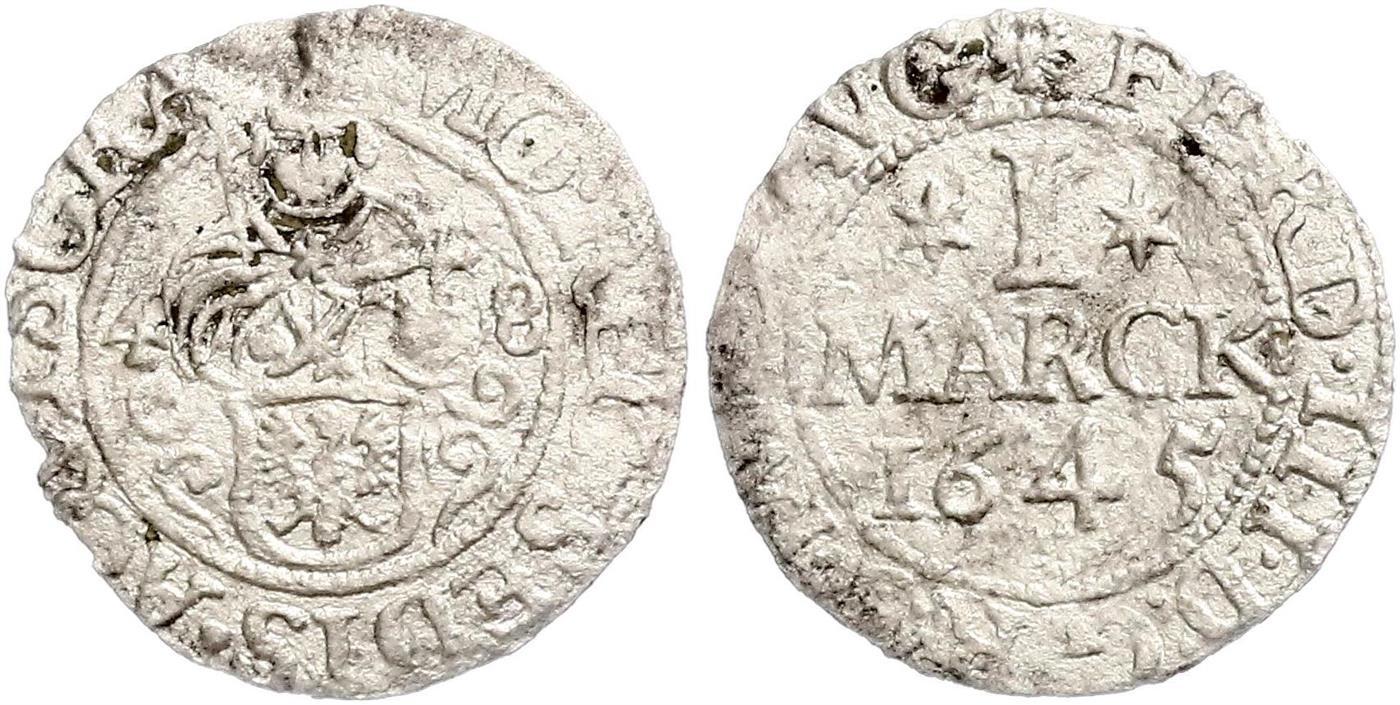 |
|
Moderator
 United States
56855 Posts |
|
|
New Member
Netherlands
11 Posts |
and the other 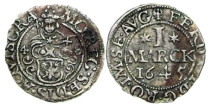 |
|
Pillar of the Community
 United States
8056 Posts |
I am seeing 43.
According to Numista, that is a known date.
Is it a mule, or is this the way the coin is designed? It seems to me the reverse always has 1645, and the obverse has the actual minting date?
And, is the 1648 a WAGO photo? I noticed Numista has no image for the coin.
Edited by tdziemia
12/20/2023 11:55 am
|
|
New Member
Netherlands
11 Posts |
|
|
Pillar of the Community
United States
8056 Posts |
It seems it was standard practice at the Aachen mint at this time: https://www.acsearch.info/search.html?id=591494It's hard to know the value because it's hard to find other examples of the 1 Marck type that have sold (and I did not see any for sale on MA-Shops). Which probably means it is a scarce type and that the bidding will move up from the starting bid. |
|
New Member
Netherlands
11 Posts |
I read from Numista the reverse lettering: MON NOVA VRBIS AQVISGRA I MARCK 1643 or ACH
So - not 1645?
Yes the first picture is from the live WAG auction.
|
|
New Member
Netherlands
11 Posts |
Edited by Bloemzee
12/20/2023 3:25 pm
|
|
Pillar of the Community
United States
8056 Posts |
First, I said 1643 was a known date, but now I see that I am wrong about this being a possibility for a mule.
If we look at #156 on the Aachener Munzen website, we see that the 1643 1 marck has the date on the reverse only.
After looking more closely at other examples of 1648/1645, I also do not like this option. In the 1648 obverse, the scepter is held vertically, very close to the head, and intersects the beaded inner circle. The obverse of the coin in the current WAGO auction does not look like this (the scepter is held at an angle and is a bit away from the head, and is within the circle). Of course there is the possibility of another 1648 die, but with so very few examples surviving, the better assumption is that there was only one die, and this does not match.
Maybe 1645/1645? The ducat with a 1645 obverse looks close to this obverse. But this raises the point of whether the ducat and the 1 marck coin would have been the same size.
Very interesting coin. I did not understand at first your comments on the rarity, but after looking through the website link, I see what you mean.
Possibly an unlisted type?
Edited by tdziemia
12/22/2023 12:04 pm
|
|
New Member
Netherlands
11 Posts |
Fascinating. You're saying the ducat with a 1645 obverse looks close to this obverse, and I tend to agree if you, however more so for the mule dukat #142 than the regular dukat #138. On #138, Carl has the wrong hat again. And on #142 if you look on the sides of the arms, there are clear vertical lines which you also find on the marck on auction now. There is still a clear difference in the words around the center though. No obverse known so far fits what we see here.
So - indeed; this could then be an unlisted 1645/1645 1 marck.
Edited by Bloemzee
12/23/2023 04:07 am
|
|
Pillar of the Community
United States
8056 Posts |
Of course, the helpful information which we are lacking is the size of the coins.
The gold ducat was usually about 21-22 mm (assuming this type was copying the Dutch one).
We don;t know the size of the 1 marck coin. Numista has the weight of a slightly later one at 0.75 g., so it was probably a rather small coin.
Since I can't find the size of any of these Aachen coins, I looked nearby in Cologne. The late 17th century 2 albus coin of 1.6 g. had a diameter of 24 mm, so I guess it is not out of the question that the die sizes could have been close on the two Aachen types (ducat and 1 marck).
It will be interesting to see how the auction goes. On the one hand, it is probably a coin with a limited number of interested collectors. On the other hand, I think the German numismatic market is quite an active and astute one (and it is a German coin in a German auction). I haven't bid on a Gerrman coin in 3 or 4 years, but I never got one as low as I had hoped. If the price goes crazy, it probably confirms that other bidders have also decided it is a previously unknown variety.
It's not clear to me why WAG assigned the 1648 date for the obverse, when it seems you were quick to determine that is unlikely. Most of the auction houses handling large numbers of coins are making an occasional mistake these days, but not usually on coins "in their own back yard." But as we see, if the person doing the attribution was working only from catalogs, this would have been the only choice ...
Edited by tdziemia
12/23/2023 08:11 am
|
|
New Member
Netherlands
11 Posts |
Thanks for the discussion tdziemia! Let's see what happens
|
|
Pillar of the Community
United States
8056 Posts |
I see that it sold at the opening bid. Was that you?
If yes, congratulations.
|
| |
Replies: 13 / Views: 1,000 |
|







 Posted 12/20/2023 09:36 am





