| Author |
 Replies: 13 / Views: 830 Replies: 13 / Views: 830 |
|
|
Pillar of the Community
United States
1850 Posts |
I'd like to get some older US coins to add to my collection and have some questions. First, on copper coins is there a value for the type of coin itself (think dateless cull to good at best)? For instance, if I could get 3 Large Cents for $1 would they have an inherent value above that $1? My second question is about damaged (including holed) better quality coins. A base value is easy as its melt value but is there any value above melt that would still apply to the coin? I know this is a broad question so confine it more common dates. So I guess the true question is value for the design. Here is an example of what I mean. 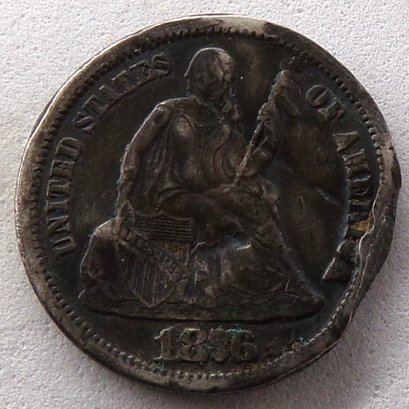 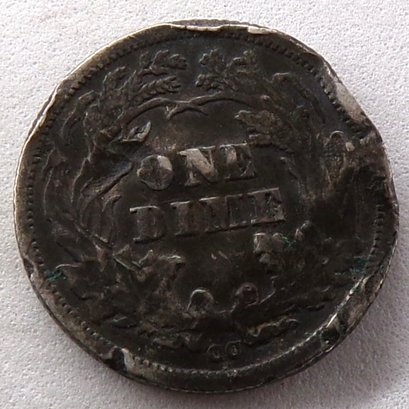 |
|
|
|
Bedrock of the Community
 United States
27514 Posts |
Seeker, the value of a coin is what someone will pay for it. I'm often baffled by the prices that cull, holed, etc., coins bring, but it's not a market in which I would speculate.
Inordinately fascinated by bits of metal with strange markings and figures
|
|
Valued Member
United States
450 Posts |
@Seeker, it depends on what you are seeking. If you're looking to fill holes to complete an album or set, the culls are fine for that. If you are looking for value appreciation, and numismatic value, I would stay away from holed coins. There are some folks that collect these, but it's not for me. Just my opinion.
|
|
Pillar of the Community
United States
3369 Posts |
There are no rules. Your 1876-CC dime is in better shape than a $3500 chain cent I saw a week ago. Coins as rare as the chain cent may be the only ones you'll ever own. IMO it's better to fill the hole than wait forever. You can always upgrade. Finding the coin is the challenge.
"Two minutes ago I would have sold my chances for a tired dime." Fred Astaire
Edited by thq
05/06/2024 07:30 am
|
|
Pillar of the Community
 United States
1850 Posts |
Thank you for your answers. I know value can be a very difficult topic. The general gist I got is its better to have something rather than nothing, especially if it can be had for dirt cheap.
|
|
Pillar of the Community
United States
6972 Posts |
That theory is true, unless you specifically plan on liquidating it in the future. In that scenario, you shouldn't be buying anything that you don't believe you can resell—and realistically, resell without taking a major loss.
After being back in the hobby for a year, I have found myself in the minority on the subject of holed coins. I don't view intentional holes like corrosion, graffiti, scratches, dents. Often if you compare a holed coin to a straight graded coin at the same price, the "good" coin is going to be terribly worn, perhaps AG3-G4. Many times you can get an XF45 or AU50-58 holed coin for a similar price. I would personally rather have 100% damage to 2% of the coin surface, rather than 80% deterioration to 100% of the coin surface. That goes with some caveats, such as preferring that the hole be cleanly punched and not through the head. Although even there, I would consider it if the remaining coin details are sharp.
|
|
Pillar of the Community
 United States
2367 Posts |
We all have our different opinions about what condition of coins are acceptable. I don't have a 1793 Chain cent because I won't pay thousands for a cull coin and I don't want to sell a car to buy one. I enjoy collecting but am not obsessed about completing a series.
I have a lot of old copper and will buy certain years with some light corrosion and slight damage. I won't buy copper that is holed or damaged. However I respect our community members who collect counter stamped and dug coins. That's what makes coin collecting so interesting.
I don't buy with resale as my primary goal so I wouldn't buy the dime you posted even for $1. My opinion of course.
Member ANA and EAC "You got to lose to know how to win". Dream On by Aerosmith |
|
Moderator
United States
110343 Posts |
Quote:
he general gist I got is its better to have something rather than nothing, Empty holes in my albums bug the heck out of me - If I cannot afford a VERY nice one at the moment, I'll settle for a lesser grade but keep searching for the 'one' that will make me happy. |
|
Moderator
United States
198046 Posts |
Quote:
Empty holes in my albums bug the heck out of me  I got three that need filling. They remain empty because I am trying to force myself to buy something better than I planned to buy.  |
|
Moderator
Australia
17032 Posts |
The reason why TPGs refuse to slab a damaged coin is because there is no hard-and-fast ready reckoning guide for converting certain kinds of damage to a certain catalogue value - as assigning that value would in essence be a framework for net-grading a damaged coin.
Some collectors simply refuse to accept anything other then either perfect examples or coins with nothing but "honest wear", no matter how hard to get such coins might be. Other people, while still obviously preferring their coins to be "undamaged", are nevertheless happy to take beat-up examples if they're "cheap enough", but "cheap enough" is a very squishy, ill-defined concept, and because of the existence of that refuse-to-touch-them cohort, there can never be a net-grading here-is-the-catalogue-value answer to the question of holed and damaged coins.
Take holed coins as an example. We'd all probably agree that the size of the hole matters; a bigger hole is worth less (or a larger negative value, depending on your point of view) than a smaller one. But placement of the hole is also important, as is the "neatness" of the hole: a coin carefully drilled near the top of the obverse or reverse so as not to disrupt any of the obverse or reverse lettering, is going to be more attractive and thus more valuable than a coin that's had a nail smashed through its centre., even if those two holes are physically the same size.
It is perhaps helpful to consider how to approach it in terms of the damage being a separate object having "negative value", especially for slabbed coins with "details" grades. You have a coin that's say, "AU Details", except for a hole. The coin would in theory be worth the catalogue value for an AU-50 coin if it didn't have the hole, but it will be worth less than that, purely because of the hole. So the hole has a "negative value".
It's rare to obtain objective data on something that is truly a subjective opinion. But I once saw one data point. At a coin show a couple decades ago, someone was selling two old silver coins from Georgia (the country in eastern Europe, not the US state). The coins seemed identical in terms of wear, toning etc, but one had a small neat hole drilled through it, the other did not. The unholed coin was being offered for $75. The holed coin was offered for $25. I was budget-conscious and only wanted "a coin from Georgia" for my one-from-every-country collection, so I bought the cheaper one. Both coins sold at the show, so both are "fair market value" since somebody paid those prices. So, one could argue that I now own a coin from Georgia that's worth +$75, and a hole attached to that coin that's worth negative $50.
Now, my negative-$50 hole would not have that same value, if you could magically transfer that hole onto some other coin - it's negative value is based entirely on the coin that it's sitting on, where the hole is placed on the coin, and on the personal opinions and attitudes of the buyer or potential buyer towards holes on coins. Transfer that -$50 hole onto a Brasher Doubloon and it's suddenly worth negative-tens of thousands of dollars.
Don't say "infinitely" when you mean "very"; otherwise, you'll have no word left when you want to talk about something really infinite. - C. S. Lewis
|
|
Pillar of the Community
United States
4433 Posts |
Quote:
The reason why TPGs refuse to slab a damaged coin is because there is no hard-and-fast ready reckoning guide for converting certain kinds of damage to a certain catalogue value - as assigning that value would in essence be a framework for net-grading a damaged coin. I confess to having zero knowledge of TPG's refusing to slab damaged coins. I've seen many hundreds of damaged coins in TPG slabs over many years now. I've a number of counterstamped coins, attributed and unattributed, in my collection. Some carry a provenance from important collections, like J.J/ Ford. Also, I'm totally surprised to hear that catalog values are a factor that TPG's consider as regards their determination to certify a given coin.  |
|
Pillar of the Community
United States
3369 Posts |
While grading services are dismissive of damage, they are extraordinarily picky about the appearance of uncirculated coins. MS67 vs MS66 means hundreds of dollars on a common date Morgan. And then there's proof-like..DPL, PL, DMPL..does the field reflect readable print from six inches.It's interesting to know but pretty subjective.
In order for coins to be in such a state of perfection they didn't ever function as money like that beat up cc dime did. I like having some MS coins around to look at but they're not my main interest. Someone will always have a better coin than mine. It's not a competitive sport.
"Two minutes ago I would have sold my chances for a tired dime." Fred Astaire
Edited by thq
05/11/2024 08:36 am
|
|
Pillar of the Community
United States
1850 Posts |
So that Carson City dime I posted sold for way more than I would ever pay for it.
|
|
Moderator
United States
198046 Posts |
Quote:
So that Carson City dime I posted sold for way more than I would ever pay for it.  |
| |
Replies: 13 / Views: 830 |
|







 Posted 05/06/2024 04:55 am


