Coin Community Family of Web Sites
Shop for APMEX Bullion on eBay!Shop CCF Members on eBay! Royal Canadian Mint products, Canadian, Polish, American, and world coins and banknotes. Coin, Banknote and Medal Collectors's Online Mall Specializing in Modern Numismatics 300,000 items to help build your collection! Vancouvers #1 Coin and Paper Money Dealer


Username:
Password:
Save Password
Forgot your Password?


This page may contain links that result in small commissions to keep this free site up and running.

Welcome Guest! Registering and/or logging in will remove the anchor (bottom) ads. It's Free!

Sarapis And Isis In Caria

To participate in the forum you must log in or register.
Author Previous TopicReplies: 6 / Views: 553Next Topic  
Pillar of the Community
Learn More...
Novicius's Avatar
United Kingdom
1168 Posts
 Posted 07/16/2024  1:31 pm Show Profile   Bookmark this topic Add Novicius to your friends list Get a Link to this Message Number of Subscribers
This coin from Herakleia Salbake (Heraclea Salbace) in Caria proved quite interesting with it's Sarapis obverse and Isis reverse. Little appears to have been written about the city, even though it had at one time held a strategic position. There is no mention of the city in Strabo's Geography for instance. As the nearby town of Aphrodisias became more important due to it's very good relations with Rome and having a large temple of Aphrodite, Herakleia Salbake and the surrounding Carian towns such as Apollonia Salbake, Sebastopolis, Tabai and Kidrama gradually lost their importance.
Sarapis-And-Isis-In-Caria
The few remains of the town border directly on the northern outskirts of the village of Vakif, in the province of Denizli. Over the centuries most of the ancient buildings were used to build the houses of the village. All that now remains are a few rows of seats in the stadium and part of the Roman city wall.

The extract below is from "Roman Cities In Northeastern Caria Enlighted By The Numismatic Evidence", a paper by Prof. Ergun Lafli.

Heraclea Salbace was first identified by W. H. Waddington at the modern Vakif, at the foot of the Salbacus mountains and at the north-eastern end of the plain of Tabae. Its territory was separated by the little river Timeles (Kirkpinar) from that of the neighbouring city Aphrodisias, and therefore the river-god ΤΙΜEΛΗC is represented on imperial coins of both cities.

The city is within the boundaries of Vakif Village, which is 10 km northwest of Tavas District. The residential area of the city is mostly concentrated in the northern region. Herakleia Salbake was a Carian city located in the southern part of the Salbakos Mountains, which separated the regions of Caria and Phrygia, at the foot of the present-day Tavas Plain. The city is bordered by Aphrodisias to the west, Apollonia and Tabai to the south, and Sebastopolis and Kidramos to the southeast. Herakleia separates the city of Salbake and Aphrodisias as the natural border of the Timeles (Kirkpinar) Stream. For this reason, the river god of both Aphrodisias and Heracleia is Timeles, and he is depicted as "ΤΙΜEΛΗC" on the coins of both cities.

The ancient city of Herakleia is located on the main road route to Kibyra (Golhisar) on Aphrodisias and Apollonia Salbake. This road then extends south to Attaleia (Antalya). For this reason, the city has a very important strategic position in terms of being on the transition point.

Herakleia Salbake was included in the Alabanda Conventus as a pre-Roman administrative union, and during the Roman period, it joined the Aphrodisias administrative union. However, neither Strabo nor Pliny mentions the city. The vast majority of the 80 or so inscriptions found in the city are from the Roman Imperial age. In the 5th century AD, the ancient city was surrounded by walls, as in all the cities of the region. Since the 12th century A.D., the region has been in the hands of the Turks.
Sarapis-And-Isis-In-Caria
Herakleia Salbake, Caria. Semi-autonomous issue, circa 2nd to 3rd Century AD.
Obverse; Draped bust of (Zeus) Sarapis right, wearing polos/kalathos. Reverse: Isis standing left, crescent behind shoulders, holding sistrum and situla. Reverse inscription; HPAKΛEΩTΩN. Bronze. Diameter: 18.5 mm. Weight: 3.18 gr.
Reference: RPC IV.2, 2422
ex-Brand and Weber collections, (Sotheby's Brand sale, part 7, 1984, part-Lot 374)
Edited by Novicius
07/16/2024 1:37 pm
Valued Member
United States
59 Posts
 Posted 07/16/2024  3:45 pm  Show Profile   Bookmark this reply Add wizened to your friends list Get a Link to this Reply
Thanks for the history bit. Interesting.
Pillar of the Community
Learn More...
Novicius's Avatar
United Kingdom
1168 Posts
 Posted 07/17/2024  10:42 am  Show Profile   Bookmark this reply Add Novicius to your friends list Get a Link to this Reply
Thanks, @wizened.
Pillar of the Community
Learn More...
Novicius's Avatar
United Kingdom
1168 Posts
 Posted 07/18/2024  1:47 pm  Show Profile   Bookmark this reply Add Novicius to your friends list Get a Link to this Reply
The coin has been accepted into the RPC database (Weber 6516) #20 on this page.

https://rpc.ashmus.ox.ac.uk/coins/4/2422
Pillar of the Community
Kamnaskires's Avatar
United States
7066 Posts
 Posted 07/18/2024  2:34 pm  Show Profile   Bookmark this reply Add Kamnaskires to your friends list Get a Link to this Reply
Excellent and informative post, as usual. A great addition to your Provincials.
Pillar of the Community
Learn More...
Novicius's Avatar
United Kingdom
1168 Posts
 Posted 07/19/2024  12:28 pm  Show Profile   Bookmark this reply Add Novicius to your friends list Get a Link to this Reply
Thanks, Bob. I was surprised to see how far the cult of Isis spread throughout the Roman Empire.
Pillar of the Community
Learn More...
Novicius's Avatar
United Kingdom
1168 Posts
 Posted 08/09/2024  10:14 am  Show Profile   Bookmark this reply Add Novicius to your friends list Get a Link to this Reply
In addition to the above coin from Herakleia Salbace I was fortunate enough to acquire a coin from the sister city Apollonia Salbace (Salbake). There is slightly more information to be found regarding Apollonia Salbace than there was for Herakleia Salbace, but it is still rather sketchy.

From the Turkish Directorate of Culture and Tourism - "Apollonia Salbace (Medet Mound) Ancient City":
The Ancient City of Apollonia and the Medet Mound are located within the settlement area of the Medet (Village) Neighborhood, which was founded on a flat plain. Apollonia, founded on the most fertile lands of the Tavas plain, is one of the ancient cities with access to the Caria region via Tabae Road in the west, Lycia region via Sebastopolis in the south, Lycia region and Phrygia region via Tavas Road in the east. Exact documents about the foundation of the city of Apollonia have not been found. However, when the mound finds are examined, it is seen that the first settlement dates back to the Bronze Ages and continued uninterrupted. It is understood that the city received the name Apollonia in the Hellenistic period and lived its most glorious period in the Roman era. The foundations and inscriptions of the Apollo temple belonging to the Hadrian period have survived to the present day.
Sarapis-And-Isis-In-Caria
From "Roman Cities In Northeastern Caria":
Apollonia Salbake is located within the boundaries of Medet Village, which is located on a flat plain 7 km west of Tavas District, Denizli Province. The city, which was established in the 3rd century B.C. by the Seleucids such as Amyzon, Lasos, Nysa and Pentachora in the Caria Region, on the most fertile lands of the Tavas Plain with an altitude of 900-1000 m, was at a point where the Caria Region was reached by the Tabai road in the west, the Lycian Region by the Sebastopolis road in the south, and the Phrygia Region by the Tavas road in the east. After the Seleucids, the Rhodians dominated the region. There is an organic connection between the city of Apollonia Salbake and Medet Hoyuk; However, this link has not been examined chronologically. In the courtyard where the Medet Village Mosque is located, there are the foundations and inscriptions of a Temple of Apollo belonging to the reign of Emperor Hadrian (117-138 AD); some inscriptions also mention the cult of Meter Oreia in the city. The city was localized thanks to its coins and inscriptions.

Hellenistic and Roman Periods Apollonia Salbake Coins:
The city minted coins in its own name from the reign of Augustus (27 B.C.-14 A.D.) to the reign of Cornelia Salonina (268 A.D.), the wife of the Roman Emperor Gallienus. On the obverse of the coins are portraits such as Hiera Boule, Hiera Demos, Demos, Athena, Apollo and Sarapis. On the reverse sides there is Apollo carrying a lyr, Zeus Nikephoros sitting, Asklepios and Hygieia, a temple with three statues, Daphne kneeling, Helios in quadriga, Isis depicted standing, Pan with a goat, Demeter, Zeus Laodiceus between the city god and Athena, and Zeus carrying a child in his hand.
Sarapis-And-Isis-In-Caria
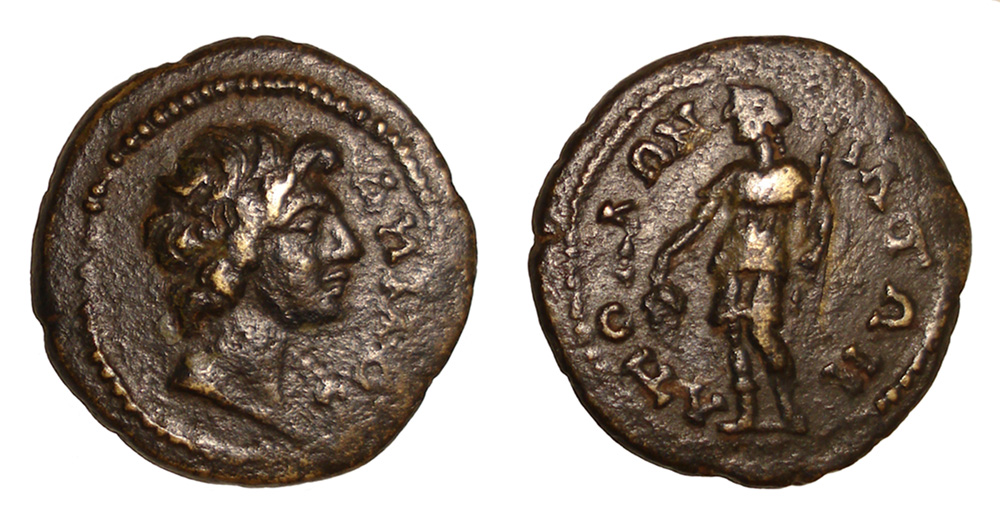
Apollonia Salbace, Caria. c.2nd to 3rd Century AD.
Obverse: Head of Demos right, wearing tainia. Obverse inscription: ΔHMΩC. Reverse: Dionysus, wearing short chiton, standing facing, head left, holding thyrsus and bunch of grapes. Reverse inscription: AΠOΛΛΩNIATΩN. Bronze. Diameter: 21 mm. Weight: 4.36 gr.
Reference: RPC VI, 5385.
ex-Brand and Weber collections, (Sotheby's Brand sale, part 7, 1984, part-Lot 374)
https://rpc.ashmus.ox.ac.uk/coins/6/5385 (Coin number 9.)

  Previous TopicReplies: 6 / Views: 553Next Topic  

To participate in the forum you must log in or register.


Disclaimer: While a tremendous amount of effort goes into ensuring the accuracy of the information contained in this site, Coin Community assumes no liability for errors. Copyright 2005 - 2026 Coin Community Family- all rights reserved worldwide. Use of any images or content on this website without prior written permission of Coin Community or the original lender is strictly prohibited.
Contact Us  |  Advertise Here  |  Privacy Policy / Terms of Use

Coin Community Forum © 2005 - 2026 Coin Community Forums
It took 0.25 seconds to rattle this change. Forums


