I thought that this would be an interesting project as Nakrasa (Nacrasa, Nakrason) is not a place that I had heard of. However, after much research I didn't find any more than the basics. The general consensus is that the city was founded by the Seleukids rather than the Attalids, and had once been garrisoned by a Macedonian guard. On the bright side the coin was submitted to the RPC and was confirmed as belonging to the RPC 3 1813A group:
https://rpc.ashmus.ox.ac.uk/coin/481873The actual location of Nacrasa is not known, and the Barrington Atlas further confuses the issue by showing two possible locations, both named Nakrason! The city obviously existed as coinage was minted there, but there is no record of coinage before Roman rule.

Sullacoins refers to Edward M. Anson:
Edward M. Anson describes Nakrasa as a Macedonian settlement in Lydia. (see: "The Hellenistic Settlements in Europe, the Islands, and Asia Minor" published in 1996)
"The location of Nakrasa is not definitely known. It was in the upper Kaikos valley and is usually placed either at Bakir, Maltepe (two kilometres east of Bakir), or Ilyaslar (six kilometres east of Maltepe)." -Anson, 1996

Another paragraph mentions Nakrason:
"Nakrason is one of a number of colonies of Macedonians in Lydia; others include AGATHEIRA, AKRASOS, DODYE, -ESPOURA, HYRKANIS, KOBEDEDYLE, and THYATEIRA. Although there is evidence indicating the Seleukos I founded Thyateira and that the settlers at Hyrkanis worshipped Zeus Seleukeios, the earliest information about most of the other colonies dates from the second century BC, i.e., the period of Attalid rule. Nevertheless it is likely that the Macedonian colonies were founded by The Seleukids rather than the Attalids." -Anson, 1996
Though some believe that Nakrasa and Akrasos are one and the same, the Atauni Edu page, "Akrasos/Nakrasa/Ilyaslar" disputes this:
"Akrasos is an ancient city located in the Kaikos Valley between Kirkagac and Gelenbe.
It is said that both cities, which are often confused with the city of Nakrasa, which is thought to be in the same region, minted separate coins.
From Ramsay's list of bishoprics, we learn that while the bishop of the city of Akrasos always attended church assemblies, the bishop of the city of Nakrasa never did. However, all settlements with urban status could mint money and these cities had a bishop. In addition, the remains of the city of Akrasos have not been identified."
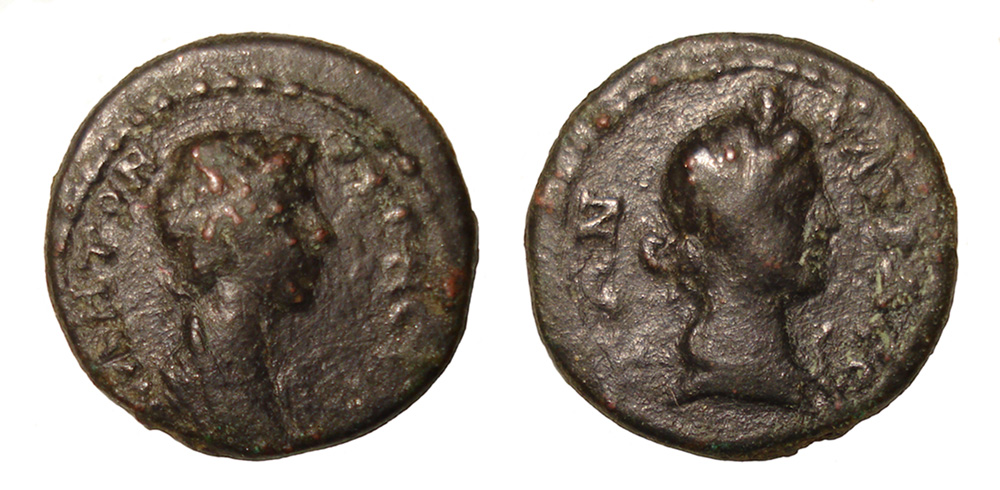
Nacrasa Lydia. c.2nd Century AD.
Obverse: Youthful draped bust of the Roman Senate right. Obverse Inscription: ΘEON CYNKΛHTON. Reverse: Bust of city-goddess (Roma) right, wearing modius. Reverse Inscription: NAKPACITΩN. Bronze. Diameter: 16 mm. Weight: 3.04 gr.
Reference: RPC 3 1813A







 Posted 09/04/2024 2:22 pm





