| Author |
 Replies: 13 / Views: 11,840 Replies: 13 / Views: 11,840 |
|
|
Pillar of the Community
Canada
1931 Posts |
I have a little coin and was hoping to get a few questions answered. First of all grade of course. I would like to know. Secondly....value if possible. thanks all! malissa 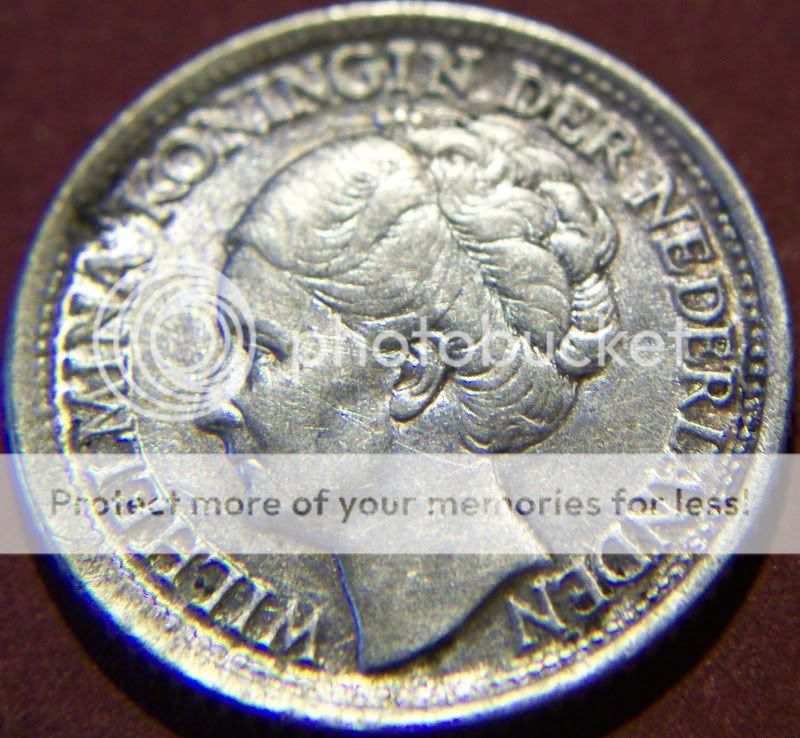 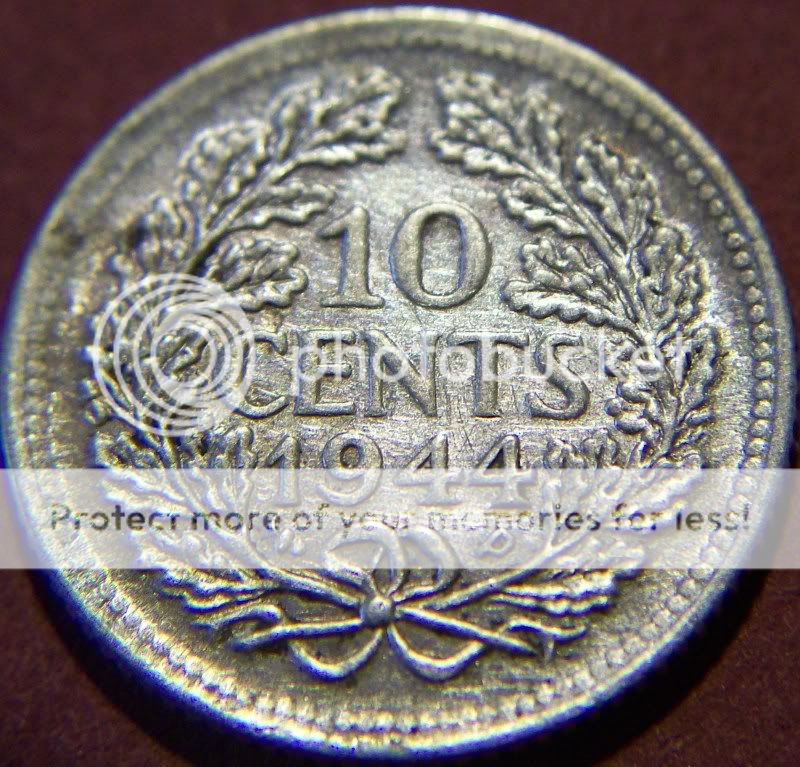 |
|
|
|
Pillar of the Community
Norway
510 Posts |
That is a nice little coin. I would grade it VF-30 myself, though it is always difficult with such small coins.
The value is not especially high for this one. 120 000 000 were produced so it is not particularly scarce...Krause gives VF $0,75 and EF $1,25. Even in BU quality it is not worth more than $3.
|
|
Pillar of the Community
United States
2669 Posts |
Well, there are 3 different listings for 1944 and it does not differentiate between them.
Coin		Mintage		FINE		VF		XF		UNC		BU
1944		120,000,000		0.50		0.75		1.25		2.00		3.00
1944		25,400,000		1,200.00	3,000.00	6,000.00	11,000.00	15,000.00
Note: Almost entire issue melted
1944		64,040,000		1.00		2.00		4.50		15.00		30.00
So.. which one do we have here? |
|
Pillar of the Community
Australia
2830 Posts |
G'day, as the Netherlands were occupied in 1944, I'm wondering if the different issues might be "local" AND from a "Government in Exile".
Although in the latter case, I wonder where the coins might have circulated: in some colonies perhaps ?
Peter in Oz
|
|
Valued Member
Bulgaria
474 Posts |
Scarce issue is "D" mintmark, in Curacao 1/10 gulden and 1/4 gulden silver starting 1944 with "D" minmark instead 10 cents and 25 cents... maybe.
|
|
Moderator
 United States
23731 Posts |
Nice little coin KM# 163, I'd grade it EF-40 with a value of about $1.25.
|
|
Pillar of the Community
United States
2669 Posts |
Do you know where to locate that D mint mark?
|
|
Valued Member
Bulgaria
474 Posts |
Under the second "4". This coin is P-mint mark
|
|
Pillar of the Community
United States
2669 Posts |
thank you, bobo13, but please, is that the first, second, or third in that Krause list I listed? (none reference mint marks - although they need to!)
|
|
Pillar of the Community
Belgium
651 Posts |
According to my Krause:
first is 1944P
second is 1944D
third is 1944S
These coins were intended to circulate immediately after the war in the homeland.
Coins intended for use in the colonies received a palm tree mark instead of the acorn mark.
|
|
Pillar of the Community
Germany
1072 Posts |
By late 1944 some parts of Holland had been liberated. Operation Market Garden in september 1944 liberated a part of the country, then the rest was liberated in March 1945. So it is possible that these were the coins circulating in the freed areas during this time!
|
|
Pillar of the Community
 Canada
1931 Posts |
Looks like I need to brush up on my history lessons. Funny though that one of my favorite topics (other than coins) is history yet I never seem to know or understand the monetary changes that have happened.
thank you for all the comments. I LOVE getting the education from it.
|
|
Pillar of the Community
Canada
1248 Posts |
Hallo Augsburger,
wie gehts?
are you in augsburg directly? You have no contact listed.
HHB
|
|
Pillar of the Community
Germany
1238 Posts |
During WW2 two kinds of "Dutch" coins were made - those produced in occupied Utrecht (zinc pieces, no royal effigy) and those made in the US. The latter were minted in Denver (D mintmark), Philadelphia (P) and San Francisco (S). Here are all the US-made pieces:
1941 P/p (800,000) for Suriname and Neth. Antilles
1942 P/p (1,500,000) ditto
1943 P/p (4,500,000) for Suriname
1943 P/e (mintage unknown) for the Netherlands
1944 P/e (120,000,000) ditto - this is yours -
1944 S/e (64,040,000) ditto
1944 D/e (25,400,000) ditto*
1945 P/e (90,560,000) ditto*
The lowercase p refers to the "palmboom" (palm tree) sign, the e is for the "eikel" (oak acorn) sign. The last two issues, marked with an asterisk, are rare and expensive.
Christian
|
| |
Replies: 13 / Views: 11,840 |
|










 Posted 05/11/2009 6:50 pm


