The primary reverse design element on the 1900 Lafayette Memorial Silver Dollar is a depiction of the Paul Wayland Bartlett equestrian statue of General Lafayette (preliminary design) erected in Paris, France.
1900 Lafayette Memorial Silver Dollar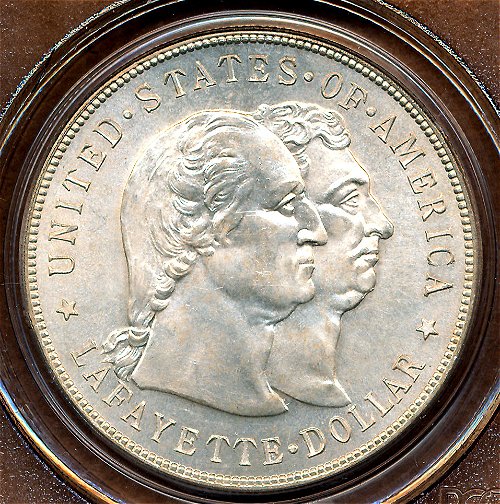
 Lafayette Memorial/Monument Erected in Paris, France
 (Image Credit: George Grantham Bain Collection held by the US Library of Congress; Public Domain.)
Here's a bit of background on how United States school-children played an important role in securing the funds needed for the construction of the Lafayette Memorial in conjunction with the Universal Exposition of 1900 (held in Paris).
The official roots of the involvement of school-children in the development of the Lafayette Memorial/Monument can be traced to February 1898 when companion resolutions were introduced in the House of Representatives and Senate. Thomas Joseph Bradley (D-NY) introduced the resolution in the House and John Mellen Thurston (R-NE) introduced the resolution in the Senate.
The Titles of the resolutions identified their purpose: "a commission [later named the Lafayette Memorial Commission] to supervise the collection of a fund among all the schools and colleges of the United States for the purpose of erecting a monument to General Lafayette in the city of Paris, France, the same to be presented to the government of France and unveiled and dedicated on the 4th day of July, in the year 1900. " The Commission was to "arrange plans and personally direct the collection and expenditures of all moneys, the Selection ot a site and the plans of said monument, the building of the monument, the dedication and unveiling of the same, and the preparation of an historical report upon the work when completed."
The Resolutions also featured an extensive Preamble that extolled the virtues of Lafayette, summarized some of his many accomplishments and expressed his importance to America and its fight for freedom. The Preamble also referenced the opportunity brought forth for America by way of presenting a Lafayette Memorial/Monument to France: "wherein the American people may reciprocate the courtesies extended us in the presentation of the Bartholdi Statue of Liberty in New York Harbor, and again show their friendship to France, their love and veneration for that compatriot of Washington, General Lafayette."
Also included in the Preamble was the call to engage America's youth:
"Whereas the proposed monument should be a spontaneous offering coming direct from the children and schools of America, and that in their bearing the expense of this work without financial aid from the Government the effect may be of the highest benefit to our people as donors in directing, as it will, the thoughts of American youth to the most patriotic and inspiring period of our history, to broaden their views to international points, and to arouse their interest in the great events of the dawning century."The Senate passed an amended version of its bill (removing almost all of its long preamble, including the "children and schools of America" line),and referred it to the House for its consideration. In the House, the resolution was referred to the Committee on Foreign affairs. The House Committee did not report on the Senate resolution, or the House's version, as pressing matters with the Spanish-American War took its attention.
Though not authorized via the aforementioned resolutions, the Lafayette Memorial Commission was created later in 1898 and it revisited the memorial/monument concept. It included in its fundraising plans for the monument, the engagement of schools and students across the US.
In a September 1898 response letter to the Commission regarding its plans, President William McKinley noted his great interest and "much satisfaction" with the Commission's Lafayette Memorial/Monument plans, stating:
"The undertaking is one in which I am sure it will be considered a privilege to participate, and the idea that the students in the schools, colleges, and universities shall take a prominent part in this tribute will not only be of vast educational value as to one of the most important epochs in history, but will keep prominently before them the inspiration of a high ideal, of devotion to great principles, and of the public recognition paid to lofty purposes." (Emphasis added.)The Commission moved forward with its plans to celebrate Lafayette Day (October 19, 1898) in schools, and to use the day to educate students about Lafayette and to promote its fundraising objectives. In total, $45,858.30 was raised via school/student participation (it was claimed to have involved over 5 million students, but that would have resulted in each student donating less than one cent so I question the use of the 5 million figure) with the money being used to defray costs of constructing the monument.
The story continues in Part II...





 Posted 12/02/2024 11:35 am





