









 Picture01.jpg


 Posted 05/18/2009 02:51 am


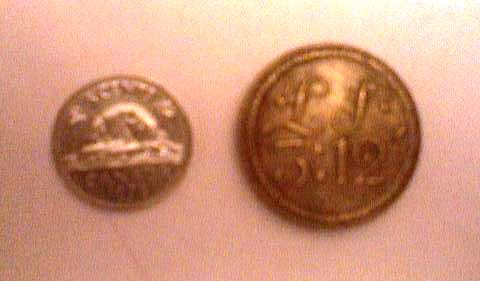
It is indeed a "coin weight", used to try to identify counterfeit foreign coins in circulation. But the symbols indicate the value (in British predecimal money) of the coin being tested. The L is a pound sign, £, while the other letter is a cursive S standing for "shillings".
In Britain in the 1700's (and presumably in British colonies too), a Portuguese gold 8 escudos coin (also known as a dobra) was reckoned to be worth £3/12/-, so I'd assume this is a coin weight for a dobra. If I'm right, your object should weigh about 26.8 grams.
These coin weights are now collectable in their own right, though of course they're not as valuable as the gold coins they once represented. This one went unsold on ebay for £22; perhaps a little pricey.
In Britain in the 1700's (and presumably in British colonies too), a Portuguese gold 8 escudos coin (also known as a dobra) was reckoned to be worth £3/12/-, so I'd assume this is a coin weight for a dobra. If I'm right, your object should weigh about 26.8 grams.
These coin weights are now collectable in their own right, though of course they're not as valuable as the gold coins they once represented. This one went unsold on ebay for £22; perhaps a little pricey.
Don't say "infinitely" when you mean "very"; otherwise, you'll have no word left when you want to talk about something really infinite. - C. S. Lewis


