From the "Commems Files"...
Historical Tidbit #1On December 6, 1919, the Maine Centennial Executive Committee voted to seek a Maine Centennial silver half dollar. Interestingly, the Committee talked of putting the coin into circulation. I wonder, however, if by "circulation" it meant selling them to the general public for a premium vs. placing them into circulation at face value. As the coins were to be legal tender, either approach would create the potential for the coins to circulate.
Historical Tidbit #2Frank C. Merritt, private secretary to Congressman John Andrew Peters (R-ME), is said to be the person who originally suggested that Maine pursue a commemorative coin for its Statehood Centennial. He presented his idea, via letter, to Frank W. Ball, Maine's Secretary of State. (See Tidbit #1.) Peters introduced a Maine coin bill in February 1920.
Historical Tidbit #3Maine Governor Carl Elias Miliken (served 1917-1921) was an active supporter of the Maine Centennial coin initiative. He wrote to Maine's representatives in Congress in early February 1920 to express his support and encourage the introduction of a coin bill. Representative Peters took up the cause and informed the Governor, via telegram, after he had completed the task.
Historical Tidbit #4Representative Peters met with the Director of the Mint - William H. Blodgett - and was, allegedly, told by the Director that the Mint would prepare the dies for the Maine coin at no charge. Such a service would have been in direct conflict to the language included in the legislation that authorized the coin: "the Government shall not be subject to the expense of making the necessary dies and other preparations for this coinage." It seems unlikely that Maine was not charged for the dies.
Historical Tidbit #5Harry Cochrane, the man who oversaw the staging of the Centennial's historical pageant - "Dramatic Production of Maine's Historical Events" - was asked by Governor Miliken to prepare a design drawing for use by the US Mint. Cochrane's design was described as "plain and handsome in its simplicity."
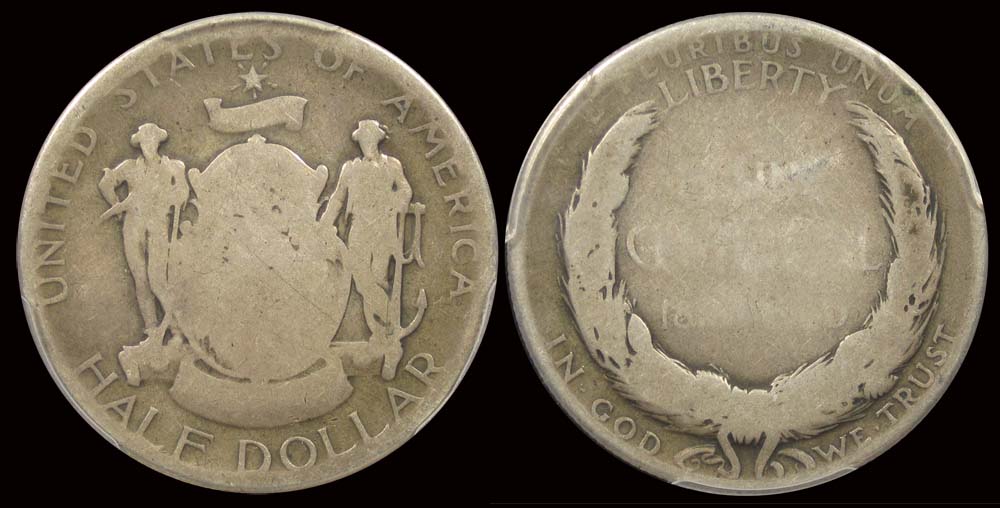
Cochrane's design was reported as: "The obverse bears the words "MAINE CENTENNIAL. 1820-1920" surrounded by a circle of pine cones and spills. The reverse carries the seal of Maine in the center, with overhead the words "UNITED STATES OF AMERICA" and underneath the words "MAINE" and "HALF DOLLAR."
Cochrane's provided design appears to have been followed rather closely.
1920 Maine Statehood Centennial Half Dollar
 Historical Tidbit #6
At a September 1, 1920 meeting of the Maine Governor and Executive Council, it was agreed that "the expense of securing and distributing the Centennial coins" was to be paid out of the State Contingent Fund. (Including die charges?)
Historical Tidbit #7At a September 8, 1920 meeting of the Maine Governor and Executive Council, it was decided that money from the State Contingent Fund would be used to cover the cost of publishing/printing the "Maine Book" and printing a promotional brochure for the book and commemorative half dollar. (See
1920 Maine Statehood Centennial - Revisited for a look at the brocure.)
I will soon be posting a story about the dies, their preparation and the delays experienced in delivering the first batch of coins to Maine.
For other of my posts about commemorative coins and medals, including more stories about the Maine half dollar, see:
Commems Collection.




 Posted 04/03/2025 11:52 am