| Author |
 Replies: 8 / Views: 3,235 Replies: 8 / Views: 3,235 |
|
|
Moderator
 Australia
16982 Posts |
I've just spent three days at the local coin show here in Brisbane; I was one of the volunteers manning the coin club display and the information desk. I still managed to find plenty of time to spend way too much money at the dealer's tables. Here's the best of what I picked up. As usual, they're scans, not photos, so lustre isn't captured well. By far the most expensive coin I bought was this Belgian Federation florin of 1790. The Belgian Federation was a short-lived revolutionary republic more-or-less corresponding to modern Belgium and Luxembourg. As an example for my OFEC collection, it's somewhat of an overkill; I don't normally buy coins this nice - or this expensive.  I was glad to pick this one up. It's the size of a British shilling, and the obverse is the same as a shilling reverse... but it's from Brunswick-Luneberg, the German state from whence the King Georges came, and at the time still ruled by the British kings as absentee monarchs. It's a 1/6th thaler, as you can see by the tiny "1/6" in the middle of the cross-of-shields. The reverse shows the "Wildman of Brunswick", kind of a German version of Paul Bunyan, commonly featured on coins of the Brunswick houses. 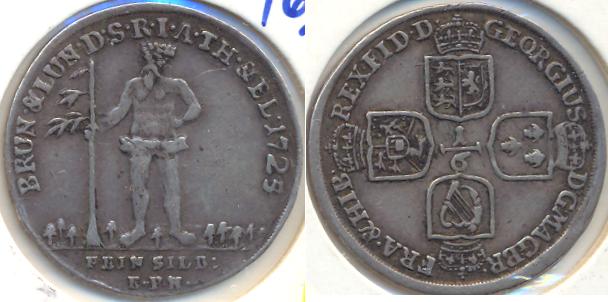 I didn't have any Byzantine gold coins, despite the fact that they're often quite cheap. This one is a gold hyperpyron of Emperor Andronicus II and his son Michael IX, 1295 - 1320 AD. The Empire's sad state of decline is dramatically illustrated by this coin: The "gold" is only 14k or so, and very rosy-coloured. And the siege mentality of this tiny remnant of the Empire is given away by the crude design on the reverse: the Virgin Mary sitting inside the walls of Constantinople. As with most Byzantine gold of the period, the coin is "scyphate", or bowl-shaped: highly concave. Nobody really knows why. 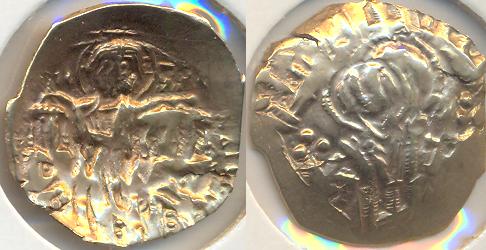 The Indian state of Kutch is one of only a handful of countries to make coins in the name of the "uncrowned king", Edward VIII in 1936. I couldn't pass up this one, which for a piece of Native State silver is in excellent condition. Edward's name is the topmost of the three lines of Arabic running across the pic on the left; the "upside-down V" at top left is Edward's number, "8". 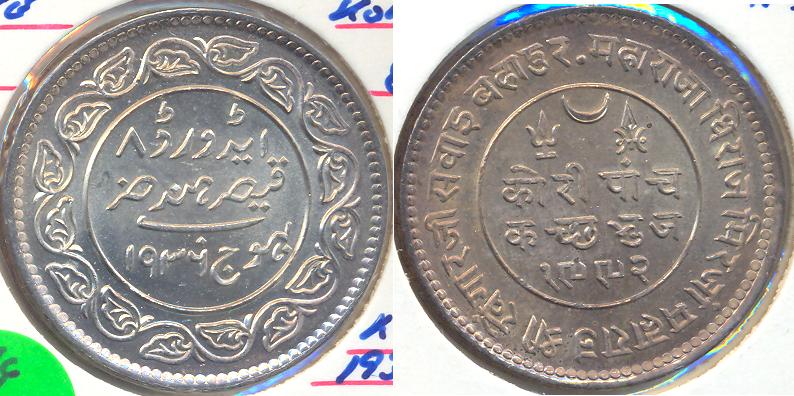 I finally picked up an example of a serrated denarius. These coins were made during the Republic period of Roman coinage, though no-one really knows why they went to all the trouble to manually cut serrations into each blank prior to striking. It may have been a very early attempt at a "security edge", but if so, the number of contemporary counterfeit serrated coins found today indicates it was quite unsuccessful. The Consul named on this coin is Scipio Asiagenus (c. 106 BC), descendant of the famous general Scipio that defeated Hannibal of Carthage. 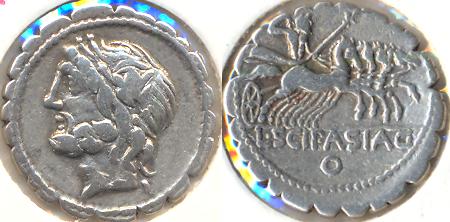 This little coin is from a country I'd never heard of till I bought it: the Barony of Schonau. This 4 heller is the only coin they ever made; apparently, their neighbours were so outraged that the baron had dared to strike these coins without obtaining the right to do so from the Holy Roman Emperor, that they ganged up on him and invaded. 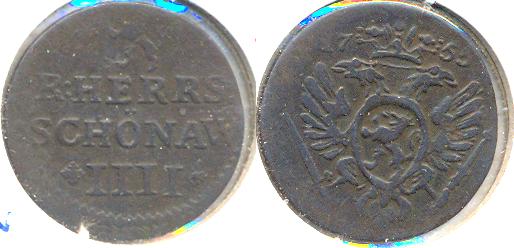 Finally, this Swedish "emergency daler" is one of a series of copper coins put out in 1718. Sweden had no silver, so these token coins were issued, with the promise to redeem them later for silver. The different obverse designs were intended to be redeemable at different times. These must not have been very popular, because a year later, Sweden began the issue of the famous Plate Money, which gave people a full daler's worth of copper (though not in a particularly convenient form). This coin obviously saw very little circulation, as it's in near-Unc condition. 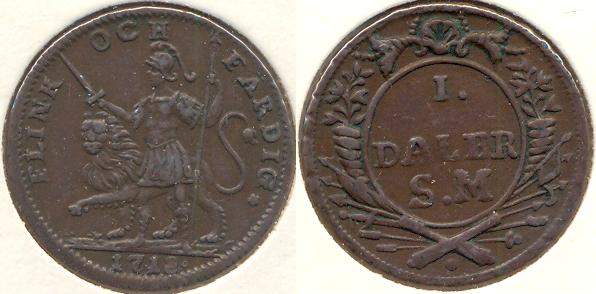 Don't say "infinitely" when you mean "very"; otherwise, you'll have no word left when you want to talk about something really infinite. - C. S. Lewis
|
|
|
|
Pillar of the Community
Australia
2830 Posts |
there's a lot of history amongst those beautiful coins.
Peter in Darwin
|
|
Moderator
United States
23731 Posts |
|
|
Pillar of the Community
United States
1415 Posts |
WOW, more great coins with history.
EXECELLENT POST - as always
|
|
Pillar of the Community
Canada
598 Posts |
The only ancient gold coins I have are real worn (AG/G) electrum(aprox half gold/silver). By saying ancient I'm referring to hammered as opposed to machine struck... even if the machine is a hand operated press. I have seen alotta gold ancients and have to look them up to get a rough idea of gold content... which varies and can vary greatly even for the electrums. Certain types don't seem all that rare, but yet command prices I think/believe to be overpriced. So, I am curious as to how you found the gold content for this particular hyperpyron(did someone scratch and burn/acid). Could you give me the specs on it? (eg. weight, diameter, thickness, content{rosy coloured=copper?}, etc. The physical stuff, not the history... my bad.)... you don't hafta comment, but I would pay only a few % above pm content on such a coin. I have stayed away from these ancients in the past because of their variability... and I don't believe I could pick out a decent counterfeit because condition issues often play into the hands of counterfeiter types. I really like the one you've picked up; the quality and information is interesting and could turn me around into getting at least one such specimen. I know in the past people purposely collected these types of coins in order to avoid a gold re-call as they were antiques and not just re-callable bullion... And I thought hey were cup shaped cuz the king found them easier to stack(cupside-down. It's good to be king!) But I digress... cuz I'm jealous! Nice coin!  |
|
Moderator
 Australia
16982 Posts |
Quote:
So, I am curious as to how you found the gold content for this particular hyperpyron...(did someone scratch and burn/acid) Nope, just looked it up in the book; the entries in the Sear catalogue of Byzantine coins give an indication of the typical fineness of the coin during the final years of decline of the Empire. I actually mis-remembered the fineness when I quoted it before; This coin is Sear #2150, which has a fineness of 12k; it's the preceding type, S#2149, which has 14k fineness. These are among the last Byzantine gold coins; the succeeding emperor, John V, replaced the debased gold coins (his were only 11k fine) with a larger, pure silver coin. Quote:
Could you give me the specs on it? (eg. weight, diameter, thickness, content{rosy coloured=copper?}, etc. The physical stuff, not the history... my bad.) It's about 20mm across. I haven't taken it out of it's 2x2 yet so can't give you a weight or precise thickness, but I suspect it's cup-shaped structure was probably intended to give these coins the appearance of being thicker than they actually were. The weight of this similar specimen on CoinArchives is given as 4.12 grams. Assuming .500 fine, that's only US$63 worth of gold at current spot prices. I paid over 6x that for this coin. Quote:
...but I would pay only a few % above pm content on such a coin... You're never going to get anything over 200 years old for anywhere near that price; the numismatic premium is way too high. The cheapest mediaeval gold you can get are Islamic dinars, and even those are typically at 1.5x to 2x spot. Early Byzantine solidii are cheap too at about 2x to 5x spot, depending on emperor. You'll rarely see an English Hammered, early European, Crusader, or ancient Greek or Roman gold coin for less than 10x spot. Don't say "infinitely" when you mean "very"; otherwise, you'll have no word left when you want to talk about something really infinite. - C. S. Lewis
|
|
Pillar of the Community
Canada
598 Posts |
I also have a Spanish 1 Escudo 1792, a 1 Dinar Ghaznavid 487-512 AH, Indian Fanhams 11th-13th C., all in fine or better condition. Although I'm too lazy to put up pictures, I would not own them if not reasonably close to spot and not multiples of spot... perhaps I'm just lucky.
I appreciate your info. The references I have are limited to a few (although very functional and old) catalogues. I of course have some modern books but they don't deal with this type of coinage.
But, I do agree with your last sentence. It's just me... but many of these coins are not particularly rare and their value befuddles me. Like European turn of the century gold coins were treated much like bullion(Russian/German/English/French (esp. Napoleans, Roosters, Angels)) ... I see that becoming less of the case all the time. Perhaps oneday I will eventually find one(hyperpyron or such) in lesser condition... or another great hoard will turn up and flood the market...
|
|
Moderator
Australia
16982 Posts |
Ancient gold can never drop down to near bullion value for long, for one very good reason: if they're only worth bullion, they'll be treated as bullion, and destroyed at the whim of the owner or finder. The destruction will continue until the "supply" (number of surviving specimens) causes the demand (and the price) to go up to the point where destruction is no longer a wise course of action.
I for one am glad that ancient gold coins are worth much more than bullion - it enhances their chances of survival as intact ancient artefacts. In many of the "ancient lands" such as Greece, Turkey, Egypt and the Holy Land, there are strict laws against private ownership of antiquities. If you find an ancient gold coin, you're supposed to hand it over to the State, who might (or might not) compensate you for it. Definitely a case of "Finders Weepers"! If a gold coin found by an impoverished local was "only worth bullion", what are they likely to do with it? Hand it over to their government for free, or melt it down and destroy it, and sell it as a perfectly legal lump of gold?
However, if you know for sure that the coin can fetch far, far more than it's bullion value to a collector, you'll probably do whatever it takes to gain that extra value, even if it means breaking the law... so long as the coin stays intact.
Don't say "infinitely" when you mean "very"; otherwise, you'll have no word left when you want to talk about something really infinite. - C. S. Lewis
|
|
Pillar of the Community
Canada
598 Posts |
I have no intention of ever melting any coin. But what happens when they leave my hands is outta my control. I even don't know why people consider doing this(melting down. >edit; besides your example). I find it ridiculous that a coin be melted down to produce a round  ... 6 of 1; half a dozen of the other. For instance, I would prefer to have Russian Roubles as opposed to an Austrian Philharmonic. Some old coins are also clearly marked as to their gold content(esp. South America, Mexico). The Mexican 20 Pesos is a beauty  , clearly marked and more desireable to me than a modern bullion round/bar, hardly ancient(but old), but usually not too much above spot... why, why melt!?!... there I go again flying off the handle  . I 'spose at some point I did become a collector. It was a gradual thing, so I don't know exactly when that occurred. I'm still jealous. >>>2nd edit. Since I'm here flappin' me gums, and pumpin' you for information. Here's a picture of Old Hognose... and I mean old... and I mean Hognose.   I wouldn't dream of parting with this anytime soon... deal or not.  Edited by IBGolden
05/27/2009 09:54 am
|
| |
Replies: 8 / Views: 3,235 |
|
To participate in the forum you must log in or register.
Disclaimer: While a tremendous amount of effort goes into ensuring the accuracy of the information contained in this site, Coin Community assumes no liability for errors. Copyright 2005 - 2026 Coin Community Family- all rights reserved worldwide. Use of any images or content on this website without prior written permission of Coin Community or the original lender is strictly prohibited.
Contact Us | Advertise Here | Privacy Policy / Terms of Use
|
| Coin Community Forum |
© 2005 - 2026 Coin Community Forums |
| It took 0.37 seconds to rattle this change. |
 |
|







 Posted 05/26/2009 01:25 am





