| Author |
 Replies: 32 / Views: 3,563 Replies: 32 / Views: 3,563 |
|
Pillar of the Community
United States
2020 Posts |
I just heard on the news that the U.S. is planning to invest heavily and promote and maintain a reserve of digital crypto currencies like Bitcoin and others as a measure to assure dominance of the U.S. dollar. I am an old school type of person who believes that the only true wealth lies with the accumulation of the PM's. To me only that which you can physically possess is considered "Money". To me this notion of a digital currency is nothing more than another fiat money con game. What's next? Perhaps we can have a virtual numismatic collection where I can purchase a virtual coin without physically owning it to add to a digital collection (sarcasm). This whole notion of fantasy assets just rubs me the wrong way and I refuse to participate.
|
|
|
|
Bedrock of the Community
Australia
21794 Posts |
That is the Chinese way of thinking.
It is also the correct way of thinking.
|
|
Pillar of the Community
United States
1338 Posts |
This world of virtual owner ship is already here in the sports card world. It's crazy and could never hop on board for something I can't touch. And to add to your point Mister T just think how each and everyone of us could be tracked with such a system. Scary thought.
|
|
Moderator
 United States
198004 Posts |
Crypto is the latest way for grifters to grift, so it seems right that the Stablecoin bill is the next logical step, especially if they want to create this digital reserve. That being said, I remain skeptical of everything when it comes to crypto, including legislation and executive actions.
|
|
Pillar of the Community
Portugal
767 Posts |
|
|
Pillar of the Community
United States
2889 Posts |
I'm curious to see what happens now the new administration created a Crypto Reserve. I've heard people's theories in regard to how, cryptos appreciation in the future, could alleviate some or completely wipe out the National Debt. Admittedly, I am biased because I did a lot of due diligence on (XRP) & purchased some. Unlike BTC (store of value similar to gold), Ripple actually has real world utility, instantaneous money transfer settlement & its technology is extremely cost-efficient vs Swift and other settlement services. I was even more impressed when I read BofA, AmEx & Amazon are all using the tech. |
|
Valued Member
United States
318 Posts |
This is what little I understand about crypto and BTC. Bitcoin itself is not needed in any capacity for digital currencies. It is a simple scarcity play in some respects like gold. Only so many BTC ever to be available. With gold I guess there is a point where mines play out. Michael Saylor likes to use this chart when pitching BTC. Chart shows where all the money/wealth in the world resides. His argument is a little like early Amazon. It had single digit market share while brick and mortar had the massive 90%+ market share. Brick and mortar losing 1% share is annoying but 1% increase in market share is monumental to somebody like Amazon. Any movement of money from these categories could be massive for BTC. Does BTC offer something unique to SOME people that have all this money sprinkled around the categories in the graph? Saylor argues BTC is the only thing where you can get instant liquidity with a push of a button. Big RE deals take months to consummate and even simple transactions always having glitches. Moving around pallets of gold, assaying, securing, triple checking takes time. Rich people invest in art mostly for the sketchy tax breaks. I THINK BTC was anonymous in the past but I don't believe it is going forward. All the world's feds made sure of that. All the old old BTC holders that have massive profits have the same problem we discussed in that thread about mainstreaming your PMs into the current money system. If you show up at a bank with millions, they are going to want to know where it came from. The liquidity argument only goes so far. Stock market, bond market and even cash markets can seize up. Imagine BTC seizing up. The other argument for BTC is performance. There are some monies out there that is always searching for outsized gains. So far Saylor has been right. So far BTC investors making risky bets have been rewarded. Performance will inevitably subside and I think that is the end. But who knows at what level that might be. And skip any argument of BTC or crypto saving the financial system. You can't just assign some arbitrary huge value to something to solve the debt crisis. Minting a trillion dollar platinum coin or $100,000 gold or pushing some crypto would be fatal. 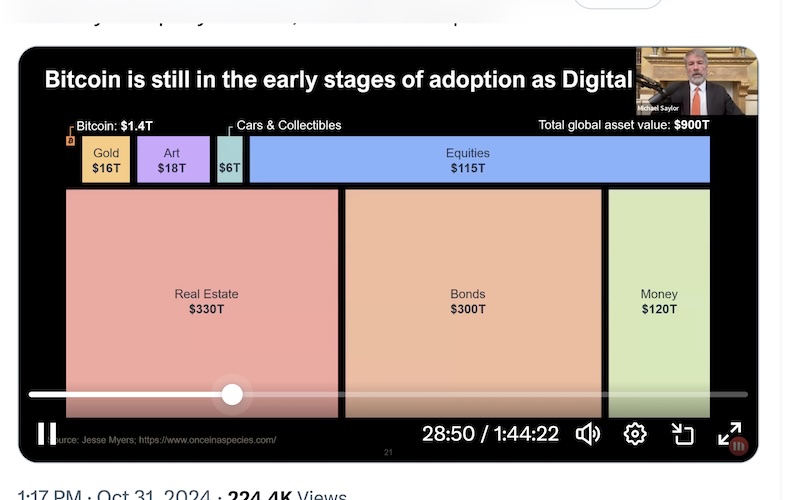 |
|
Valued Member
New Zealand
238 Posts |
My issue with cryptos broadly is this: What's to stop there being a million different ones? With country currencies, there's a finite number of governments. While they can print as much currency as they want, that will impact its value, as will confidence in that country and/or its government. Also, a given currency is backed by that government (unless/until it isn't, but it in theory.....). Who backs a crypto? It's finite nature only guarantees a limited supply of that particular one, but there's still the potential for an inifinite number of possible cryptos. Which ones maintain value? They can't all.
No crypto advocates have ever been able to answer this question. I can't recall any of them even trying.
Personally, I'd rather invest in tulips.
Do not read this sentence.
|
|
Moderator
United States
198004 Posts |
You are correct to question it. Crypto is complicated, but not infallible. Does it have a future, yes. But that future is not now. You will loose less money with tulips.  |
|
Valued Member
United States
81 Posts |
|
|
Valued Member
United States
318 Posts |
You don't have to ask a crypto bro, just ask any AI.
I asked perplexity, "why will btc survive when so many imitations".
Answer:
Bitcoin is likely to survive despite the proliferation of imitations and altcoins for several key reasons that set it apart from its competitors:
Unique Advantages of Bitcoin
First-Mover Advantage and Network Effects
Bitcoin was the first successful cryptocurrency, which gave it a significant head start in building a large, global community of users, developers, and miners.
Its network is the largest by hash rate, market capitalization, and transaction volume, making it the most recognized and trusted brand in the cryptocurrency space.
Proven Reliability and Lindy Effect
Bitcoin has demonstrated unmatched reliability, with continuous uptime since 2013—surpassing even major tech companies in this regard.
Its survival through technical, social, and regulatory challenges has established a track record that inspires confidence among investors and developers.
Decentralization and Security
Bitcoin's decentralized structure, with tens of thousands of nodes and miners worldwide, makes it extremely difficult to censor, manipulate, or shut down compared to most altcoins, which often have more centralized control.
This decentralization also ensures that its monetary policy—specifically, the hard cap of 21 million coins—is credible and cannot be easily altered, unlike many altcoins where central authorities can change rules at will.
Immutable and Sound Monetary Policy
Bitcoin's fixed supply of 21 million coins is a core feature that cannot be replicated with the same credibility by other projects.
Even altcoins that copy Bitcoin's hard cap cannot match its level of decentralization and community consensus, making their supply limits less trustworthy.
Brand Recognition and Institutional Trust
Bitcoin is widely recognized as the original and most legitimate cryptocurrency, attracting both retail and institutional investors.
Its status as a "store of value" is reinforced by its long history and the entry of established financial players into the Bitcoin ecosystem.
Why Imitations Fail to Threaten Bitcoin
Lack of Network Effects
New coins, even those that copy Bitcoin's code or branding, struggle to attract the same level of user adoption and developer engagement.
Imitating Bitcoin's name may offer short-term gains but does not translate into long-term survivability or trust.
No Inflation from Altcoins
The creation of new altcoins does not dilute Bitcoin's supply or value, just as new stocks do not inflate the value of existing ones. Bitcoin remains a distinct asset with its own market.
Decentralization and Immutability
Bitcoin's decentralized governance and consensus rules make it uniquely resistant to changes that could undermine its monetary policy or security, a claim most altcoins cannot make.
Conclusion
Bitcoin's survival and dominance are underpinned by its unique combination of first-mover advantage, unmatched network effects, proven reliability, decentralized governance, and immutable monetary policy. While many altcoins and imitations exist, none have been able to replicate these core strengths, making Bitcoin resilient in the face of competition and imitation
|
|
Pillar of the Community
United States
944 Posts |
I opened a small position in the Bitcoin ETF IBIT a while ago. I look at it as additional diversification.
|
|
Pillar of the Community
United States
2889 Posts |
Quote:
My issue with cryptos broadly is this: What's to stop there being a million different ones? .... There are literally millions of crypto currencies, reminiscent of the late 90's internet companies. After the Internet Bubble exploded in early the early '00's, only a handful of companies survived, AMZN & ebay are the ones I can think of. The same WILL happen to crypto & similarly only few cryptos will remain. BTC is backed by absolutely nothing & nobody even knows who created it, not a great choice. XRP, however has been working on their technology for over a decade & is now in a position for mass adoption. What makes XRP a better choice than others? They're now associated w/ the current administration/Crypto Reserve, their technology is being tested & utilized by some huge corporations, BofA, AmEx, Amazon, etc. IMO, XRP is the frontrunner over all other cryptos. Edited by coin rejector
06/04/2025 12:19 pm
|
|
Pillar of the Community
United States
1880 Posts |
I did not understand Bitcoin until I read the book, The Bitcoin Standard: The Decentralized Alternative to Central Banking. I am not all in, but have added some Bitcoin to my portfolio. Decentralization and Security is certainly one of the keys as is limited supply - a downfall of XRP.
While I am not sure it will be $13M as Saylor says, I am confident that it will be several hundred thousand dollars in the next several years. It is a risk on asset for sure. It seems to either be the best performing or worst performing asset in a given year - being the best most years.
|
|
Valued Member
United States
318 Posts |
XRP does have limited supply of 100 billion versus only 21 million BTC. Half of that 100 bil is owned by the founders so it is not decentralized and will never gain a huge crypto following. It is designed to facilitate quick and reliable cross border transfers which is a big deal. A tiny amount of XRP is needed to make these transfers and then that XRP is burned (disappeared) necessitating a constant need for more XRP. This makes it look more like a commodity like iron ore and will have a relatively stable price.
|
|
Valued Member
New Zealand
238 Posts |
I understand cryptos as much as I want to. I get the security aspect of block chain, although now apparently quantum computing may change that. The whole thing just feels like a long con.
Do not read this sentence.
|
| |
Replies: 32 / Views: 3,563 |







 Posted 05/28/2025 05:11 am


