You may be wondering why I am posting a What If? story about the recent Morgan / Peace Dollar coins, considering they have been in production for several years at this point. This post is not about the bill that led to Public Law 116-286 which authorized the current coins, I'm writing about a predecessor bill that differed in several key areas.To establish a common ground of knowledge regarding Public Law 116-286 and the Morgan / Peace Dollar coins:
1. The Public Law ("PL") specified only a start date for coining authority - no end date. As a result, the United States ("US") Mint can annually produce one or both of the Silver Dollars as long as it believes the issues to be economically viable.
2. The PL does not set annual mintage limits for the Silver Dollars. Thus, the US Mint can strike as many coins as it believes it can sell. It can, of course, choose to limit the number of coins struck to excite collectors.
3. The PL does not limit / specify the finishes / versions (e.g., Proof, Uncirculated, Reverse Proof, etc.) that can be struck.
4. The Issue Price of each coin
does not include a surcharge. No surcharge funds are collected or distributed to outside organizations - all proceeds go the US Mint Public Enterprise Fund ("PEF"). (For more on the PEF, see
"Numismatic Item" Definition.)
5. The bill that became Public Law 116-286 was introduced in the House of Representatives ("House") by Andy Barr (R-KY) in March 2020. A companion bill was introduced in the Senate by Michael B. Enzi (R-WY) in July 2020.
Prior to these bills, however, Emanuel Cleaver (D-MD) introduced a bill in the House in July 2019. (The
raison d'être for this post!)
Cleaver's bill called for "coins in commemoration of the centennial of the minting of the Morgan dollar and the Peace dollar." Up to 500,000 (combined) Silver Dollars could be struck; Proof and Uncirculated versions were authorized.
Note: All Silver Dollar coin bills discussed here were introduced during the 116th Congress.The bill's "Findings" section provided a brief historical background for context:
Congress finds the following:
(1) The United States of America entered the First World War when it declared war against Germany on April 6, 1917.
(2) The armed hostilities ceased on November 11, 1918, the "11th hour of the 11th day of the 11th month".
(3) The First World War effectively ended on June 28, 1919, with the Treaty of Versailles, but the United States Senate failed to ratify that treaty and later ratified a peace agreement with Germany on October 21, 1921.
(4) Over 4,700,000 American military personnel served during the First World War with 116,516 sacrificing their lives for freedom and another 204,002 wounded.
(5) In December 1921, the Peace silver dollar (in this Act referred to as the "Peace dollar") was approved by Treasury Secretary Andrew Mellon, replacing the Morgan silver dollar (in this Act referred to as the "Morgan dollar") and commemorating the declaration of peace between the United States and the Imperial German government.
(6) The Peace dollar was designed by Anthony de Francisci with the Goddess of Liberty on the obverse and a bald eagle clutching the olive branch (a symbol of peace) on the reverse. The Peace dollars were minted between 1921-1935.
(7) The Morgan dollar was designed by George T. Morgan and was minted from 1878 to 1904, and again in 1921. The obverse depicts a profile portrait of Lady Liberty and on the reverse, a heraldic eagle.
(8) The conversion from the Morgan dollar to the Peace dollar design in 1921 reflected a pivotal moment in American history. The Morgan dollar represents the country's westward expansion and industrial development in the late 19th century. The Peace dollar symbolizes the country's coming of age as an international power while recognizing the sacrifices made by her citizens in World War I and celebrating the victory and peace that ensued.
(9) These iconic silver dollars with vastly different representations of Lady Liberty and the American Eagle, reflect a changing of the guard in 1921 in the United States and therefore on the 100th anniversary must be minted again to commemorate this significant evolution of American freedom.The bill's design specifications stated that the coins were to be "representative of either the Morgan dollar or the Peace dollar." It specified only "2021" as the date to appear on the coins. A separate provision specified that the coins could be struck for a one-year period commencing on January 1, 2021. Thus, a one-year commemorative issue was being proposed not an open-ended series.
Unlike the Morgan and Peace Silver Dollars authorized by Public Law 116-286, Cleaver's bill established a surcharge of $10 per coin, with collected surcharges to be paid out via a split distribution model:
(1) 40% to the American Numismatic Association "for the purpose of numismatic educational activities."
(2) 40% to the National World War I Museum and Memorial in Kansas City, Missouri, "for the purposes of education and commemoration activities relating to World War I and its enduring impact."
(3) 20% to the Nevada State Museum (formerly a United States Mint facility) located in Carson City, Nevada, for the purposes of:
"(A) supporting the preservation of the historic features of the museum relating to the United States Mint;
"(B) designing interpretive programs that connect visitors to the significance of minting in the United States, the Comstock Lode, and the American West; and
"(C) to support the activities of the Nevada Division of Museums and History."
Total surcharges would have reached $5 million if the issue sold out - a highly likely scenario based on the PL 116-286 experience of 2021!
The bill was referred to the House Committee on Financial Services, but did not proceed further. The competing, and more supported, bills of Representative Barr and Senator Enzi were introduced in the Second Session of the 116th Congress, and the rest is history!. (It's too bad the American Numismatic Association ("
ANA") missed out on a potential revenue stream.)
2021 Morgan Silver Dollar - Issued via PL 116-286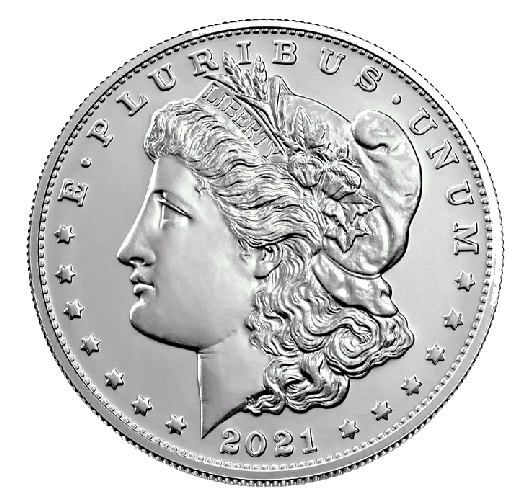
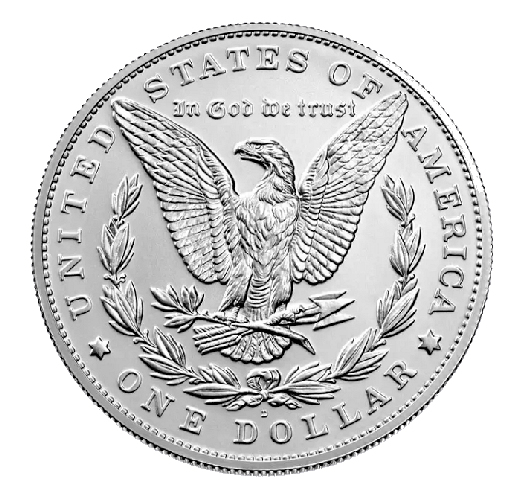 (Image Credit: US Mint. Media Image.)2021 Peace Silver Dollar - Issued via PL 116-286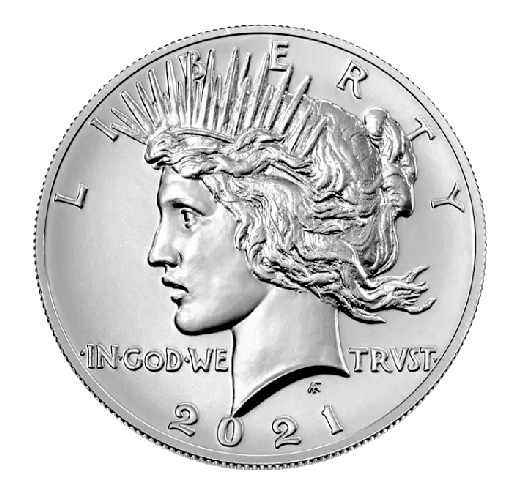
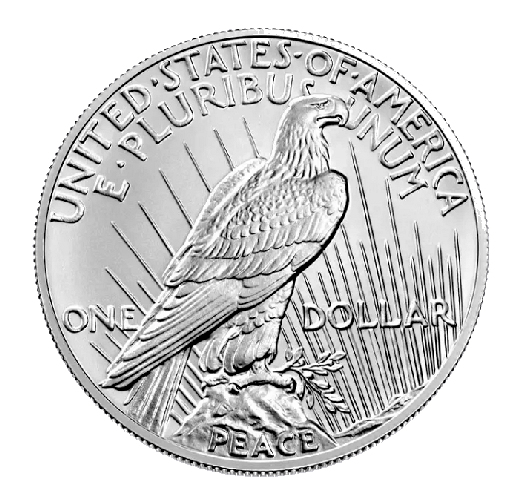 (Image Credit: US Mint. Media Image.)
Personally, I think the more limited provisions of Cleaver's bill (vs. those of PL 116-286) would have intensified collector interest in the coins even further and made them more of a true commemorative issue (vs. a new, ongoing, non-circulating Silver Dollar series). In such a scenario, however, the Mint would not make nearly the same amount of profit. It seems plausible, therefore, that the Treasury / Mint had a hand in crafting the PL's language to maximize its position.
For other of my posts about commemorative coins and medals, including more What If? stories, see:
Commems Collection.






 Posted 09/14/2025 11:06 am





