While certain financial issues prevented the Oregon Trail Memorial Association ("Association") from issuing a 1930-dated half dollar, it did not prevent them from celebrating the Covered Wagon Centennial in 1930. The 100th Anniversary was formally recognized by United States ("US") President Herbert Hoover via Proclamation (read it here: 1926-39 Oregon Trail Memorial - A Missed Opportunity. You can also read about the Association's financial issues of the time at the same link.)
The Covered Wagon Centennial was meant to celebrate the 100th Anniversary of the embarking of the first wagon train from St. Louis, Missouri for the Pacific Northwest (April 10, 1830) via what would come to be known as the Oregon Trail.
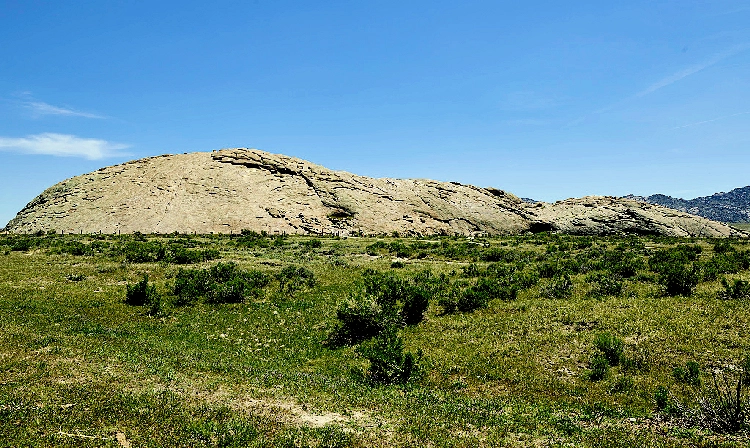
One Centennial Year event of note was the special encampment at Independence Rock in Wyoming during July 3-4-5, 1930.
Independence Rock in Present-Day Wyoming (Image Credit: Library of Congress, Prints and Photographs Division. Public Domain.)
What is the Importance of Independence Rock?
For pioneers making the westward journey, Independence Rock was/is at the approximate midpoint of the journey from the Mississippi River (or nearby departure points) to their far west destination. Also, it was considered very important to reach Independence Rock by July 4 in order to make it through the Rocky Mountains before heavy snows made it near impossible and often fatal.
It is believed that William Sublette, one of the leaders of the first wagon train over the trail to arrive at the spot, named the formation "Independence Rock" after celebrating with his team on July 4, 1930.
In 1928, the Association invited the Boy Scouts of America to participate in the Oregon Trail Centennial encampment and to help mark the Oregon Trail (among other trails). The encampment celebration took place at Independence Rock, Wyoming over the course of July 3-5, 1930. Per the records I've seen, between 750 and 1,000 Scouts participated.
Note: By the late 1920s, the scope of interest for the Oregon Trail Memorial Association had expanded beyond the Oregon Trail to also include other western trails, including the Pony Express Trail
In an interview regarding the July celebration, James E. West, Chief Scout Executive, expected that "This commemoration camp at Independence Rock, to pay tribute to our American pioneers, will acquaint Scouts with many of America's historic traditions; it will enable them to comprehend more clearly the old Western life of the plains, and it will give them an active part in marking old trails and historic shrines which are identified with the opening and development of the West." (Source: James E. West, Chief Scout Executive, The New York Times, March 30, 1930. Fair use, education.)
The encampment was considered significant enough for Frank C. Emerson, Governor of Wyoming in 1930, to issue a supporting proclamation. Here are a couple of excerpts from the Proclamation:
"The young manhood of America has always received inspiration from the romantic figures of those having part in the historic exploits attending the conquest and development of our western country. It is therefore fitting that the Boy Scouts of America should heed the call and join heartily in the celebration of this year."
"Therefore, I, Frank C. Emerson, Governor of Wyoming, believing many things combine to make this event at the time of our great national holiday of outstanding significance, call upon our people to give attention to the celebration of the "Covered Wagon Centennial and the National Boy Scout Rendezvous"
From the accounts I've read, the encampment was successful.
The national office of the Boy Scouts of America encouraged local troops to engage in active support of the Oregon Trail Memorial Association's objectives regarding helping to mark local historic trail points and by helping to sell/distribute the Association's commemorative half dollar; troops were specifically encouraged to purchase the coin in groups of five from the Association to help with fundraising.
The national Boy Scouts of America office donated 60 bronze trail markers and challenged individual scout troops to step up and donate the needed granite base for one or more Trail Markers/Memorials - the granite bases had an estimated cost of $100. Troops could pay for the base directly, via subscription (i.e., payment plan) or via purchase and distribution of the Oregon Trail half dollar.
Note: The Boy Scouts supported efforts to mark the Oregon Trail as well as the Pony Express Trail; the group's ultimate focus, however, appears to have been dedicated to the Pony Express Trail.
I haven't yet been able to track down sales numbers for the Boy Scouts efforts, but maybe someday...
1926 Oregon Trail Memorial Association Half Dollar
For other of my posts about commemorative coins and medals, including more US classic-era commemorative coin stories, see: Commems Collection
If you have a few minutes, this YouTube vudeo provides interesting background on the encampment and Centennial:
b9njGUZl968
Collecting history one coin or medal at a time! (c) commems. All rights reserved.
Disclaimer: While a tremendous amount of effort goes into ensuring the accuracy of the information contained in this site, Coin Community assumes no liability for errors. Copyright 2005 - 2026 Coin Community Family- all rights reserved worldwide. Use of any images or content on this website without prior written permission of Coin Community or the original lender is strictly prohibited. Contact Us | Advertise Here | Privacy Policy / Terms of Use









 Posted 02/07/2026 9:35 pm


 Uncirculated American Silver Eagles


