Moving forward with the Wichita Centennial medal story...Of the 100,000 medals authorized, a total of 9,000 bronze and 3,500 silver medals were struck; the first production batch included 4,000 bronze and 1,500 silver medals - the initial run of silver medals was sequentially edge-numbered. Of the numbered 1,500 silver medals, the first was presented to US President Nixon, 100 were reserved for special fund-raising mail-bid auctions and 17 were given to participants in the 1969 Midwestern Governor's Conference that had recently (June 1969) been held in Wichita.
The silver medals were sold at $7.50 each, the bronze versions at $3.00; two-piece sets were also available. The medal, in either metal, is 1-9/16" in diameter; 1/16th inch larger then standard US Silver Dollar.
Each side of the medal features a design by artist Donald T. Gist (b. 1918; d. 2003). Each side of the medal depicts a related but different design that was based on an Official symbol developed for the Wichita Centennial.
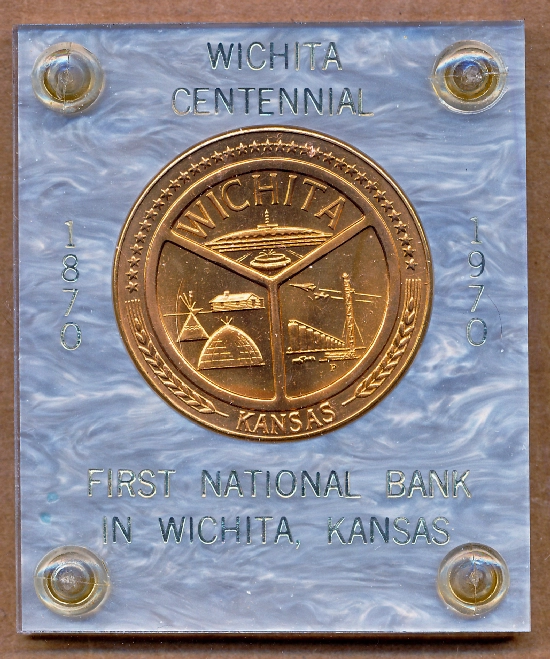
The medal's obverse design is based on the
Official Seal of the Wichita Centennial - it presents a "Past, Present and Future" theme. Central to the design is a "Y" shape that is symbolic of the confluence of the Big Arkansas River and the Little Arkansas River in Wichita - - this confluence has been the site of settlements by indigenous people for centuries and Europeans since the 1800s.
The "Y" creates three segments within the design. The lower left represents the "Past" with a lodge and teepee of Native Americans plus a cabin meant to represent early European settlers. The right segment features symbols of Wichita's then-current major industries: oil/gas, aviation and agriculture. The top third presents "WICHITA" above the city's new (at the time) Century II Civic Center - it was used as a marker for Wichita's progress into its second century. Wheat ears flank the inner design elements near the bottom rim, with 34 stars framing the design at the top - Kansas was the 34th State to join the Union (in January 1861).
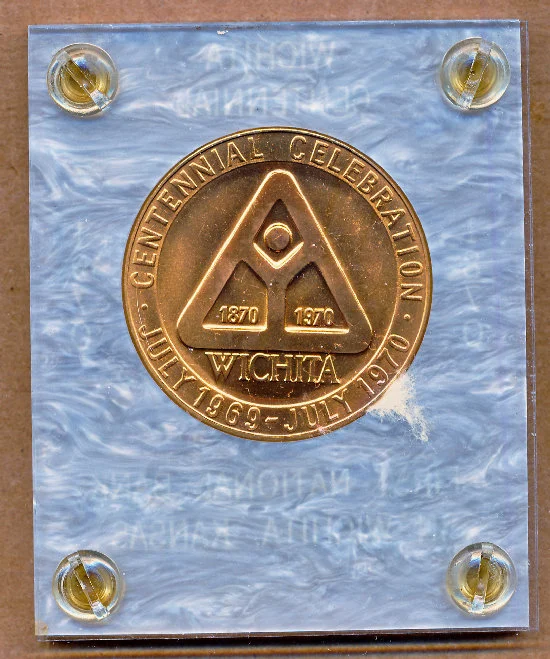
Don Gist's design for the Centennial's
Official Symbol was adapted for use on the medal's reverse. To my eyes, its bold style is very much in line with 1970s design aesthetics.
The dominant feature of the design is a triangle with bold sides/lines. - it is a multi-layered symbolic element. In its simplest interpretation, the triangle represents strength and stability - hallmarks of a city celebrating its Centennial and poised to continue on for many years to follow.
The three sides of the triangle can be interpreted as representative of the Centennial's three-pronged "Past, Present and Future" theme, as well as Wichita's three primary industries (oil/gas, aviation and agriculture). The shape is also sometimes connected with the shape of a) the area's early teepees used as shelter by indigenous tribes, b) the frame of an oil derrick and c) the delta-shaped wing of a modern jet.
Inside of the triangle is found the "Y" that is symbolic of the city's river confluence (see discussion above). In the upper segment of the design, the dot represents a bird's eye view of the dome of the Century II Civic Center.
The dates of Wichita's Centennial celebration are featured along the lower rim.
Gist's designs were sculpted and engraved by US Mint staff:
Frank Gasparro, Edgar Z. Steever and Philip Fowler.
I have a silver and bronze example of the medal in my collection. I didn't have them available to image, so I present images of the silver medal from PCGS CoinFacts.
1970 Wichita, Kansas Centennial Medal - Silver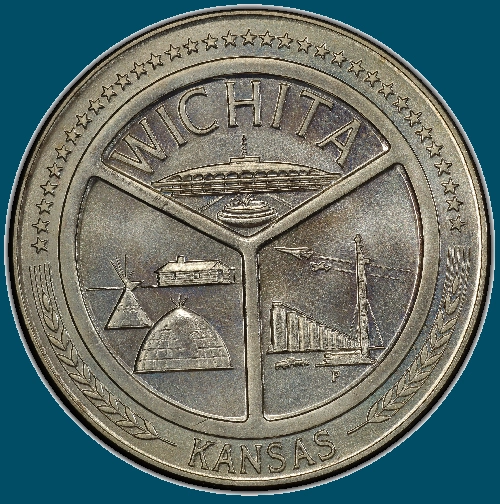
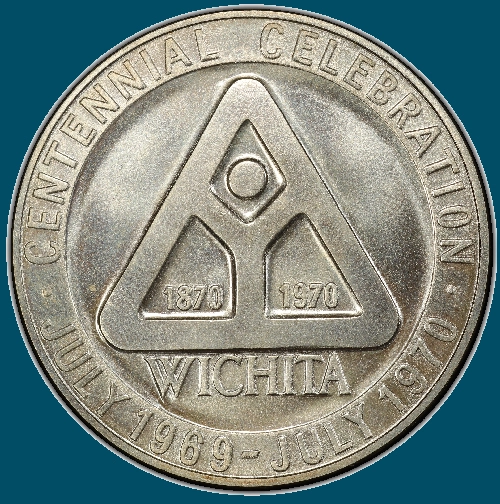 Image Credit: PCGS CoinFacts. Fair use, education.)
I plan on exploring one other aspect of the medal in a post later this week - it includes a bronze example of the medal in a custom holder. Stay tuned!
To catch up on Part I - of thie Wichita medal's story - its journey in Congress, see
1970 Wichita, Kansas Centennial - In CongressFor other of my posts about commemorative coins and medals, including more "Historical Tidbits" stories, see:
Commems Collection 









 Posted 03/04/2026 2:23 pm