To review the first part of my 1985 story, see:
American Gold Eagle Program - 1985 Proposals / Part IThe bill that would ultimately result in the American Gold Eagle bullion coin program was introduced in the Senate in September 1985 by J. James Exon (D-NE). It incorporated many of the provisions that had been seen in previous bills that called for gold bullion coinage. (As discussed in 1985 Proposals / Part I, Senator Exon introduced a simlar gold coin bill in March 1985.)
The new bill was referred to the Senate Committee on Banking, which reported the bill favorably with an amendment regarding the source of the gold to be used for the coins.
The amendment specified that the gold used for the American Gold Eagle coins was to be "mined from natural deposits in the United States, or in a territory or possession of the United States, within one year after the month in which the ore from which it is derived was mined."
In terms of the coins themselves, the bill sought the minting of:
"A fifty dollar gold coin that is 32.7 millimeters in diameter, weighs 33.931 grams, and contains one troy ounce of fine gold.
"A twenty-five dollar gold coin that is 27.0 millimeters in diameter, weighs 16.966 grams, and contains one-half troy ounce, of fine gold.
"A ten dollar gold coin that is 22.0 millimeters in diameter, weighs 8.483 grams, and contains one-fourth troy ounce of fine gold.
"A five dollar gold coin that is 16.5 millimeters in diameter, weighs 3.393 grams, and contains one-tenth troy ounce of fine gold."The bill included design specifications for the $50 coin:
"(i) on the obverse side, a design symbolic of Liberty; and
"(ii) on the reverse side, a design representing a family of eagles, with the male carrying an olive branch and flying above a nest containing a female eagle and hatchlings; "1986 American Gold Eagle - One Ounce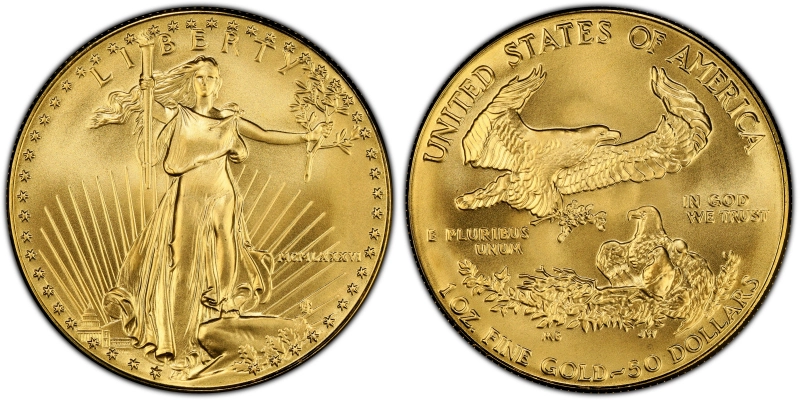 (Image Source: PCGS CoinFacts.)
The Secretary of the Treasury approved the use of Augustus St. Gaudens striding figure of
Lady Liberty from the double eagles of 1907 to 1933 as the obverse's "symbolic of Liberty" design. The previously discussed Miley Busiek 'Family of Eagles' design (as described above) appeared on the reverse.
The bill left the designs for the other denominations to the Secretary of the Treasury - the Secretary chose to use the same designs for all denominations.
Note: The original designs (type I) were used until mid-2021 when the Type II designs were introduced).The coins were to be legal tender as per Section 5103 and Section 5112 of Title 31 of the US Code - a big change from many preceding gold bullion coin proposals which specified that they were not to be considered legal tender.
The selling price of each coin was specified as "the market value of the bullion at the time of sale, plus the cost of minting, marketing, and distributing such coins (including labor, materials, dies, use of machinery, and promotional and overhead expenses)." (Based on this provision, the sales price of each coin could potentially vary throughout each day based on market fluctuations in the spot price of gold.)
Net proceeds from the gold coins were specified to be deposited in the General Fund of the US Treasury, and be used used solely to help reduce the national debt.
The bill was considered and passed in the Senate in November 1985. During Senate consideration of the bill, the recent banning of South African gold coins on October 1, 1985 by President Ronald Reagan via Executive Order was used as a supporting argument by gold bullion coinage proponents in Congress.
Senator Exon (the bill's sponsor) stated:
"Now that President Reagan has banned the importation of South African gold coins, we need an American alternative which will keep investment in the United States and give world coin collectors and investors an opportunity to purchase American gold coins."The Senate-passed bill was then sent it to the House for its consideration. The House considered and passed the bill in December. It was then signed and examined before being sent to the US President for approval. The bill was signed into law by President Ronald Reagan on December 17, 1985.
The American Gold Eagle bullion coin program was born!
Related bills were introduced in the Senate by E. J. Garn (R-UT) (October 1985) and in the House by Jerry Lewis (R-CA) (November 1985), but neither proceeded past initial referral - Senator Exon's bill had Congress' attention.
An interesting side note, in May 1986, William E. Dannemeyer (R-CA) introduced a bill that called for the repeal of the "authorization for the minting of $10 gold bullion coins." The bill did not move forward past its referral to the House Committee on Banking, Finance and Urban Affairs and subsequent referral to its Subcommittee on Consumer Affairs and Coinage.
The subject of gold coinage was a 'hot' one in Congress during the early- to mid-1980s with a variety of gold-related bills presented in the Senate and House. In this "by request" series, I've focused on the activities directly related to the foundation and evolution of the American Gold Eagle bullion coin program. Hopefully, if you've been following along, you now have a better understanding of how it was far from a simple, straightfoward journey through Congress.
Maybe I'll assemble an Index to the stories of the journey to facilitate easy access. Stay tuned!For other of my posts about commemorative coins and medals, including previous stories about the journey taken to arrive at the American Gold Eagle program, see:
Commems Collection









 Posted 08/10/2026 07:53 am


