|
CCF Master Historian of Commemorative Coins
 United States
12673 Posts |
In September 2010, during the Second Session of the 111th Congress, Denny Rehberg introduced the "American Eagle Palladium Bullion Coin Act of 2010". The bill called for the minting of an annual one-ounce palladium bullion coin with a denomination of $25. The Act included specific guidelines for the new coin's designs: "Coins minted and issued under this subsection shall bear designs on the obverse and reverse that are close likenesses of the work of famed American coin designer and medallic artist Adolph Alexander Weinman--
"(A) the obverse shall bear a high-relief likeness of the 'Winged Liberty' design used on the obverse of the so-called 'Mercury dime';
"(B) the reverse shall bear a high-relief version of the reverse design of the 1907 American Institute of Architects medal".The coin marked the first time that Weinman's "Architects" design appeared on a United States ("US") coin. The bill was signed into law by President Barack Obama on December 14, 2010. The US Mint released the first coins on September 25, 2017. I purchased one of the First-Year issues for my collection for its novelty. 2017 Palladium $25 Bullion Coin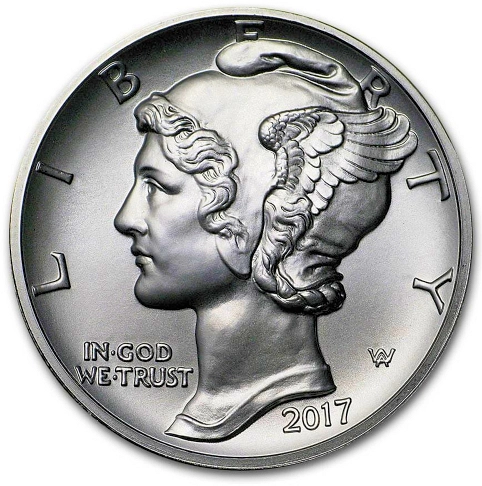 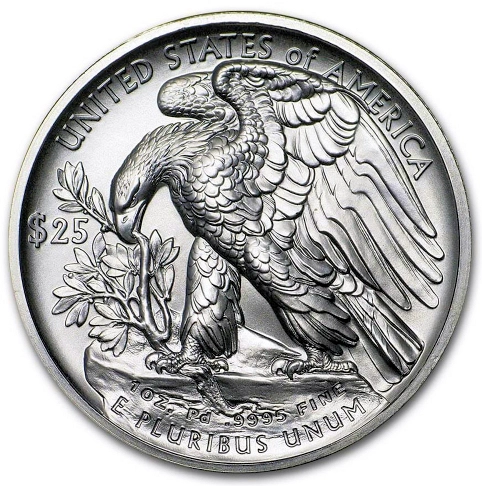 (Image Source: US Mint Media Images.) But the United States' Palladium Bulllion Coin may have had a different denomination and design if prior legislative proposals had been successful. Between the 110th and 111th Congresses, four bills were introduced that called for "production of Saint-Gaudens Double Eagle ultra-high relief bullion coins in palladium to provide affordable opportunities for investments in precious metals." Two companion bills were introduced in each Congress. The companion bills of the 110th Congress were introduced by Michael Castle (R-DE) in the House of Representatives ("House") and Max Baucus (D-MT) in the Senate. The bills were introduced in March 2008 and April 2008, respectively. The bills featured extensive "Findings" sections that provide some great history and background related to the coin's proposed designs and precious metal content: "The Congress finds that--
"(1) the Augustus Saint-Gaudens $20 gold pieces of 1907 with ultra-high relief are considered by many in the numismatic community to be the most beautiful coins ever produced;
"(2) two separate "pattern" versions of the ultra-high relief Double Eagle were produced in 1907;
"(3) a 34-millimeter version was hand-struck on a standard Double Eagle planchet using a medal press and, because manufacturing and technical limitations prevented mass production of these pieces, this production resulted in low mintage, with fewer than two dozen specimens of the 34-millimeter version known to be in existence today;
"(4) a second, 27-millimeter, version was struck using two stacked $10 Eagle planchets;
"(5) these experimental "pattern" 27-millimeter pieces were deemed to be illegal to produce and all specimens were destroyed except for 2 that reside in the Smithsonian's National Numismatic Collection;
"(6) the 27-millimeter pattern pieces are ranked by numismatists as among the most beautiful coins ever produced, but none are in private hands and none have ever come up for sale;
"(7) the ultra-high relief Double Eagles are representative of the greatest period of American coinage, the so-called "Golden Age of Coinage" in the United States, initiated by President Theodore Roosevelt, with the assistance of noted sculptors and medallic artists James Earle Fraser and Augustus Saint-Gaudens;
"(8) the introduction of this famous piece as a numismatic proof coin would not only give collectors an opportunity to own a version of a legendary coin that has never before been available for private ownership, but also inaugurate a neo-renaissance in United States coin design and demonstrate the technological advances that the United States has achieved over the last century;
"(9) the modern coin version of the $20 gold piece would be updated with the addition of the inscription "In God We Trust" and would include the date of minting or issuance, to distinguish it from the originals and prevent counterfeiting;
"(10) palladium is a rare silver-white metal, and is considered a precious metal because of its scarcity;
"(11) palladium is one of 6 platinum group metals that include ruthenium, rhodium, osmium, iridium, and platinum; it is the least dense and has the lowest melting point of the platinum group metals;
"(12) the major nations mining palladium are in order of volume: Russia, South Africa, United States of America, and Canada;
"(13) the major mine producing palladium in the United States is located in Montana;
"(14) palladium is fabricated into a wide range of applications that includes its extensive use as an industrial catalyst and a key component in the manufacturing of automotive catalytic converters;
"(15) palladium is also used in dentistry, jewelry, and in the production of surgical instruments and electrical contacts;
"(16) the demand for precious metals is driven not only by their practical use, but also by their role as a store of value;
"(17) a variety of investment options are available to palladium investors that includes coins, bars, and exchange-traded funds;
"(18) palladium coins have been issued by several countries, mainly as commemorative coins, but also as bullion investment coins (bullion is the form of palladium traded for investment purposes and is a reference to its purity);
"(19) Tonga commenced issuing palladium coins in 1967 and other issuing countries have included Canada, the Soviet Union, France, Russia, China, Australia, and Slovakia;
"(20) today, only Canada mints palladium bullion coins;
"(21) during the period 2003 through 2007, the price of palladium ranged between $148 and $404 per troy ounce, and the average price in 2007 was $355 per troy ounce;
"(22) by contrast, during the same period, the price of platinum ranged between a low of $603 and a high $1,544, and the average price in 2007 was $1,303 per troy ounce;
"(23) thus, platinum bullion coins have become too expensive for the average investor;
"(24) The Royal Canadian Mint minted platinum bullion coins for 14 years (between 1988 and 2001), but ceased production in the face of high metal prices and declining sales;
"(25) when the United States Mint's American Eagle Platinum Bullion Coin was launched in 1997, the average price for the metal that year was $395 per troy ounce; and
"(26) over the past decade, the price has more than tripled, which has caused a dramatic decline in demand for these coins, from 80,050 ounces sold in 1997 to 9,050 in 2007."The proposed palladium coin was to be a one-ounce coin with a denomination of $20 - the same denomination as its design inspiration. The proposed coin was in response to the rise in the spot price of gold to nearly $1,000 per ounce (circa 2008), a level which it was believed shut out many potential individual investors (e..g., IRA investors). In contrast, the spot price for one ounce of palladium at the time was ~$425, a more workable level for many. The story continues in Part II. For other of my posts about commemorative coins and medals, including other What If? stories, see: Commems CollectionCollecting history one coin or medal at a time! (c) commems. All rights reserved.
Edited by commems
Today 9M ago
|





 Replies: 0 / Views: 23


 Posted Today 14M ago


