| Author |
 Replies: 8 / Views: 1,496 Replies: 8 / Views: 1,496 |
|
|
New Member
United States
3 Posts |
I recently cleaned off a bunch of green buildup from this coin to find a coin I could not identify.  I have attached a picture, scanned and HDR, to show as much detail as is possible with a picture. I tried to use a bigger picture but the file size restriction stopped me. Any help would be greatly appreciated. I have now included bigger pictures. Sorry for the smaller ones before. Thanks 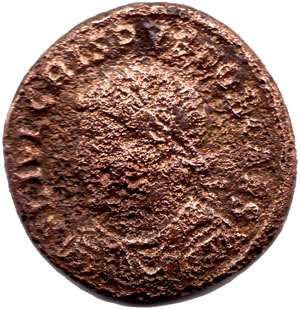 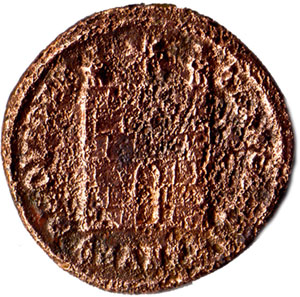 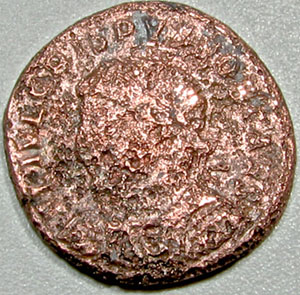 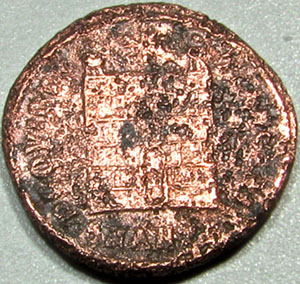 Edited by AngellXP
07/06/2009 5:58 pm
|
|
|
|
Pillar of the Community
Norway
510 Posts |
 to the forum! It is possible someone with better eyesight can help you, but I am unable to see what this is. I cannot make out a single letter. I know you can post bigger pictures than this here, I have done so myself. If you try a somewhat bigger one of one side only, and another with the reverse, then your odds of getting an informative answer will improve. As an example of what is possible when it comes to pictures, check out the posting "Mexican pesos 1910-1914". Edited by Litotes
07/03/2009 04:59 am
|
|
Pillar of the Community
United States
2254 Posts |
I can't help with identification, but I did try to enlarge the pictures a bit. Unfortunately, the source was not very good to begin with. 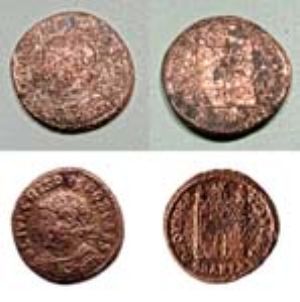 |
|
Moderator
 Australia
16982 Posts |
They appear to be late Roman bronzes, of the type known as "campgates" because of the turreted military camp gate on the reverse. Probably dating sometime around the early 300's AD. Quote:
I recently cleaned off a bunch of green buildup from this coin to find a coin I could not identify... Ancient coins often come "uncleaned" and require an outer crust to be removed. However, on ancient Roman bronzes, there's usually supposed to be some "green buildup". Removing all of it has probably removed some of the coins's surviving fine details. Ancient coins aren't supposed to be cleaned down to bare metal. Don't say "infinitely" when you mean "very"; otherwise, you'll have no word left when you want to talk about something really infinite. - C. S. Lewis
|
|
New Member
 United States
3 Posts |
Again I apologize for the smallness of the original pictures. I hope the new ones can help. If this is in fact a 300ad campgate, do you know what it might be worth?
Thanks again.
Edited by AngellXP
07/06/2009 5:59 pm
|
|
Moderator
Australia
16982 Posts |
Ah, yes. That's better. The ruler depicted is Crispus Caesar, son and heir of Constantine the Great, from 317 until his execution in 326 AD. The mintmark appears to be Antioch. Such coins are very common. In this condition, even fully identified, it would only be worth a few dollars. As I alluded to before, this poor thing's been "zapped" - overcleaned using acid or electrolysis. Here's what it would look like in better condition; that one sold for $29. Don't say "infinitely" when you mean "very"; otherwise, you'll have no word left when you want to talk about something really infinite. - C. S. Lewis
|
|
New Member
United States
3 Posts |
This thing was Caked in rock hard green corrosion and no details were visible at all. There is very little I could have done to prevent any damage that had already occurred. For future reference how would I go about removing the green stuff?
Thanks for the help.
Edited by AngellXP
07/06/2009 6:46 pm
|
|
Valued Member
286 Posts |
Hello there Angell Welcome to the Forum, First I would like to say Never Clean Your Coins, But if you have to and would like to do it in a very professional way instead of using brushes or acids like most people do, I would recommend a Machine that would do it for you with out destroying the coin and its patina. Again they would only use this type or other types of Machine to read or try to make out who what and where did they coin or coins come from. Here is a link that may be of an interest to you. http://www.metaldetectorshop.co.uk/...ing/6ccm.htmBut I still would not recommend cleaning coins Period. Especially if its ROMAN coins. |
|
Pillar of the Community
United States
2669 Posts |
Some of these poor coins are found with barnacles so hard it would take a chainsaw and a chisel. I've been working on a few for MONTHS with acids, vibratory tumblers, cleaners like you linked to, barnacle remover for boats.. you name it, I've tried it. I think I have about half the covering off so far with no damage to the coin yet. It just takes patience and time. So.. saying not to clean some roman coins at all could be relative - some need it, just don't OVERclean. Once you get past the barnacles, slow down and use more precise methods, is all. It also takes a LOT of practice on all kinds of ancient coins to know not only what to try, but when to stop.
First: Distilled Water, changed daily
Second: Olive Oil, better quality = better results
Third: Dremel (just kidding!)
There are a lot of suppositions and a lot of proven methods - google "cleaning ancient coins" or search here on the forum for cleaning techniques. Some people use lemon juice, tobasco, etc... it's just up to how much you need to get off the coin vs how much damage you want to inflict once you are at the patina. You do want to leave the patina if at all possible - this protects the coin and gives it the ancient aura it has earned.
|
| |
Replies: 8 / Views: 1,496 |
|





 Posted 07/03/2009 07:08 am





