| Author |
 Replies: 12 / Views: 3,231 Replies: 12 / Views: 3,231 |
|
|
Pillar of the Community
United States
3499 Posts |
A coworker of mine showed me this coin today and hoped that I could identify it. It was scanned and she sent me pics of the obverse and reverse. Unfortunately, only one of the scans was not corrupted somehow. So based upon this one pic can anyone help identify this coin? Thanks! 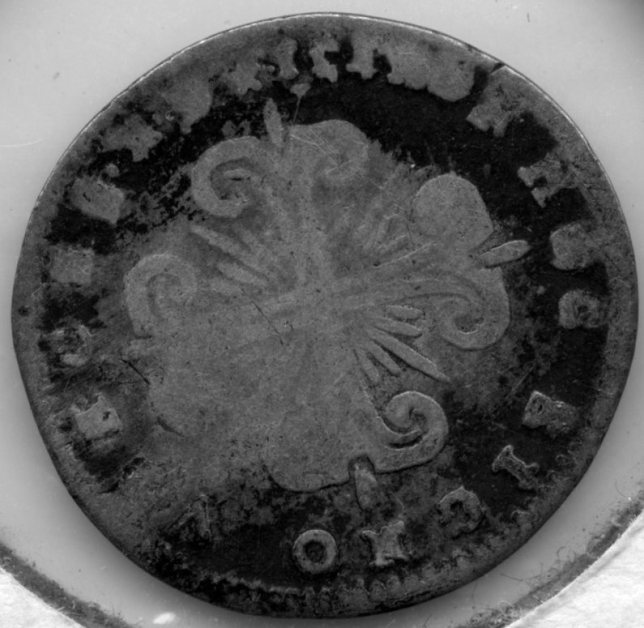 |
|
|
|
Pillar of the Community
United States
3363 Posts |
It's a puzzle to me. This sol parisis is similar, but not a match: http://www.numishop.com/ficheboutiq...&argretour=1It'd be nice to see the other side and to know the weight and diameter. If it's a French royal, I'd guess late 1500's, and would expect to see a big initial of the king centered on the other side. "Two minutes ago I would have sold my chances for a tired dime." Fred Astaire
|
|
Pillar of the Community
 United States
3499 Posts |
thq- Thanks for the link and Input. Unfortunately the obverse image was corrupted (and I can't just rescan it since it is not my coin), but I do remembered that there was a bust of a king facing right with a rather large wig. On the right side of the coin the inscription almost looked like it said "Crom," so I at first thought that it was a coin from Cromwellian England, but I really can't find a match in my Krause. It is a rather small coin. It's about the size of a US dime and presumably around the same weight (though of course reduced a bit due to the heavy wear).
I really do think that this may be either late 17th or early 18th century due to how the coin was made. It certainly was milled and not hammered. As for the country of origin, I was just guessing that it was of France. It could very well be from one of the Italian or German states. So this may be a tough one to ID.
|
|
Pillar of the Community
United States
2605 Posts |
Oliver Cromwell used his first name on the coins.
Archraz, I took your hunch about France and took it to Swiss cantons by geographic proximity. I haven't found anything in the 1800's Krause, although there are some similar crosses there. I'd check the 1700's book but I don't have one. Good luck!
|
|
Pillar of the Community
United States
3499 Posts |
svslav- thanks for the tip! I am seeing some similar reverses for some of the billon coins of the canton of Neuchatel, but nothing perfectly matches up yet. I'l. have to keep looking...
|
|
Pillar of the Community
United States
3363 Posts |
By 1600 many of the European states were milling small denominations. The simplicity of the design is what pushes me to this period. I can't find anything in comparable size German state coins (ca 3 kreutzer). English coins of this size were hammered until 1660, and this isn't a Commonwealth design. Jetons present an infinite number of possibilities, but they're usually more complex, bigger, and wouldn't show so much wear.
Maybe north German/Holland/Flanders?
"Two minutes ago I would have sold my chances for a tired dime." Fred Astaire
|
|
Moderator
 Australia
17005 Posts |
"In hoc signo vinces" (in this sign conquer) around a cross was a common design motif on the coins of Portugal; however, I can't spot any small silver coins from there with this kind of floreated cross, nor with a portrait on the obverse. The Latin phrase was also used on some coins of Brazil and Denmark, but not in conjunction with a simple cross design. The Knights of Malta also used it (or a version thereof) on some of their early coins, but again not with a flowery cross like this, that I can see. It's also entirely possible it's "just a medal".
I've said too many guesses, not enough facts. I think we'll need to wait on the obverse pic.
Don't say "infinitely" when you mean "very"; otherwise, you'll have no word left when you want to talk about something really infinite. - C. S. Lewis
|
|
Pillar of the Community
United States
3363 Posts |
"Two minutes ago I would have sold my chances for a tired dime." Fred Astaire
Edited by thq
01/20/2010 9:17 pm
|
|
Pillar of the Community
United States
3499 Posts |
Sap- Thanks for the help. Any input is appreciated!
thq- Thanks for the links. The bust on the coin in the first link does not look quite right, but the reverse looks somewhat similar.
|
|
Pillar of the Community
United States
3499 Posts |
I now have a new scan of the obverse, which I hope is sufficient for helping in the identification of this mystery coin. Sorry if it is a bit small, but it was the best I could get since I don't actually own the coin. Thanks for the help, everyone! 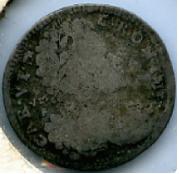 |
|
Moderator
Australia
17005 Posts |
With the coin posted by thq, that's enough.  On the obverse, we can read "CAR VI" - Charles VI, king of Naples 1713-1735, with Sicily added in 1720. The denomination is likely to be the same as the one in thq's link: a carlino, or 10 grani. Alas, the Krauses don't include many of the smaller denominations of most of the Italian states prior to 1750, so I don't think there's a Krause reference. Don't say "infinitely" when you mean "very"; otherwise, you'll have no word left when you want to talk about something really infinite. - C. S. Lewis
|
|
Pillar of the Community
United States
3499 Posts |
Sap- Really, the Krause book does not include many of the smaller denominations of most of the Italian states prior to 1750? That strikes me as being quite odd, but it is true that the 18th and 17th century books are works in progress. Thanks a bunch for helping me ID this coin for my coworker! Do you suppose that it is a rather scarce coin?
Thanks everyone! I am really glad that we finally figured this out.
|
|
Moderator
Australia
17005 Posts |
The Krause listings for many countries are copied out of the old Craig (KM/C numbers) and Davenport (KM/Dav numbers) catalogue. Davenport goes back to 1495 but only includes crowns. Craig includes all coins but only goes back to 1750.
Don't say "infinitely" when you mean "very"; otherwise, you'll have no word left when you want to talk about something really infinite. - C. S. Lewis
|
| |
Replies: 12 / Views: 3,231 |
|










 Posted 01/19/2010 9:54 pm


