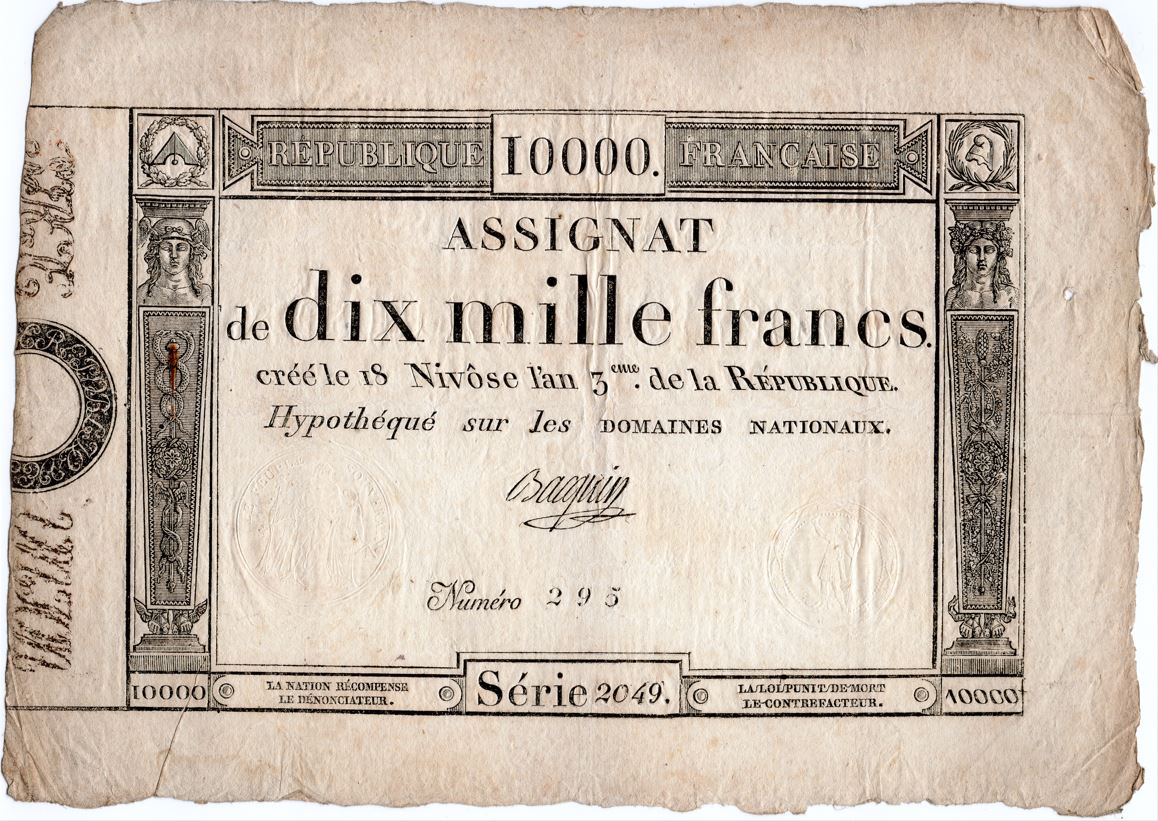
A fresh pick-up of a not so fresh note: 10,000 francs assignat, France 1795. (The reverse is blank.)
Soon after the French revolution in 1789, the revolutionary government found itself lacking funds. To remedy that,
assignats were emitted from 1790 as mortgage bonds on land confiscated from the church and crown. As the need for money grew, so did the temptation to emit more assignats than could be backed by actual property. Not surprisingly, that led to a loss of confidence in the assignats' value and in 1796 their real value (what they could be exchanged for in coin) was only a few percent of the nominal value.
Originally emitted in
livres, assignats were from 1795 denominated in the new currency
francs, with values from 100 to 10,000 francs. These assignats were in fact the first money denominated in francs, coins came later.
It is a big note - 23x16 cm / 9"x6.5" - and a big sum: 10,000 francs (about £ 400 in contemporary British currency, or nearly 3 kg of gold), a life income for most people at that time! But, only on paper ... already at emission in January 1795, the real value of this 10,000 francs assignat was only about 2,000 francs, and one year later it was down to 50 francs.
The paper is very thin. The watermark has the text
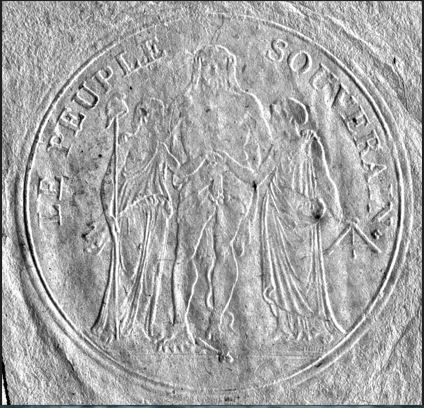
Liberte ou La mort ("Freedom or Death"). Additional security details include two dry stamps (visible in the lower left and right corners). A closer look at the one to the left reveals a motif immediately recognized by any collector of French coins: Hercules flanked by Liberty and Justice. It was designed by Augustin Dupre,
graveur general at the Paris Mint, originally for these assignats, later reused for the first 5 francs coins (with some small modifications, you can see the coin version
here) as well as for later 5 francs and modern large coins.





 First Page
 Previous Page


 Posted 08/24/2022 09:05 am