


Coin Community Family of Web Sites Join Thousands of Coin, Bullion, & Money Collectors
Coin, Banknote and Medal Collectors's Online Mall 300,000 items to help build your collection! Vancouvers #1 Coin and Paper Money Dealer Royal Estate Auctions - $1 Coin AuctionsSpecializing in Modern Numismatics Royal Canadian Mint products, Canadian, Polish, American, and world coins and banknotes. Join Thousands of Coin, Bullion, & Money Collectors


Username:
Password:
Save Password
Forgot your Password?


This page may contain links that result in small commissions to keep this free site up and running.

Welcome Guest! Registering and/or logging in will remove the anchor (bottom) ads. It's Free!

Peru 1 C - Is This An Error?

To participate in the forum you must log in or register.
Author Previous TopicReplies: 4 / Views: 2,130Next Topic  
Pillar of the Community
DL20K's Avatar
Poland
3201 Posts
 Posted 02/27/2010  1:37 pm Show Profile   Bookmark this topic Add DL20K to your friends list Get a Link to this Message Number of Subscribers
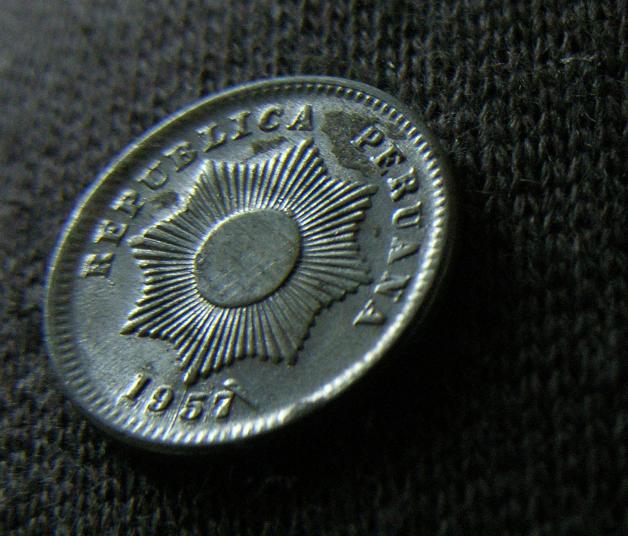
Bought this specifically to show you so please tell me, would this be considered an error? If so, what's it called?

Peru-1-C---Is-This-An-Error?

Peru-1-C---Is-This-An-Error?
Valued Member
Russia1981's Avatar
United States
150 Posts
 Posted 02/27/2010  11:59 pm  Show Profile   Bookmark this reply Add Russia1981 to your friends list Get a Link to this Reply
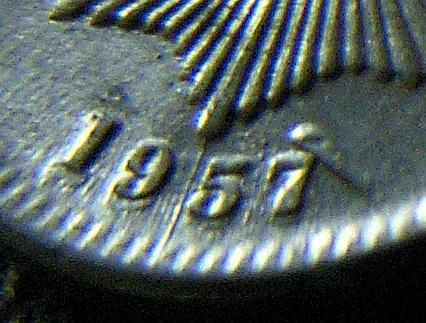
Die crack + double die on date?
I don't have much experience, just guessing.
Pillar of the Community
DL20K's Avatar
Poland
3201 Posts
 Posted 02/28/2010  06:48 am  Show Profile   Bookmark this reply Add DL20K to your friends list Get a Link to this Reply
My guess would be die crack + Machine Doubling on date, but what about the *large* thing near the 7?
Pillar of the Community
swamperbob's Avatar
United States
5362 Posts
 Posted 03/06/2010  4:00 pm  Show Profile   Bookmark this reply Add swamperbob to your friends list Get a Link to this Reply
There were a few things going on with the die that struck this coin. First, keep in mind one simple fact, whatever you see on the coin was reversed on the die that made the coin. A raised line or area on the coin translates to a void of some sort in the die.

1. The surface of the die was slightly pitted - probably a little rust. A new die pair (in the modern coining era) is prepared for striking by polishing the high points of the die (the fields on the coin). This surfacing wears off as striking of coins proceeds. The longer the die stays in the press the more the die itself wears out. Sometimes, depending on the quality of the die steel small pits develop (usually rust) but at times due to voids or small bubbles in the die steel itself that were no originally visible. Sometimes after extended use a real large flaw (originally below the die surface) gets exposed. This starts as an apparent swelling of the coin - later the underlying defect can open up. The larger the die void the more there tends to be a weak spot on the opposite side of the coin at the same location. This is caused by a reduction in the cross section pressure.

2. There is a nice small die crack running through the date to the rim. Die cracks of this sort are the result of the failure of the die. The strike pressure fatigues the die metal and it simply gives up by splitting. Cracks if they progress too far will become terminal die flaws and the die has to be retired.

3. There are erosion flow lines (radial lines) near the rim of the coin. These are seen on older dies as the pressure of the coin metal flowing over the die surface wears groves in the die face. As these get deeper, raised lines start to appear on the coin. These are usually not a terminal defect and they can often be removed by resurfacing the die itself. This process, called "lapping the die" was far more common in the earlier days of coining and as dies become cheaper to produce the labor involved in lapping can be simply too costly to do. Coins made from eroded dies are usually considered a bit substandard by many collectors.

4. Beneath each digit of the date is a die erosion feature referred to as "a ghost image". It is formed in a manner similar to the erosion flow lines but it erodes the area next to digits resulting in the appearance of a false double date. The physics behind what happens to a die when struck by the master hub is fairly simple. The area directly under the pressure from the hub design HARDENS. It is a fact that pressure HARDENS steel as it does to most metals. A coin blank is softer than the coin after being struck. The metal adjacent to the feature remains just slightly softer. The softer metal is eroded more quickly by repeated striking and you get a ghost image just outside the original and SLIGHTLY LARGER. It is a radial feature.

5. The most impressive die feature is the diagonal raised line segment above the 7 in the date. That is due to damage to the die. Something like a "tool" hit the die surface for some reason making a hole in the die face. Every coin struck after that point in time will have the same raised lump. Sometimes these strange marks are caused by a hard object falling into the coining chamber. Usually a metal chip that got mixed in with blanks to be struck. Mints are FACTORIES no more no less. Lots of metal and metal chips get everywhere - when a hard object enters the coining chamber there will be damage of some kind.

These errors are all fairly common, but of the entire group the only one likely to attract attention and cause a small increase in value is #5. In fact, in some very popular series (especially earlier US) marks like this can result in a lot of collector interest (read higher prices). All you need is a very popular coin series and then a way to publicise this die variety. Only one die had the flaw so it is much rarer than the typical coin. I don't believe Peru has any such level of interest but if it did this would be a KEY die type.

Nice find.

Pillar of the Community
DL20K's Avatar
Poland
3201 Posts
 Posted 03/09/2010  03:37 am  Show Profile   Bookmark this reply Add DL20K to your friends list Get a Link to this Reply
Thank you for the detailed explanation!
  Previous TopicReplies: 4 / Views: 2,130Next Topic  

To participate in the forum you must log in or register.


Disclaimer: While a tremendous amount of effort goes into ensuring the accuracy of the information contained in this site, Coin Community assumes no liability for errors. Copyright 2005 - 2026 Coin Community Family- all rights reserved worldwide. Use of any images or content on this website without prior written permission of Coin Community or the original lender is strictly prohibited.
Contact Us  |  Advertise Here  |  Privacy Policy / Terms of Use

Coin Community Forum © 2005 - 2026 Coin Community Forums
It took 0.27 seconds to rattle this change. Forums
