









 I purchased this ZAR 1892 5 shillings single shaft(14,000 minted) last night on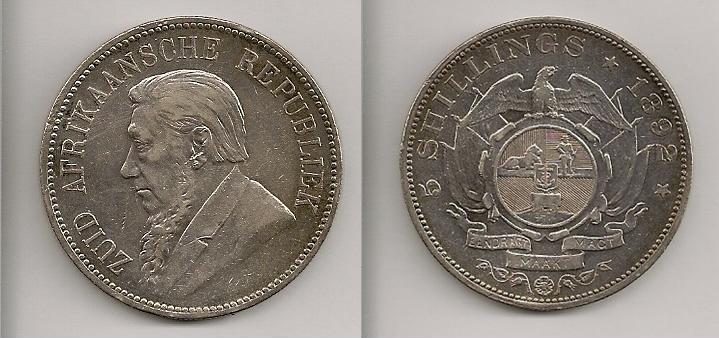


 Posted 08/11/2010 11:35 am


Zarboy Hello. I first of all want to say that from the photos posted - I SEE NO OBVIOUS PROBLEMS.
However, you can take that with a grain of salt because the pictures are actually not good enough for me to see what I would be looking for in person.
But, I can say that this is not one of the junk grade Chinese copies that have flooded the market recently. It could however be one of the Numismatic grade Chinese or even Eastern European forgeries.
I have a couple of questions to begin with.
What was the auction number? - I would like to know who the seller was, where he is located and what he normally handles.
Unfortunately this coin has been forged by the Chinese and there are high quality Numismatic forgeries for sale. I believe (will have to research the facts) that this is one of the types that has been seen in forged ANACS and NGC slabs. So only your trust in the seller really matters in the long run.
The forgeries come in a wide range of qualities. The low end off metal kinds are made to a low standard and usually have wide rims. The wide rim is needed because the molded image shrinks in the transfer process and to get the diameter correct they have to add a small bit to the edge. It leaves a wide rim on the cast coin.
Here is a typical one on ebay right now for $6. The seller is from Hong Kong. In reality the coin will arrive WITHOUT the word REPLICA - I have dealt with the seller before and no coin I have ever purchased has the word actually stamped into the coin. Also notice there has been NO attempt to remove evidence of the use of a ring die to apply the reeding. You can see the reed ends at the edge - check the area near ZUID for example.

I do not see a really wide rim on your coin but I am always suspicious of any coin where there is a collar seam even slightly evident.
The forgeries that are most common are the single shaft but there is a Numismatic quality forgery of the double shaft coin as well.
The silver content in the Numismatic copies does vary with SGs as low as 10.1 and as high as 10.4 depending on what silver is on hand to make the casting.
Most copies even numismatic do use a ring die application of reeds because the coins are CAST. Cast edge reeds are hard to duplicate. Do not interpret this to mean a rough or easily spotted casting. The casting process in use to create Numismatic forgeries can easily copy die erosion lines. Look for subtle clues and especially mint luster preserved in protected areas of the coin. Also because EVERYTHING is copied look for small dents and dings in the surface where there is NO OBVIOUS IMPACT damage. When a coin is dented the DENT LOOKS DIFFERENT than the adjacent areas. The change in surface texture is due to the force of the impact. Look for this difference.
I don't want to be a wet blanket BUT PLEASE examine it VERY CLOSELY when it arrives. Do not let your wish that the coin is real cloud your judgement. There is likely too much money involved to pass it by as GOOD ENOUGH.
However, you can take that with a grain of salt because the pictures are actually not good enough for me to see what I would be looking for in person.
But, I can say that this is not one of the junk grade Chinese copies that have flooded the market recently. It could however be one of the Numismatic grade Chinese or even Eastern European forgeries.
I have a couple of questions to begin with.
What was the auction number? - I would like to know who the seller was, where he is located and what he normally handles.
Unfortunately this coin has been forged by the Chinese and there are high quality Numismatic forgeries for sale. I believe (will have to research the facts) that this is one of the types that has been seen in forged ANACS and NGC slabs. So only your trust in the seller really matters in the long run.
The forgeries come in a wide range of qualities. The low end off metal kinds are made to a low standard and usually have wide rims. The wide rim is needed because the molded image shrinks in the transfer process and to get the diameter correct they have to add a small bit to the edge. It leaves a wide rim on the cast coin.
Here is a typical one on ebay right now for $6. The seller is from Hong Kong. In reality the coin will arrive WITHOUT the word REPLICA - I have dealt with the seller before and no coin I have ever purchased has the word actually stamped into the coin. Also notice there has been NO attempt to remove evidence of the use of a ring die to apply the reeding. You can see the reed ends at the edge - check the area near ZUID for example.
I do not see a really wide rim on your coin but I am always suspicious of any coin where there is a collar seam even slightly evident.
The forgeries that are most common are the single shaft but there is a Numismatic quality forgery of the double shaft coin as well.
The silver content in the Numismatic copies does vary with SGs as low as 10.1 and as high as 10.4 depending on what silver is on hand to make the casting.
Most copies even numismatic do use a ring die application of reeds because the coins are CAST. Cast edge reeds are hard to duplicate. Do not interpret this to mean a rough or easily spotted casting. The casting process in use to create Numismatic forgeries can easily copy die erosion lines. Look for subtle clues and especially mint luster preserved in protected areas of the coin. Also because EVERYTHING is copied look for small dents and dings in the surface where there is NO OBVIOUS IMPACT damage. When a coin is dented the DENT LOOKS DIFFERENT than the adjacent areas. The change in surface texture is due to the force of the impact. Look for this difference.
I don't want to be a wet blanket BUT PLEASE examine it VERY CLOSELY when it arrives. Do not let your wish that the coin is real cloud your judgement. There is likely too much money involved to pass it by as GOOD ENOUGH.


