Coin Community Family of Web Sites Join Thousands of Coin, Bullion, & Money Collectors
Vancouvers #1 Coin and Paper Money Dealer Shop for APMEX Bullion on eBay!Royal Canadian Mint products, Canadian, Polish, American, and world coins and banknotes. Specializing in Modern Numismatics Coin, Banknote and Medal Collectors's Online Mall 300,000 items to help build your collection! Join Thousands of Coin, Bullion, & Money Collectors


Username:
Password:
Save Password
Forgot your Password?


This page may contain links that result in small commissions to keep this free site up and running.

Welcome Guest! Registering and/or logging in will remove the anchor (bottom) ads. It's Free!

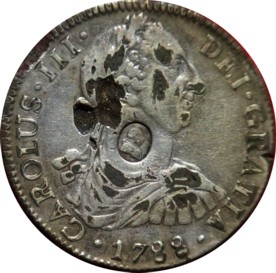
Counterfeit 1788 Mexico 8R With George III C/S

To participate in the forum you must log in or register.
Author Previous TopicReplies: 1 / Views: 2,356Next Topic  
Valued Member
Pistareen's Avatar
United States
309 Posts
 Posted 09/04/2010  9:25 pm Show Profile   Bookmark this topic Add Pistareen to your friends list Get a Link to this Message Number of Subscribers
Let me join the discussion of contemporary countfeit Spanish Colonial coins. This coin was dug from a War of 1812 site along the Hillsboro River in P.E.I., Canada. The coin purports to be a 1788 8 reales of Mexico with 1797 4 shilling, 9 pence counterstamp. It is bogus, but quite well made. It weighs 24.9 grams. Would anyone know whose work this is and when it was fabricated?

Counterfeit-1788-Mexico-8R-With-George-III-C/S
Pillar of the Community
swamperbob's Avatar
United States
5362 Posts
 Posted 09/06/2010  7:25 pm  Show Profile   Bookmark this reply Add swamperbob to your friends list Get a Link to this Reply
Pistareen Most counterfeit collectors would refer to it as a "Birmingham" type coin. We have discussed the subject several times, but to cover the high points.

The 8R you have appears to be a Sheffield Plate variety. The Sheffield Plating process was developed in England around 1770. The process involves rolling a three metal sandwich (2 silver layers that are 900 fine on the outside and copper or some other base metal as the center) under high pressure and causing the three layers to bond. They start with small ingots and roll the material to the desired thickness before cutting it into round blanks.

This method of producing planchets allowed a proper color metal to be struck with forged dies. But the silver content was minimal. It was a huge improvement over the cast or struck debased silver coins of the era immediately preceding. It was not replaced as the counterfeiters metal of choice until about 1840 when first German Silver and then Electroplating were introduced.

The Birmingham emission (the high quality copies) started as a war effort in the 1796 when England and Spain were at War, once again. At that time several different date Portrait 8Rs were forged with the approval or at least tacit approval of the English Crown. These coins were shipped to the orient to attempt to destabilize the Spanish trade but the effort failed. The Chinese adopted the practice of Chopping coins precisely to identify this type of fake.

The dies were however EXCELLENT copies and they were NOT destroyed. The Birmingham craftsmen KEPT THEM.

The war with Spain ultimately caused a silver shortage for England because the Spanish Colonies were the primary source for silver world wide. This caused a financial emergency in England, leading to the restamping of old 8Rs with the punch in question. This happened about 1804. The restamped coins were stamped with a HIGHER than silver value so that they would not be hoarded. They were a Token coinage.

At some point in the emergency some of the Birmingham firms brought out their old 8R dies and made a fake punch of George. These coins PROLIFERATED because of the monetary shortage. Other forgers making lower quality copies joined in. It finally resulted in an Act of Parliament finally making counterfeiting of Foreign coins illegal. Intrinsic full value coins were never seen in circulation in this period and the worn, clipped and counterfeit specie acted as a Token currency for most Poor English citizens.

From my understanding of the way things worked, the English banks and merchants pulled many of the good fakes out of circulation but instead of destroying them - they were dumped on the various colonies for their use. I suspect that is how your coin got to Canada ca. 1812. I read a story someplace in an old Numismatist that the coinage in circulation in Canada at one time exceeded 50% counterfeit. I am working only from memory (my back issues of the Numismatist are still packed) but the fact that HALF of the money in circulation was fake has stuck in my memory.

To a lesser extent the same thing happened in the US colonies. Money (silver and gold) was in SHORT SUPPLY and counterfeits often filled a void of sorts.

So to summarize a very long answer - Based on the limited detail I can see in the picture - your forgery was made in England (possibly Birmingham) shortly after 1804.
  Previous TopicReplies: 1 / Views: 2,356Next Topic  

To participate in the forum you must log in or register.


Disclaimer: While a tremendous amount of effort goes into ensuring the accuracy of the information contained in this site, Coin Community assumes no liability for errors. Copyright 2005 - 2026 Coin Community Family- all rights reserved worldwide. Use of any images or content on this website without prior written permission of Coin Community or the original lender is strictly prohibited.
Contact Us  |  Advertise Here  |  Privacy Policy / Terms of Use

Coin Community Forum © 2005 - 2026 Coin Community Forums
It took 0.18 seconds to rattle this change. Forums