| Author |
 Replies: 15 / Views: 3,642 Replies: 15 / Views: 3,642 |
|
|
Valued Member
United States
176 Posts |
1929 $20 Nat. Curr. Type 2   1953A $5 Red Seal  2006 $10 RADAR  2006 $5 Doubles  2003A $1 Mini Repeater  and since everyone here seems to be obsessed with Barr notes... here's 1 of 5.  Just a few of my faves. Haven't been collecting very long but have enjoyed it even if the collection isn't anything extraordinary. |
|
|
|
Valued Member
United States
160 Posts |
Nice notes! Is it true that for some of those national bank notes, there are only a couple known to exist?
|
|
Valued Member
 United States
176 Posts |
Quote:
Nice notes! Is it true that for some of those national bank notes, there are only a couple known to exist? I don't know a whole whole lot about them, but have read that all banks were given the opportunity to print their own, so depending on the bank and their demand, I'm sure some printed a minimal amount. As you can see, the serial number for this one would seem low, but if they only printed 400 then it's really quite high! The Federal Bank 1929 series printed in much greater quantities. |
|
Pillar of the Community
3660 Posts |
Yes it is quite true that some of the National Bank notes are unique. There are also notes of this nomenclature that are quite common with upwards of 100 known to exist. Some bank names may have only one large size note known to exist, but many dozens of the small size extant. Some bank names may have only one large size $100 note existing, and 70 small size twenties. Some bank names issued only large size notes, some banks issued only small size. Many banks issued both, Many banks that issued notes have no known surviving specimens at all. No, it is quite untrue that: Quote:
all banks were given the opportunity to print their own, so depending on the bank and their demand, some printed a minimal amount. In order for this to occur, all banks would need to own their own set of plates and presses. Only the U.S. Government printed these notes, (and actually 'owned' them, as they do with currency of today). These National Bank Notes 'could' be considered nothing more than IOUs between the bank and the U.S. Government. The following is how a bank was able to acquire banknotes with their names printed on them: From a previous thread: Quote:
National Bank Notes were first issued (via charter) in 1863 (as large size notes) under the National Banking Act of that same year. The notes were printed by the US government and issued to private banks across the nation. These private banks were required to deposit government bonds with the Treasury in order to be issued NBNs. The bank could then circulate NBNs up to 90% of the face value of the bonds that they had on deposit at the Treasury. If a bank were to fail, and many did, the NBN became an obligation of the US Government rather than the failed bank (however, the failed bank lost all interest in its bond on deposit). This relationship between the government and the private banks continued until the government no longer renewed the charters with these private banks after 1929. |
|
Pillar of the Community
United States
4541 Posts |
|
|
Valued Member
United States
458 Posts |
I love the Shamokin, P.A note. My parents and granparents were from Shamokin. Still have some family there today.
|
|
Valued Member
United States
458 Posts |
iamkayelem, can you P.M me your email?
|
|
Valued Member
United States
176 Posts |
apparently I need 50 posts to PM
|
|
Pillar of the Community
3660 Posts |
If you are looking for one of these Shamokin notes bvalania, they are not scarce, I think I know where a couple of them are, and can put you in touch if you wish.
|
|
Pillar of the Community
3660 Posts |
|
|
Pillar of the Community
3660 Posts |
Quote:
Is it true that for some of those national bank notes, there are only a couple known to exist? Yes it is true. As a matter of fact, here is a bank from which only one small size note remains, and this is it. 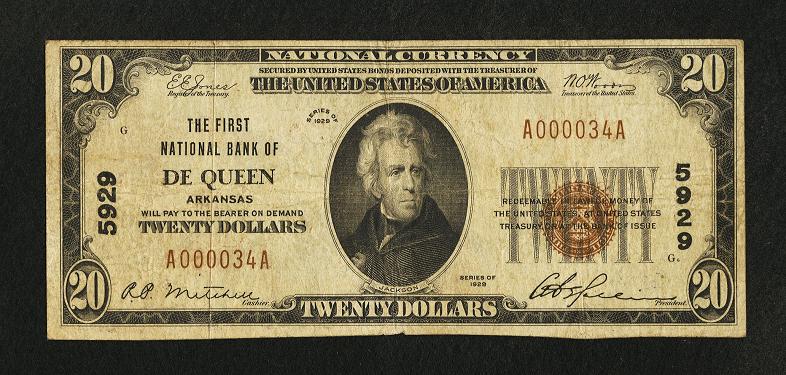 The most interesting thing about this note is that I have heard that the founding fathers (Bocefus Jackson and Lamar Beauregard) wanted to name this small southern town in honor of the Queen of England, but didn't know how to spell Victoria.  Edited by zeewool
09/15/2010 07:26 am
|
|
Valued Member
United States
160 Posts |
 hahaha very funny story! I always love it when notes have some history behind them. |
|
Pillar of the Community
3660 Posts |
My information was outdated. Updated information says this bank now has four known small size notes as someone was sitting on three of them. Such is life.
|
|
Pillar of the Community
United States
1397 Posts |
Quote:
The most interesting thing about this note is that I have heard that the founding fathers (Bocefus Jackson and Lamar Beauregard) wanted to name this small southern town in honor of the Queen of England, but didn't know how to spell Victoria. Actually De Queen and many other towns were named by Arthur Stilwell in the late 1800s. These towns were the product of the Kansas City Southern Railway that Stilwell was the founder and builder of. He named towns along the line after investors, co-workers, himself, and family members. His vision was to connect Kansas City to the Gulf of Mexico by rail, he began building and acquiring rail lines for the Kansas City, Pittsburg and Gulf Railroad Company (later to become the Kansas City Southern Railroad), plotting townsites along the way which included Mena Arkansas, Stilwell Oklahoma, Port Arthur Texas, De Queen Arkansas, and many more. Stilwell and his crew purposely missed established towns while laying out the railroad, as their money came from land speculation, not rail traffic, hence the reason he was able to establish and name so many towns. The actual town of De Queen was named when an economic depression beginning in 1893 which dried up sources of American capital needed for the railway's completion, Arthur was forced to seek outside investors from Holland for the project to continue on. Stillwell, in 1894, contacted Jan DeGeoijen who was a coffee broker he had met on a previous trip to Europe. He convinced DeGeoijen to support the project and in a few months the two managed to raise $3 million dollars, a tidy sum of money in the late 1800s. De Queen which had its roots in a tent settlement called Hurrah City was named in honor of DeGeoijen, but Since no one could pronounce his Dutch name they called him "Jack De Queen". The rest is history. |
|
Pillar of the Community
United States
1397 Posts |
Oh and one more thing, the newspaper for De Queen is De Queen Bee. In case anyone was interested... |
|
Pillar of the Community
3660 Posts |
Humph.....I don't like your version of the story Nick, it is just too believable. |
| |
Replies: 15 / Views: 3,642 |
|










 Posted 09/13/2010 11:33 pm


