











 Posted 09/24/2010 12:17 am


Some background..
The Continental Congress wished to bestow medals on some officers and generals of some of the battles fought ousting the British. Benjamin Franklin was an Ambassador in France at the time and knew some of the engravers, so he proceeded to start the process along. (He had a heck of a time getting it finished - Thomas Jefferson and Colonel David Humphreys had to get involved before they were all finished.)
Brigadier General Daniel Morgan's medal was to be in gold. There was another set of the medals presented to President Washington, all in silver. The US Mint has been striking them in bronze to the present day, but also put out sets in pewter in honor of the upcoming bicentennial in 1976 (most books I've seen that go with the set have been dated 1973). The one that sold for 80K was probably from the silver set, or they had made a few more sets at the time this book does not mention. It also doesn't have any weights listed for the gold or silver pieces.
Translation of inscription:
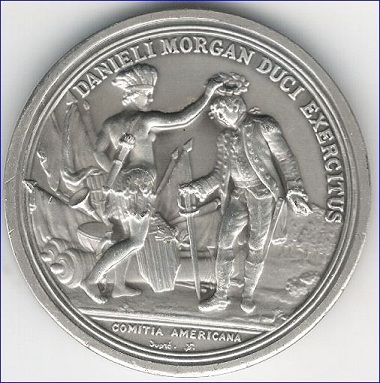
Obverse: The American Congress to the Commander of the Army Daniel Morgan
Reverse: Victory, defender of liberty -- The enemy put to flight, captured, or slain at Cowpens, January 17, 1781.
Design:
Obverse: America, distinguishable by her scutcheon, rests her left hand on a trophy of arms and flags, and with her right hand crowns the General who bows before her.
Reverse: General Morgan at the head of his army charges the enemy who takes to flight.
The others in the set are:
General George Washington, For the liberation of Boston, 1776
Major General Horatio Gates, For the victory at Saratoga, 1777
Brigadier General Anthony Wayne, For the victory at Stony Point, 1779
Lieutenant Colonel Louis De Fleury, For the storming of Stony Point, 1779
Major John Stewart, For the storming of Stony Point, 1779
Major Henry Lee, For the attack on Paulus Hook, 1779
Captain John Paul Jones, For the capture of the Serapis, 1779
Lieutenant Colonel William A. Washington, For the victory at Cowpens, 1781
Lieutenant Colonel John Eager Howard, For the victory at Cowpens, 1781
Major General Nathanael Greene, For the battle at Eutaw Springs, 1781
The Continental Congress wished to bestow medals on some officers and generals of some of the battles fought ousting the British. Benjamin Franklin was an Ambassador in France at the time and knew some of the engravers, so he proceeded to start the process along. (He had a heck of a time getting it finished - Thomas Jefferson and Colonel David Humphreys had to get involved before they were all finished.)
Brigadier General Daniel Morgan's medal was to be in gold. There was another set of the medals presented to President Washington, all in silver. The US Mint has been striking them in bronze to the present day, but also put out sets in pewter in honor of the upcoming bicentennial in 1976 (most books I've seen that go with the set have been dated 1973). The one that sold for 80K was probably from the silver set, or they had made a few more sets at the time this book does not mention. It also doesn't have any weights listed for the gold or silver pieces.
Quote:
For the "complete and important victory over a select and well appointed detachment ...British troops," Congress resolved on March 9, 1781 to present Brigadier General Morgan with a gold medal. Already in 1783, Morgan became impatient waiting for the medal and tried to solve matters by himself. But only in November 1785 did Colonel Humphreys give Morgan's name to the French Academy. The American specifications called for a special emphasis in the inscription on the number of killed, captured, or wounded. In December, the Academy made its proposals leaving open the figures which had to be obtained later, complaining that "this was not a style and manner in which such medals were executed." Disagreements in the United States about the final form of the inscription delayed even further the production of this medal to which hinged, through association, also those of William Washington and J. E. Howard.
Only in January 1789, did Thomas Jefferson succeed to pry it loose approving a simple and more general inscription proposed by the Academy. At the same time he contracted Augustin Dupre' for the engraving, with the understanding that the medals should be struck before the 15th of April. A series of sketches by Dupre' have survived showing the constant changes introduced by the artist or by Jefferson before the medal could reach its final form.
In spite of the endless delays, Morgan's medal may certainly be considered as one of the finest artistic creations in the whole series. The French artist succeeded to capture in a masterful way the powerful motion of the attack accentuating its dramatic impact.
For the "complete and important victory over a select and well appointed detachment ...British troops," Congress resolved on March 9, 1781 to present Brigadier General Morgan with a gold medal. Already in 1783, Morgan became impatient waiting for the medal and tried to solve matters by himself. But only in November 1785 did Colonel Humphreys give Morgan's name to the French Academy. The American specifications called for a special emphasis in the inscription on the number of killed, captured, or wounded. In December, the Academy made its proposals leaving open the figures which had to be obtained later, complaining that "this was not a style and manner in which such medals were executed." Disagreements in the United States about the final form of the inscription delayed even further the production of this medal to which hinged, through association, also those of William Washington and J. E. Howard.
Only in January 1789, did Thomas Jefferson succeed to pry it loose approving a simple and more general inscription proposed by the Academy. At the same time he contracted Augustin Dupre' for the engraving, with the understanding that the medals should be struck before the 15th of April. A series of sketches by Dupre' have survived showing the constant changes introduced by the artist or by Jefferson before the medal could reach its final form.
In spite of the endless delays, Morgan's medal may certainly be considered as one of the finest artistic creations in the whole series. The French artist succeeded to capture in a masterful way the powerful motion of the attack accentuating its dramatic impact.
Translation of inscription:
Obverse: The American Congress to the Commander of the Army Daniel Morgan
Reverse: Victory, defender of liberty -- The enemy put to flight, captured, or slain at Cowpens, January 17, 1781.
Design:
Obverse: America, distinguishable by her scutcheon, rests her left hand on a trophy of arms and flags, and with her right hand crowns the General who bows before her.
Reverse: General Morgan at the head of his army charges the enemy who takes to flight.
The others in the set are:
General George Washington, For the liberation of Boston, 1776
Major General Horatio Gates, For the victory at Saratoga, 1777
Brigadier General Anthony Wayne, For the victory at Stony Point, 1779
Lieutenant Colonel Louis De Fleury, For the storming of Stony Point, 1779
Major John Stewart, For the storming of Stony Point, 1779
Major Henry Lee, For the attack on Paulus Hook, 1779
Captain John Paul Jones, For the capture of the Serapis, 1779
Lieutenant Colonel William A. Washington, For the victory at Cowpens, 1781
Lieutenant Colonel John Eager Howard, For the victory at Cowpens, 1781
Major General Nathanael Greene, For the battle at Eutaw Springs, 1781
Edited by xshift
09/24/2010 12:19 am
09/24/2010 12:19 am


