Sorry, guys, but this is another jewellery imitation, just like
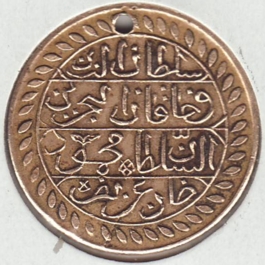
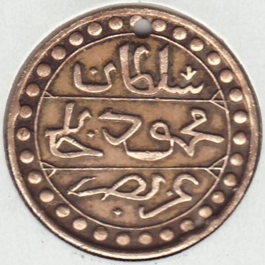
the one alanbagerap posted, only slightly better in execution. The coins are loosely copied from the designs found on Ottoman Algerian coins from the 1800s; the lettering is slightly garbled and hard to read, but the named sultan on both sides is Mahmud II.
The reason finding a date is so hard is because this "coin" doesn't have one; It's actually a "two-headed" imitation, and the coins they are derived from had the dates on their reverses. The side with four lines of script (top pic) is copied from the obverse of a
silver budju (KM# 68). The three-line side is from the fractional coins, like the 1/4 budju (KM 67) or
1/8th budju (KM 74) of the same time period.
Needless to say, it's not likely to be made of gold. Gold-plated is the best you could hope for, but brass is more likely.
Quote:
I see dates like AH1187///(119)7 in the coin book. Can you explain this date notation?
I assume you're looking in the 1700s Krause under Egypt, say KM# 127? In this case, "1187" is the date on one side (in Arabic numerals) and the number "7" appears on the other side. "1187" is the year in which that particular sultan, Abdul Hamid I came to power, while "(119)" is there to tell you that, unlike most Ottoman coins, the "7" in this instance actually is short for 1197, and is the actual year in which that coin was struck.
Don't say "infinitely" when you mean "very"; otherwise, you'll have no word left when you want to talk about something really infinite. - C. S. Lewis











 Posted 10/04/2010 4:13 pm


