Well, the display here covers pretty much the entire spectrum of the coinage history of Afghanistan. Here's a few of what I can make out:
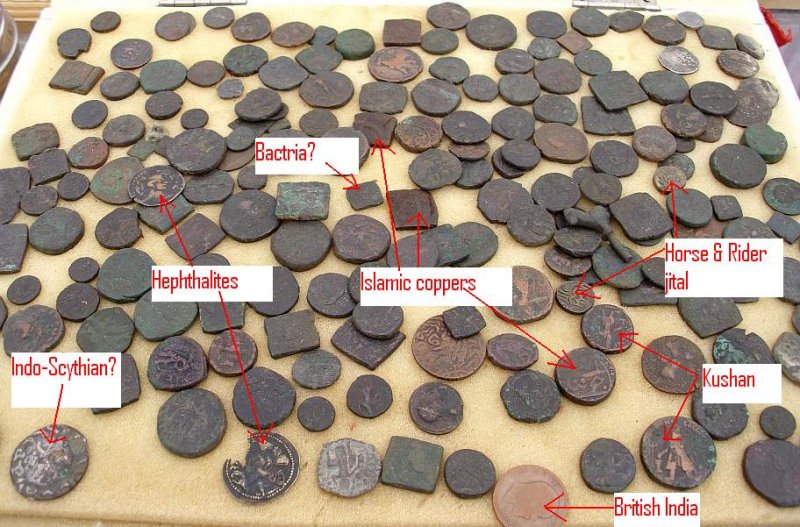
The oldest one there might be Bactrian, struck by Alexander the Great's succcessors in Afghanistan 300 - 100 BC. Unfortunately, I can't confirm any Bactrian for sure, but the zoomed in pic of the highlighted one looks promising.
The Indo-Scythians (100 BC - 100 AD) ruled after the Bactrians were kicked out; their coins were similar in style, though becoming cruder and less "Greek".
The ones I've labelled "Kushan" are from the Kushan Empire,which ruled Afghanistan in ancient times (100 - 300 AD). There are other Kushan coins on the table, these two are the clearest and most prominent.
The "Hephthalites", known to us more commonly as the Huns, struck coins like these circa 400 - 500 AD.
The Horse and Rider jitals were struck in the period 800 - 1100 AD, gradually becoming less and less horse-like. These look crude, perhaps post-Islamic Conquest types.
There are quite a few Islamic types; these would date from the 1600s to the 1800s. Mostly copper, though that appears to be a couple of Islamic silver coins in the top right corner.
The British India coin is of King Edward VII, early 1900s.
All the coins appear genuine to me. Or, I should say, I can't see any obvious fakes from the photo. They look pretty much like Afghani coins you'd see on a coin dealer's tray in the West. I own several similar to most of the types I've highlighted.
A few things to note. Technically, buying, selling and exporting ancient coins (defined as "anything older than 1748") from Afghanistan is illegal without a permit. But, as you are no doubt all too keenly aware, Afghanistan is pretty lawless right now. Afghanistan's
antiquities laws date from 1958, well before the troubles there started. These days the authorities probably have better things to do than harassing visitors over a few coins, but they would have legal reason to confiscate them if detected on exiting the country.
The converse side is of course, uncertainty over the use the funds from sale of these antiquities is put to. Militias and terrorist groups are known to use the sale of plundered and stolen antiquities to help fund their cause.
Don't say "infinitely" when you mean "very"; otherwise, you'll have no word left when you want to talk about something really infinite. - C. S. Lewis







 Posted 11/07/2010 11:16 am





 to the community


