| Author |
 Replies: 13 / Views: 3,776 Replies: 13 / Views: 3,776 |
|
|
Valued Member
United States
167 Posts |
In AD 293, Constantius, newly appointed Caesar of the west in Diocletian's Tetrarchy, was assigned the task of removing Carausius, the usurper Augustus of secessionist Britain, and restore that former possession to the Empire. Constantius thereupon set about planning the invasion, occupation and restoration of Britain to the Empire. One of the first orders of business for Constantius was to insure that a supply of reformed aes coinage - now the commonplace legal tender of the Roman Empire - was available for use not only by his occupying force, but also by the British civilian populace. To that end Constantius established a Continental Mint (exact location unknown), manned by Lugdunese workers, to produce this invasion coinage - issued in the names of Diocletian & Maximian Herculius as Augustus and Constantius & Galerius Maximian as Caesar. This coinage is characterized by right facing laureate heads with the long laurel wreath ribbon laying on the neck. The Genius of the Roman People reverse with the legend GENIO POPVLI ROMANI is standard and bears no mint mark. Genius is depicted standing, head surmounted by modius, naked except for chlamys over left shoulder, holding patera in right hand and cradling cornucopia in left arm. Peripheral legends read clockwise. The inscriptional lettering is relatively large with delicate letterforms. Examples of unknown Continental Mint invasion coinage - RIC Volume VI, Lugdunum, Group I, (iv), folles, Class I, No. 14-21, c. 296, 10.5-8.75 gm, reverse axis 6 or 12 o'clock - Laureate head, right, with bare neck truncation:
 
IMP C DIOCLETIANVS PF AVG ............................. GENIO POPV -- LI ROMANI
RIC VI, Lugdunum, No. 14a - DIOCLETIAN

Actual size of coin
weight: 8.9 grams
* * * * *
 
IMP C MAXIMIANVS PF AVG ............................. GENIO POP -- VLI ROMANI
RIC VI, Lugdunum, No. 14b - MAXIMIAN HERCULIUS

Actual size of coin
weight: 8.8 grams
* * * * *
 
FL VAL CONSTANTIVS NOB C ............................. GENIO POPV -- LI ROMANI
RIC VI, Lugdunum, No. 17a - CONSTANTIUS

Actual size of coin
weight: 9.0 grams
* * * * *
 
C VAL MAXIMIANVS NOB C ............................. GENIO POPV -- LI ROMANI
RIC VI, Lugdunum, No. 17b - GALERIUS MAXIMIAN

Actual size of coin
weight: 8.5 grams
James |
|
|
|
Moderator
 United States
23731 Posts |
Very interesting, thanks for posting.
|
|
Bedrock of the Community
United States
10045 Posts |
Fascinating post!  |
|
Valued Member
 United States
167 Posts |
In 296 Constantius launched a powerful naval invasion force against Britain in two divisions: one led by himself, which sailed from Boulogne and the other led by his Praetorian Prefect, Asclepiodotus, which sailed from the mouth of the river Seine. The forces of Constantius were triumphant and Britain was restored to the Empire. Constantius subsequently entered the city of London to proclaim his conquest as restorer of the eternal light of the Roman Empire. Following are images of a bronze copy of the famous ten aurei multiple (RIC VOLUME VI, TREVERI, No. 34), the original of which presently resides in the museum at Arras, commemorating the restoration of Britain to the Roman Empire by Constantius. The obverse is a bust of Constantius and the reverse depicts the personification of Londinium (LON) kneeling and supplicating to Constantius (on horseback) outside the City Fortification while a galley with Roman soldiers waits on the river Thames. The inscription REDDITOR LVCIS AETERNAE proclaims Constantius as the restorer of the eternal light (of Rome). The Treveri (Trier) mint mark (PTR) is in the exergue.
 
FL VAL CONSTANTIVS NOBIL CAES ...................... REDDITOR LVCIS AETERNAE

Actual size
Bastien records the original (unique) coin as No. 218 in his book on the Arras Hoard and mentions that galvano copies were made and sold by the Paris coin dealer Bourgey. At a weight of 23.0 grams, I think my copy was cast in bronze from one of those galvano copies. James |
|
Moderator
United States
23731 Posts |
Where did you find this? Even though it's a copy I would love to have one.
|
|
Valued Member
United States
167 Posts |
echizento wrote: Quote:
Where did you find this? Even though it's a copy I would love to have one. I bought it at a local coin shop some thirty years ago. I have encountered bronze, silver and gilt copies for sale from time to time over the years (but not frequently) at coin shows and on the Internet. |
|
Pillar of the Community
United Kingdom
2838 Posts |
Great post - like the history included in it |
|
Valued Member
United States
167 Posts |
bobbyhelmet wrote: Quote:
Great post - like the history included in it Thank you. My collecting emphasis is on the historical association of the Britannic coinage of ConstantiusJames Edited by jamesicus
12/21/2010 07:09 am
|
|
Pillar of the Community
United Kingdom
2838 Posts |
I was in the British Museum on Wednesday and tucked away in one of the Roman rooms was a gold ten aurei multiple!  Remembered it from here as soon as I saw it. It was much bigger than I imagined, about 5cms diameter! Stole this image from elsewhere as can not find one of the BM one. 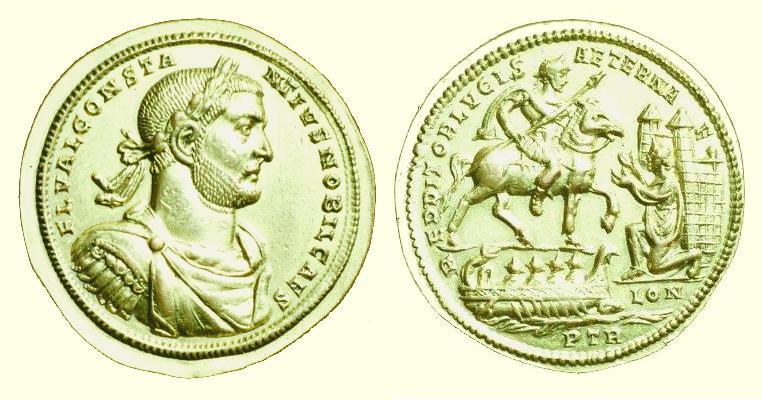 They also had a second more interesting one - they were unsure if it was an original defaced ten aurei or if it was made from scratch, it looked much as the one above does but seemed to commemorate a personal victory for a particular Roman. Contemporary in date it was perhaps made as an expensive curiosity or even as a joke for the commissioner. Does anybody else known the full story of the two I saw? - wasn't much info with them on display and searching the net I've found nothing. Edited by bobbyhelmet
03/01/2011 7:58 pm
|
|
Valued Member
United States
167 Posts |
|
|
Pillar of the Community
United States
1315 Posts |
As a beginner to ancient coins I'm afraid I don't have much to offer as far as knowledge goes, but reading posts like this one is truly inspirational. I'm still looking for an area or era to concentrate on. Leaning toward Greek, but I like Roman too.  It's very exciting. Thanks so much |
|
Valued Member
United States
167 Posts |
Edited by jamesicus
03/31/2011 12:52 am
|
|
Valued Member
United States
167 Posts |
Doucet wrote: Quote:
As a beginner to ancient coins I'm afraid I don't have much to offer as far as knowledge goes, but reading posts like this one is truly inspirational.
I'm still looking for an area or era to concentrate on. Leaning toward Greek, but I like Roman too.
It's very exciting.
Thanks so much Thank you, Doucet. There are many different ways to start off collecting ancient coins and I am not so sure there is a best one. For me, the excitement comes from historical association of the coins. That has been my own collecting mantra throughout the years. Of course that means a lot of reading but it makes for exciting collecting and really brings the coins to life. You have to be careful though -- for instance, if you start collecting coins associated with the assassination of Julius Caesar you are going to spend a lot of money real fast -- even for coins in mediocre condition. If you do go the route of collecting ancient coins due to their historical association and you want to concentrate on a particular period, I suggest you start with the era of Constantine the Great -- the coins are readily available in good condition at reasonable prices and there are numerous books (and online articles via Google) available -- plus the period is a fascinating study. James Edited by jamesicus
03/31/2011 01:38 am
|
|
Valued Member
United States
90 Posts |
Great History, Very Inspirational.
Just got a new book on the works of Josephus, time for my next history lesson.
Thanks jamesicus for the awesome history, I will be looking for more.
|
| |
Replies: 13 / Views: 3,776 |
|







 Posted 12/12/2010 1:48 pm





