| Author |
 Replies: 12 / Views: 7,839 Replies: 12 / Views: 7,839 |
|
|
Pillar of the Community
United States
1204 Posts |
I got last month a lot of 2 100 dollar bills with back plate numbers 76, 73 from new York and Philadelphia federal reserve notes also 3 50 dollar bills with plate numbers 112 , 103 , 40 New York ,new York and Philadelphia . How can I identify them if are they mule or not ? Is the back plate number the only reference we have or is also something about the serial number ? They are all in very good condition is worth to pay to grade or not ? Please help me guys !?
|
|
|
|
Pillar of the Community
 United States
1204 Posts |
Almost forget the notes I have are all from 1934 federal reserve light green seal notes !
|
|
Pillar of the Community
3660 Posts |
A mule is identified by the font size of the plate numbers on the face and back of the note....If the height size of the numbers on the face and back are the same, it is not a mule.....If the numbers differ in physical size, the note is a mule.
The reason that these notes are called mules is the same that a mule is called a mule....But, mate a horse with a donkey and the result is a mule.... mate a horse with a horse, and the result is a horse, (two donkeys result in a donkey)....... mate a large font with a small font and the result is a mule....the matings of two large fonts or two small fonts result in a non mule.
|
|
Pillar of the Community
3660 Posts |
Originally, all plate numbers were half a millimeter tall, but in 1938 (series 1934-1934A) this was doubled to one millimeter.....The existence of mules was not a concern of the BEP (being such a trivial thing) in the earlier days of small size notes, so either large, small, or both were used and that is why they exist.
Mules were quite common for small size green seal FRN from 1938 up through the early 1940s...After the mid 1940s, no mules were printed in the $5, $10, or $20 denominations, and the reason for this was that the back plates were retired gradually as opposed to face plates that were retired with series changes.....$50 and $100 notes were printed in few quantities (especially the $50s), and the back plates lasted longer, and so mules were printed for these two denominations up until 1953.
In 1952, the sheets that notes were printed on changed from 12 notes per sheet to 18.....For series 1950, all $50 notes printed on 12 note sheets used the smaller sized numbers, while all series 1950A $50 notes printed on 18 note sheets used the large (new) size plate numbers.....All $50 notes from series 1934A to series 1950 are mules....All $50 notes printed for series 1950A are non mules.
Some $100 notes exist from series 1934A through series 1950 as non mules, but they are scarce.
The above relates only to $50 and $100 notes as you mentioned....All other denominations have both mule and non mule types, but the specific change overs are quite different.
|
|
Valued Member
United States
268 Posts |
Thanks for the information Zeewool. I was wondering what a mule was. I am pretty new to collecting my self and still have alot to learn. Thanks again for the info.
|
|
Pillar of the Community
United States
1397 Posts |
Zee, I have been staring at these 4 consecutive notes trying to figure out what exactly what "Mule Change Over" means, but haven't been able to make any sense of it. At first I thought that some would be mules and some not, Front plates are A,B,C,D, (can't make out the exact numbers) but they all seem to have the same back plate 6115 except one that just doesn't say. Try as I might I just can't find a back plate number on these notes. My BE's have the back plate number located in the lower right of the interior non-printed area. These don't seem to be there. While searching for an answer to this I ran across the following... Quote:
The Black Eagle MULE note has been defined as an original Bureau of Engraving and Printing error note.
It is considered an error because of the fact that the wrong rear plate was utilized in regards to a specific front plate during the printing process. This error was undetected for decades...
234 mule has Elliott-Burke front plate and White back plate 64 known
235 mule has Elliott-White front plate and Burke back plate 254 known
236 mule has Spellman-White front plate and Burke back plate 105 known
Only the FR-234, 235, 236 Black Eagles can be defined as Mules.
Mule notes are identified by the change in location of the rear plate number when White came into office. OK, if they changed the location... where is it? Could you shed some light on this for me? 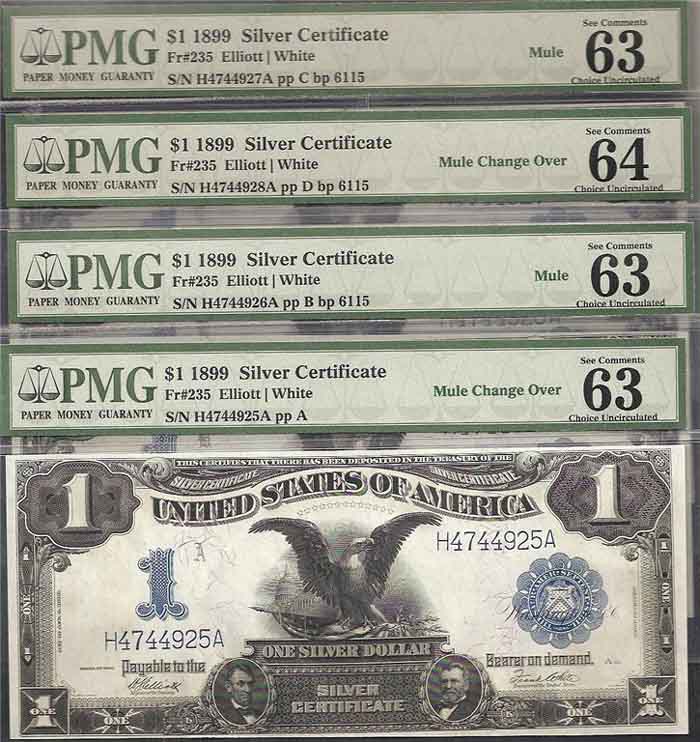 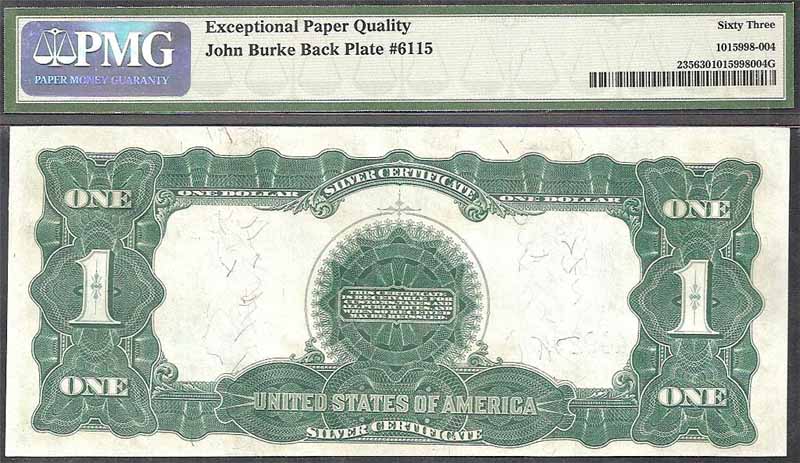 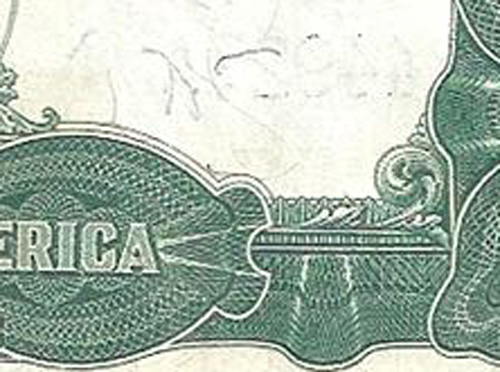 *EDIT* These are a cut sheet with the back plate of Burke according to the person selling them. But the other issues are still a mystery to me. Edited by Nickelman
12/23/2010 10:36 am
|
|
Pillar of the Community
3660 Posts |
Is it not here? 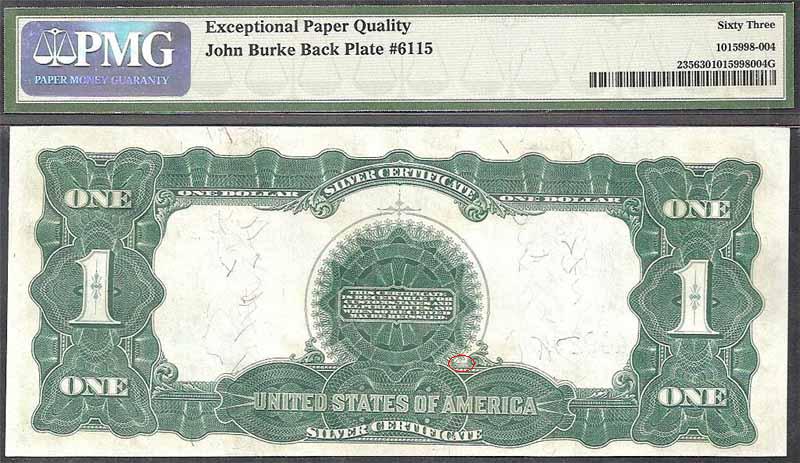 edited to add: I drew a little red circle around where it should be....I didn't realize how little that circle was until I had already posted...(look for the little red circle). Edited by zeewool
12/23/2010 11:39 am
|
|
Pillar of the Community
United States
1397 Posts |
lol yes it is, now what the heck does the "Mule Change Over" mean?
|
|
Pillar of the Community
3660 Posts |
You are getting a little deep into something that I consider to be just a bunch of hype Nick...
I think it is supposed mean the point at which the location of the plate number changed location, but if that is the case, why would pp-A be a changeover, pp-B not be, pp-C be a changeover again, and pp-D not be again? How many back and forth changeovers are possible (or even realistic)? I really don't think that the BEP was that fickle as to keep changing their minds 254+ times as to where they wanted the back plate number.
I rather think that it similar to the change in the FR-229 face where the series designation changed from under the SN to the right vertical side..... only like I mentioned earlier with small sized notes, the back plates do not change with the series as do the face plates....a face plate change is immediate and will not be intermingled with older faceplates..... some of the older back plates are still serviceable, and can be used while the new (number location) back plates are being phased in.....(I am not really buying that changeover jazz)....
I prefer to look at it as a sheet where both old and new style of (plate number location) plates were used.... No big deal to me.....But...I am not all knowing, and so a serial number census including back plate locations could be useful in determining if I am correct or not.
|
|
Pillar of the Community
United States
1397 Posts |
Thanks for the responses, I'm glad I am not the only one confused by all this. First, supposedly these are from the same sheet, did notes from this time have consecutive numbers on a sheet? Second, why would all the notes use the same back plate and different front plates? That makes no sense to me. Third, I only posted one picture of the back of the notes, but all have the plate number in the same location.  |
|
Pillar of the Community
3660 Posts |
Quote:
First, supposedly these are from the same sheet, did notes from this time have consecutive numbers on a sheet? Yes, that is definitely how they were printed....Four note sheets, pp-A at the top, pp-D at the bottom....serial numbered sequentially. Quote:
Second, why would all the notes use the same back plate and different front plates? That makes no sense to me.
Third, I only posted one picture of the back of the notes, but all have the plate number in the same location. It makes no sense to me either Nick, but from what I gather, back plate numbers were not unique to individual plates then (as they are now), but a sheet was assigned a set of four plates (with the same back plate number).....All notes on the same sheet would necessarily have the same back plate number, and other sheets could also use this same set of plates....The rationale for this totally escapes me....This is my understanding of it anyway. |
|
Valued Member
United States
268 Posts |
I am new to collecting so let me get this straight. Those notes were printed 4 to a sheet. The question that I have were these individual plates for each note, front and back, or were there one plate that had all four on it. I could see what would happen if they used individual plates for each note.
|
|
Pillar of the Community
3660 Posts |
That is an excellent question Johnny, and I just learned the answer to that yesterday.... Yes, the plate was large and had four notes on it, hence the same plate number on all notes on the sheet.
|
| |
Replies: 12 / Views: 7,839 |
|








 Posted 12/22/2010 1:48 pm


