|
This page may contain links that result in small commissions to keep this free site up and running.

Welcome Guest! Registering and/or logging in will remove the anchor (bottom) ads and the security checks. It's Free!
To participate in the forum you must log in or register. | Author |
 Replies: 7 / Views: 2,872 Replies: 7 / Views: 2,872 |
|
|
Valued Member
Australia
112 Posts |
Hi, I recently bought a 1966 decimal Currency Herritage set that contained a 1c, 2c and silver round 50c coin. The 2c coin has an interesting feature. Below the base of the neck and to either side, where the coin has a mirror like finish it appears there is some ripplink, like water rippling or like the inside of one of those jamacan drums.... you can just make it out in the scan it looks bumpy and its very hard to see on the coin but when the light hits it its very clear, I've never seen anything like it before on a proof coin... any ideas? 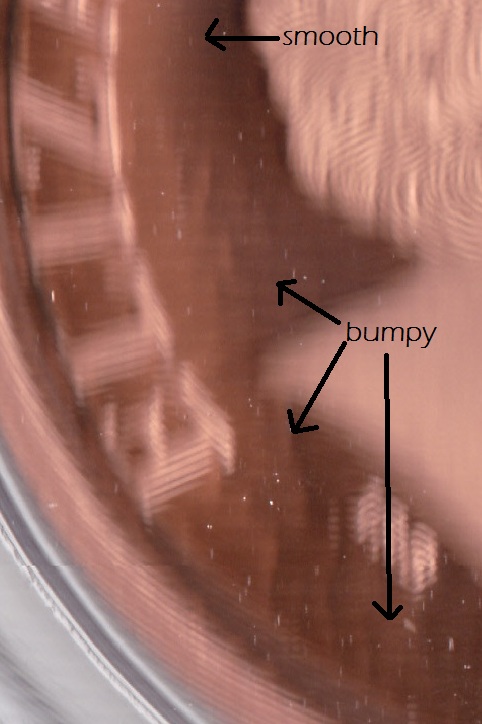 |
|
|
|
Pillar of the Community
Australia
1295 Posts |
Quite often the mirrors of proof coins are not quite flat, and certain photographical techiniques make this quite obvious. That being said I'll check out my partners 2010 heritage set and see if her 2c shows the same features.
|
|
Valued Member
Australia
121 Posts |
Hello , Guys!
I am in market for a 2010 Heritage Set. If you have any offers please PM me!
Cheers,
ZIC
|
|
Bedrock of the Community
Australia
21792 Posts |
I have quite a lot of experience at car detailing.
I am also a gem facetor, where I use 50,000 or 100,000 grade diamond paste to achieve polished facets in cut stone.
With more modern cars, it is often found that the paint surface has an 'orange peel' effect, that is the result of a thick clear coat layer over the metallic paint colour layer. This thick layer allows for buffing during ownership over the years to restore a shiny surface and to remove fine 'spider web' scratches, most often seen with black cars in sunny conditions.
The analogy with proof coins is obvious to me. When a die surface field is prepared, it is polished with what appears to me to be about 25,000 grade diamond dust. However, the surface has undulations in it, much like the 'orange peel' effect that occurs in the clear coat surface of new cars.
This lumpy type of surface has a much larger scale of relief, 'topography', if you like, than the diamond dust, and so a shiny, but lumpy surface in the field of the polished die remains.
You may be prompted to ask "why not remove the lumpy surface of the die with coarser diamond dust, before final polishing?" If you did that, some of the coarser diamond dust can get under the masking of the detail, especially near the edges of the detail, thus damaging same.
I certainly use coarser diamond paste for pre polish of gem facets, (3,000 grade), but I don't have a masking problem to contend with.
|
|
Pillar of the Community
1119 Posts |
sel I have a piece of quartz that needs polishing, where is the best place to buy a small amount and whats should I look for?
|
|
Bedrock of the Community
Australia
21792 Posts |
erkle: Best to send the quartz to a gem facetor. Ask nicely and he is likely to do it for nothing. To polish a facet onto a gem, you need a faceting machine Unfortunately mine is out of action just now because I have to store some other equipment in the area where I work with my faceting machine.
You need the flat surface of the polishing lap top in association with diamond dust, to produce a polished facet.
I use diamond dust of various grades because I work with rough sapphire, which is the second hardest natural stone. Quartz, because it is two orders of Mohs scale softer, can be cut and polished with metal oxide compounds.
Can't use a flat lap on the fields of a planchet (because of the rims), but you can on the die. I don't know if the Mint uses a lap to polish the fields of a die, but if the fields of a coin are slightly lumpy, I suspect not.
Edited by sel_69l
01/10/2012 8:14 pm
|
|
Pillar of the Community
1119 Posts |
thank you, I found it many years back and every so often I have worked on shaping it with and very fine sharpening stone, so now I will hunt for some metal oxide compounds to use on it.
|
|
Bedrock of the Community
Australia
21792 Posts |
Metal oxide polishing and cutting compounds are best obtained from a lapidary store, but in the quantities that I think you may require, they may not be all that economical. Tin or cerium oxides are often used.
I have used cerium oxide for removing fine wiper scratches from the windscreen of my car, but it is a very slow process with hand rubbing. NEVER use an electric buff for this process. You will most certainly WILL crack the windscreen with local overheating. Gauranteed! The professionals use a specialised water cooled buff for this process.
Hand rubbing of the quartz with metal oxide pastes on a perspex (lucite) surface may work, but there is a risk that the polishing compounds can 'pill', then roll betweeen the surface of the lap and the stone, which can cause fine scratching. It is imperative to keep the paste at a fairly watery consistency.
|
| |
Replies: 7 / Views: 2,872 |
|
To participate in the forum you must log in or register.
Disclaimer: While a tremendous amount of effort goes into ensuring the accuracy of the information contained in this site, Coin Community assumes no liability for errors. Copyright 2005 - 2026 Coin Community Family- all rights reserved worldwide. Use of any images or content on this website without prior written permission of Coin Community or the original lender is strictly prohibited.
Contact Us | Advertise Here | Privacy Policy / Terms of Use
|
| Coin Community Forum |
© 2005 - 2026 Coin Community Forums |
| It took 0.27 seconds to rattle this change. |
 |
|
| |
| |





 Posted 08/13/2011 03:27 am


