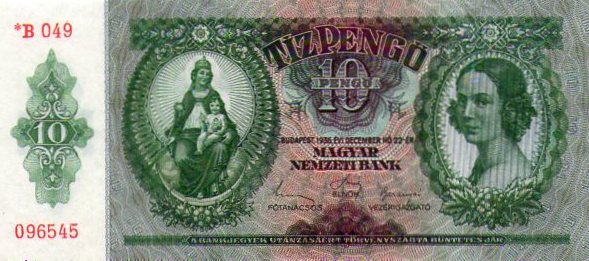
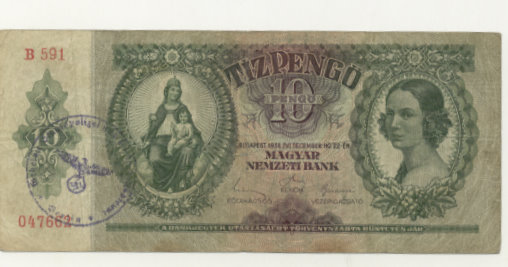
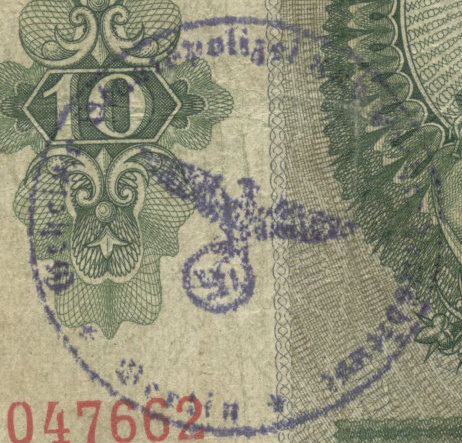
this 10 pengo bannote was issue before the Nazi took over Hungary at 1943 , you can find many bank note with low market value issue before or at WW2 that in order to increase their value had been "stamp" by Nazi seals
as for the bank note issue by Salzi Nazi regime in hungary see below
Series of banknotes were printed in Veszprém by the evacuated Szálasi government and circulated in the Nazi-ruled part of Hungary in 1944.
The 100 P bill of 1930 and the 10 P bill of 1936 were reprinted in late 1944. These banknotes were marked with a star in the serial number. Some of the 100 P banknotes were overstamped with an 1000 P adhesive stamp - these were later replaced by the 1000 P bill of 1943.
Later in 1944 there was a plan to issue a new series of 10, 100 and 1000 P banknotes - all designed by Endre Horváth. Due to lack of time, only the 1000 P bill was officially put into circulation, 100 P bills were printed but only used by the evacuated troops in Austria, the 10 P bill is only known as printer's proof. The 100 and 1000 P bills were designed using elements of earlier banknotes. In the last days of the Szálasi government, some of the bills (10 P of 1936, 20 P of 1941, 50 P of 1932, 100 P of 1930 and 1000 P of 1943) were overstamped with a green arrow-cross stamp - however, most of these overstamped banknotes are considered to be fake (i.e. overstamped later to turn these common banknotes into more expensive 'rarities'): stamp inks are tend to be very fresh on these banknotes and it is not clear what the purpose of such overstamping would have been.










 Posted 03/30/2011 01:19 am