| Author |
 Replies: 15 / Views: 4,428 Replies: 15 / Views: 4,428 |
|
|
Valued Member
United States
257 Posts |
I found this coin, apparently Asian, but have no idea as to the country or date. Any and all help would be most appreciated. Thanks in advance for once again letting me tap into this group's infinite knowledge. 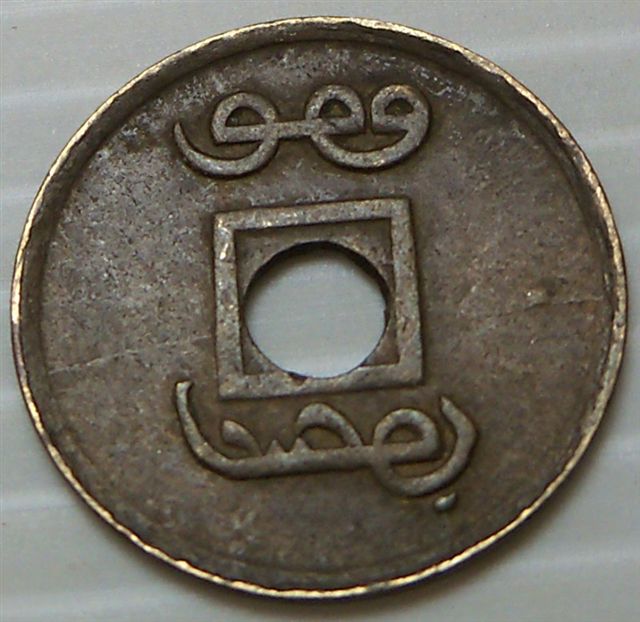 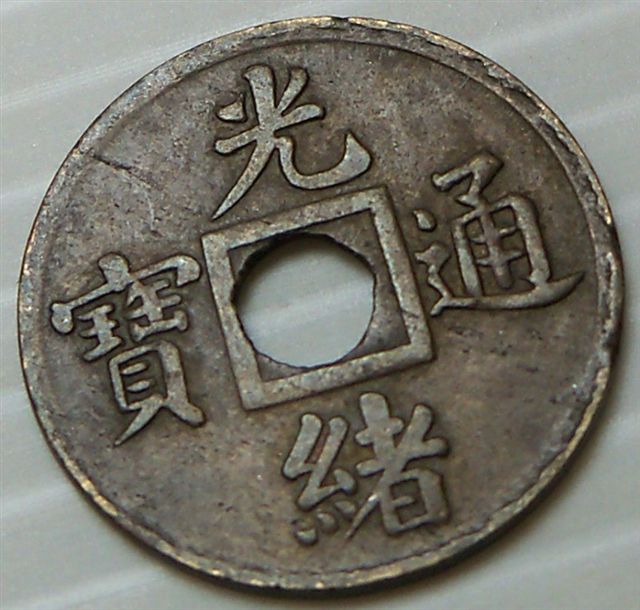 |
|
|
|
Pillar of the Community
United States
3098 Posts |
It's a Western style machine struck 1 cash coin during the Guangxu era. Not as common as the cast ones, which are the ones you see the most with the fully square hole.
|
|
Valued Member
 United States
257 Posts |
Thanks for the fast response. Is it Chinese? Any idea of the year or dates of the era mentioned? Thanks again, in advance.
|
|
Valued Member
United States
200 Posts |
I tend to go with wd, a true Chinese cash coin has the FULL square determinant. There may be variants, but I highly doubt it.
Anyway, the coin purports to be from the Kuang Hsu reign, dating 1875-1908,
type A, yet the three "dots" on the bottom symbol don't line up correctly to the slash of the main character. Actually, wd, isn't it Kuang Hsu instead of the common Guangxu?
it is a 1 cash, and it is from a Chinese coin, yet, I agree that it not genuine. The mint is a very close match to the Boo GUWANG, Canton KWANGTUNG Mint.
Edited by Tam
05/21/2011 10:14 pm
|
|
Valued Member
United States
257 Posts |
Hmmm...I don't believe that WD said that the coin was not genuine. I believe he said the machine struck coin is less common. Information backs that up, stating that the machine struck versions of the coin represented one of three advancements in producing coins made during the period. Mostly later in the era. Illustrations in Krause show coins both way, with the round and square holes, with the less than fully squared holes shown under milled coins as opposed to the cast coins. I appreciate the further information of the probably mint.
|
|
Valued Member
United States
200 Posts |
Agreed. like I stated, there may be variants, but the key word is "Western" style, so I stand by my statement. IMO, the CHINESE did not incorporate WESTERN styles until around after WW II.
I am happy to be proven wrong, but I haven't seen anything to say that.
Edited by Tam
05/21/2011 10:33 pm
|
|
Valued Member
United States
257 Posts |
I believe the "Western style" was in reference to the way the coin was minted (milled vs cast). It has been documented that a western press was obtained from the British in the latter part of the era (according to a few sources found on Google). Even if this coin isn't worth much money, I sure hope it isn't a fake.
|
|
Pillar of the Community
United States
3098 Posts |
Yes, by "Western" I do mean milled rather than stamped. Canton/Kwangtung/Guangdong was the first (and I think only) mint that produced machine-struck cash coins in the imperial era.
This was not struck after WWII, but pre-1911 (still imperial times). I have seen round ones that are the size of pennies with a fully round hole without the outer square outline. How big is yours?
Machine struck cash coins themselves are much rarer than the billions of cast ones, so until I find more reference for you, I would mark this as "uncommon" and keep it safe. Chinese coin markets are bubbling right now...
|
|
Valued Member
United States
257 Posts |
Actually, wd1040, I cannot tell you how big this coin is as I have yet to receive it. I just purchased this coin on ebay, out of curiosity, as an "Unknown Asian" coin for 99 cents. I'll post its size and approximate weight when received, hopefully by this time next week. Do I take it correctly that it is your opinion that the coin has a realistic possibility of being genuine? |
|
Pillar of the Community
United States
3098 Posts |
oh ho, I don't think counterfeiters have gotten to cash coins yet. I just flipped through the Krause, and yours is type 191,
F .10
VF .25
XF 1.00
UNC 3.00
Unusual... the prices for that piece is lower than cast pieces...
|
|
Valued Member
United States
257 Posts |
Thanks again wd1040. I spent lots of time flipping through Krause without success. After awhile, all the Chinese symbols/words/numbers began looking alike. Then my vision blurred. Then it got ugly. I will look for 191 somewhere in the 100+ pages Chinese coins take up in Krause. It's hard to believe, assuming this information is wholly reliable, that I overpaid on a 99-cent purchase. Did you happen to notice if this is one of the coins with a billion+ mintage figure? Thanks again for the legwork and direction. Do you know anyone who may be interested in a mysterious Asian coin...for cheap?
|
|
Valued Member
United States
200 Posts |
well, however it turns out, I did learn a few things, and that is all good IMO.
|
|
Pillar of the Community
United States
3098 Posts |
Actually you didn't overpay. My version is from 2002. I just looked at some Chinese auction sites and the going price is around 20-25 RMB (3 to 4 bucks). The cast coins may not be in the billions, but at least a few hundred million total, of all the coins with the Guangxu era name. http://www.seaeaglecoin.com/guangxu1.htmlI say it's still a good buy. |
|
Valued Member
United States
257 Posts |
Thanks again, wd1040. The link is a great reference. And I am much relieved by the value. I'm with you, TAM. I learned much from all the responses, and that is, indeed, all good. Both the volume of knowledge and the generosity to freely share it (consistently shown on this site) has never failed to delight, amaze, and educate me.
|
|
Valued Member
United States
257 Posts |
Just as a brief follow-up: I received the coin, today. It is very small and very lightweight. It is a bit smaller than a US dime. wd1040 asked about the size. I hope this leads to further enlightenment.
|
|
Pillar of the Community
United States
3098 Posts |
Yup, that's the one. I was working with one last summer at the ANA and I thought it was quite rare, but turned out not to be. |
| |
Replies: 15 / Views: 4,428 |
|







 Posted 05/21/2011 8:10 pm





