| Author |
 Replies: 17 / Views: 2,859 Replies: 17 / Views: 2,859 |
|
Valued Member
Canada
241 Posts |
Hi there. This penny has a flaw that I have not seen before. It is in the 9:00 to 10:00 position. If you can offer any ideas as to how this 'bubble' occurred, that would be very much appreciated. I hope the photographs show the details well enough. Thanks for your time. 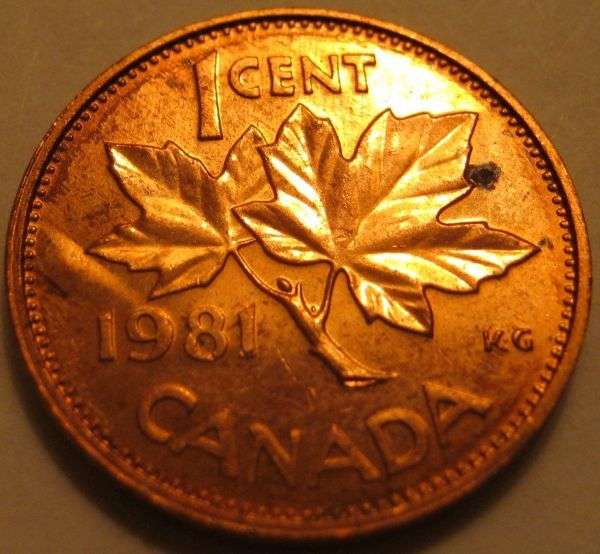 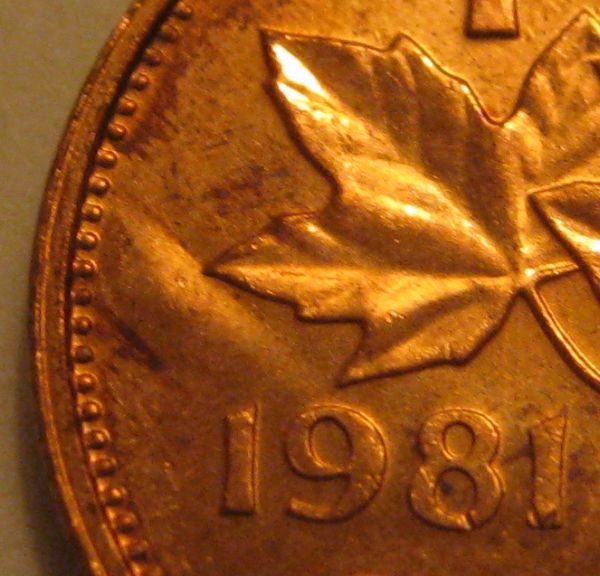 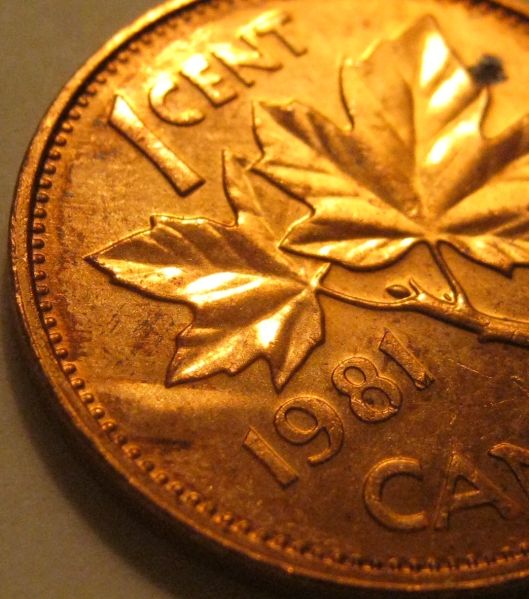 Edited by staircase
08/06/2011 04:48 am
|
|
|
|
Moderator
 United States
56855 Posts |
Can you post a photo of the other side? John1  |
|
Valued Member
 Canada
241 Posts |
Thanks! I forgot to include that... here it is. 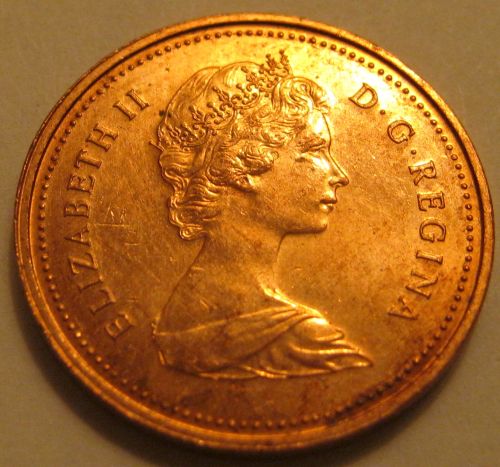 |
|
Pillar of the Community
Canada
1166 Posts |
I'm going to piggyback on your thread. I also have the same defect on a cent from 1947. I posted this a while ago but didn't get a response. The obverse is normal.   Edited by ikandiggit
08/06/2011 09:42 am
|
|
Valued Member
Canada
241 Posts |
I'm relieved to see that someone has something similar. The 'blob' on the '47 is basically the same shape and size as that on the '81, almost mirrored. The '47 shape bites into the denticles and rim, which might point to a couple of possible causes.
Thanks for the info, they were minted 34 years apart and...
If there are any other examples like these out there, it would be great fun to determine what went wrong.
Edited by staircase
08/06/2011 12:33 pm
|
|
Bedrock of the Community
United States
10045 Posts |
Wow...that's very interesting to see two coins with an almost identical flaw!
On the 1981 cent, I think I see a bunch of scratches parallel to the raised mark.
Could this possibly be some kind of wear to the die? Are the opposing details on the obverse weaker?
|
|
Valued Member
Canada
241 Posts |
Hi there DV, thanks for your comments. The obverse seems to have no markings opposite of the raised area on the reverse. In general, the strike seems to be normal. Great eye, indeed there are lines running parallel to the raised area, and also a couple of markings between the rim and the leaf, just northeast of the 'blob'. Also, there is some streaking from the rim towards the leaf. Some of those are probably normal wear.
I was leaning towards a possible die problem with a large portion of the die actually breaking away. To have it occur in such a span of years is amazing. Hopefully other examples show up.
Thanks again for your time!
Edited by staircase
08/06/2011 1:25 pm
|
|
Bedrock of the Community
United States
10045 Posts |
When I saw the parallel lines, I wondered whether continued abrasion damaged the die and left the impression? When I saw a second coin, I thought about something mechanical in the striking process gouging the die, such as a feeder mechanism wearing that depression over time? Just my guesses, because I don't see how the defect could be on the planchet.
|
|
Valued Member
Canada
241 Posts |
That makes a lot of sense, thanks DV! That 1947 pictured above becomes a true rarity, it's great to see that.
Edited by staircase
08/06/2011 2:07 pm
|
|
Bedrock of the Community
United States
10045 Posts |
 If it's feeder damage, it might be possible to find a few, showing different amounts of wear. I haven't found one yet, but I'll look again at my bags of Canadian cents. |
|
Valued Member
Canada
241 Posts |
To be honest, I discovered the '81 during the second round of sorting. The initial sorting was rapid fire a few years ago. I'm going to keep slowing the pace down and be more careful. Speaking of being careful, somehow I over-wrote my previous message. I agree with your thoughts DV, on the feeding mechanism being faulty. Thanks!
Edited by staircase
08/06/2011 2:25 pm
|
|
Moderator
Canada
10477 Posts |
Looks like a "bubble" feature to me, on both coins. One theory is that there is a flaw or air bubble in the planchet, when the coin is struck the trapped air is heated rapidly and the coin blisters out. Try doing some searches on gas bubbles or air bubbles with struck coins, to see if there are similarities to your coin(s).
"Discovery follows discovery, each both raising and answering questions, each ending a long search, and each providing the new instruments for a new search." -- J. Robert OppenheimerContent of this post is licensed under a Creative Commons Attribution-NonCommercial 3.0 Unported License. See: http://creativecommons.org/licenses...0/deed.en_USMy eBay store
|
|
Bedrock of the Community
United States
10045 Posts |
Hmm...I don't know how you could test the bubble hypothesis without damaging the coin.  I still find it interesting how the raised area is straight/rectangular, and limited to one side. And, there is a second coin just like it. To me, that suggests a process involving the die/press, rather than random bubbles inside coins. Edited by DVCollector
08/06/2011 5:51 pm
|
|
Valued Member
Canada
241 Posts |
Hi, thanks for the comments. I looked around and found that the gas bubbles are associated only with the zinc core planchets introduced in 1997. For a few years there were groupings of the copper plated zincs with trapped air bubbles clearly visible. When the RCM began flipping back and forth between zinc and steel core blanks, the 'P' series didn't reflect those air bubbles. I'm going on memory only now, and perhaps I'm in error about the P series. In recent years there have been exceptions to that rule of thumb, with the most notable being 2006. I think the purity of the copper planchets used in 1947 and 1981 were not prone to air entrapment below the surface. Thanks again! |
|
Pillar of the Community
Canada
1166 Posts |
It's definitely damage to the die. I've been trying to hunt down my original post but I'm not even sure what forum it was on and I think it may have been an add-on to a bunch of other errors I was trying to identify.
|
|
Valued Member
Canada
241 Posts |
Hi there again. I have spent many hours searching through some coppers and found a 1941 with markings that are interesting. There are similarities to those shown above, particularly with regard to the '47. The obverse of the '41 is normal. I hope this is of interest, and thanks for taking another look! 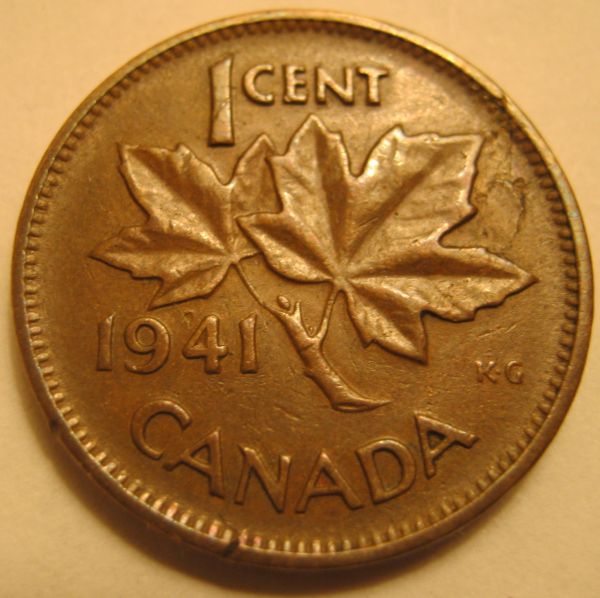 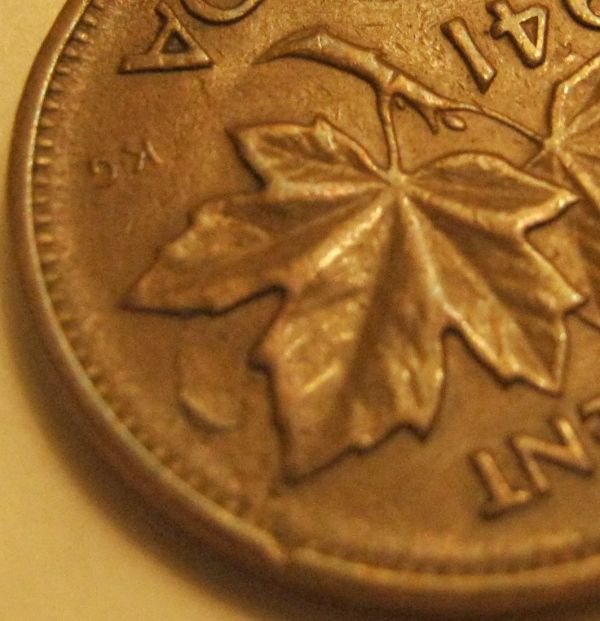 Edited by staircase
08/20/2011 03:47 am
|
| |
Replies: 17 / Views: 2,859 |







 Posted 08/06/2011 07:03 am





