| Author |
 Replies: 22 / Views: 4,051 Replies: 22 / Views: 4,051 |
Page 2 of 2
|
|
|
|
Pillar of the Community
United States
5362 Posts |
I have been away a few days buying fakes in Florida.
The 1835 Zs appears to be one of the "real" but debased issues of Zacatecas. The edge is actually doubled it appears, The 1835 and 1836 coins were actually very poorly made. It was under State control until 1836 and then the Central Government took it over - in part for very shoddy work in 1835 and 1836.
The standards are LOOSER in those 2 years at Zacatecas.
The coins are technically fraudulent in that they fail to come up to standards BUT they are real as far a collector is concerned.
|
|
Valued Member
United States
426 Posts |
Yep, that coin looks like it's related to my 1835. https://goccf.com/t/99996I'm away from my references right now but I believe 1835 was one of the worse years for planchet porosity accounting for the "mushiness". Either way nice coin! Love the mysterious origin of these pieces! Edited by RealPeso
01/19/2012 5:48 pm
|
|
New Member
 United States
47 Posts |
Swamperbob - Thank you very much for your valuable opinion. Thank you all for your comments. RealPeso Quote:
Love the mysterious origin of these pieces!  The fact that the coin has such a low weight but is a real coin makes it unusual and interesting. I'm glad I can add the coin to my small collection  Edited by bobstam
01/19/2012 8:17 pm
|
|
Pillar of the Community
United States
1962 Posts |
|
|
Valued Member
United States
329 Posts |
realeswatcher - I don't know about the coin you are asking about but I do have a question about the edge of the 1835 coin the OP posted in the 6th picture. Why is the edge slanted or on an angle? Is is normal? Did the stamping process do this?
Larry
|
|
Pillar of the Community
United States
5362 Posts |
realeswatcher - The 1836 Zs coin appears real. The porosity is a planchet defect not the result of casting. If you look at the coin the "pores" are concentrated in places where the die pressure is lowest - at the deepest parts of the die. There are far fewer visible pores in the high pressure areas (fields). This is typical of how the pressure of the strike CLOSES pores on the high pressure surfaces while leaving the pores nearly intact on the low pressure areas.
Simply stated the lowest point of the design (which is the highest point of the die) makes contact with the planchet first and with the highest pressure. The deepest recesses of the die (the high points of the coin design) are contacted last, if at all, and receive the lowest pressure.
In hand struck coins (a screw press is operated manually), the pressure exerted is lower than on a steam press and weak strikes are normal. A weakly struck coin shows features consistent with the original surface of the planchet at the high points of the design. That is why so many eagles lack their breast feathers even on MS grade coins. This weakness is also a reason that grading the series is very difficult.
So the 1836 is normal but a typically weak strike for the mint making it rather common.
Larryh86GT I believe part of the problem is the angle of the photo. The segments in the lower portion of the picture are absolutely correct - as you look toward the top of the picture something changes. It could be that the edger had a worn retaining lip (or a broken one) allowing the blank to slip or the original punch that made the blank could have been worn. But something caused the blank to tilt in the edger just at the point of release from the edger mill. It is a commonly occurring feature on the poorly made coins of the State run mint.
Unfortunately features like both of the above can get confusing when authenticating coins of this period. In many cases pores are the results of casting and a slanted edge is the result of shoddy work by forgers - but just keep in mind that you need to fully think through the mechanics of how a coin was actually made to understand when a "feature" crosses the line dividing fake from real. That is the part of authentication that takes the most time to develop.
|
|
Pillar of the Community
United States
1962 Posts |
Quote:
The 1836 Zs coin appears real. The porosity is a planchet defect not the result of casting. If you look at the coin the "pores" are concentrated in places where the die pressure is lowest... Bob, the debased Zacatecas issues were STRUCK (using some semblance of actual mint punches/dies), not cast, correct? This piece was clearly struck, not cast, and it seems the design elements are correct... I was assuming it was a struck debased piece figuring that the porosity was due to an alloy impurity/annealing issue, and b/c the patina/tone of the piece, to me, is like that you see on silver lower than .900 fine. Quote:
It could be that the edger had a worn retaining lip (or a broken one) allowing the blank to slip or the original punch that made the blank could have been worn. But something caused the blank to tilt in the edger just at the point of release from the edger mill. It is a commonly occurring feature on the poorly made coins of the State run mint. I don't think that's all optical illusion - definitely looks like there's a slight slope to the edge as it runs from obverse to reverse. I've noticed that effect on a decent amount of portrait 8R also... Edited by realeswatcher
03/01/2012 3:19 pm
|
|
Valued Member
United States
329 Posts |
Quote:
I don't think that's all optical illusion - definitely looks like there's a slight slope to the edge as it runs from obverse to reverse. I've noticed that effect on a decent amount of portrait 8R also... I've got a couple 8 reales portrait coins that have this slope on the edge which is the reason I asked about it. I have not seen anything about this edge slope before and was curious. |
|
New Member
United States
47 Posts |
The angle of the photo is ok. The edge has a slope. Imho the angle of the slope depends on the thickness of the blank at this area. The coin in the area of this slope is thiner by 0.2-0.3 mm than the opposite part of the coin. Maybe this affected the edger to tilt. 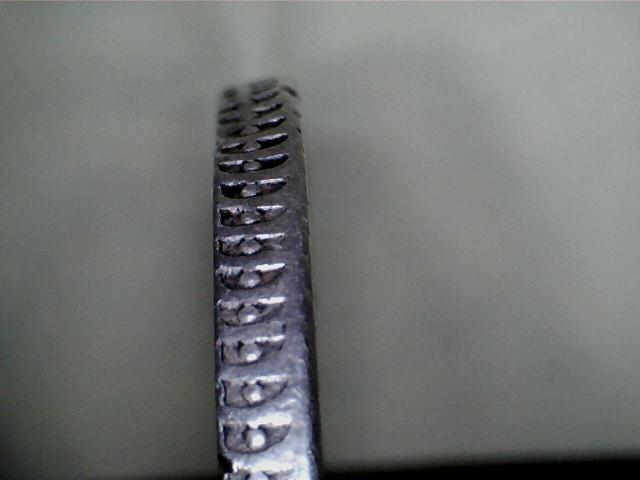 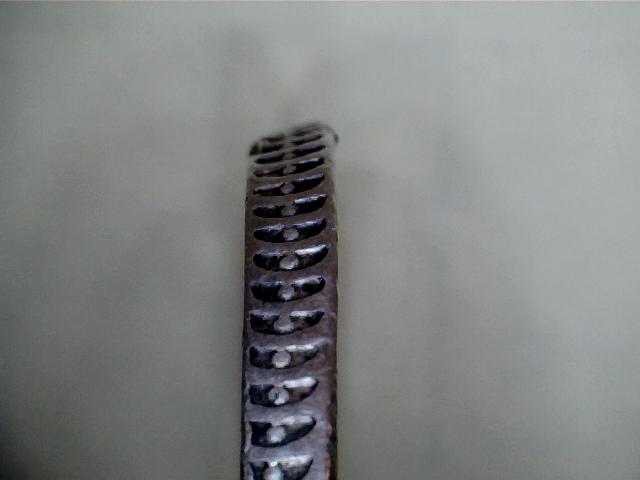 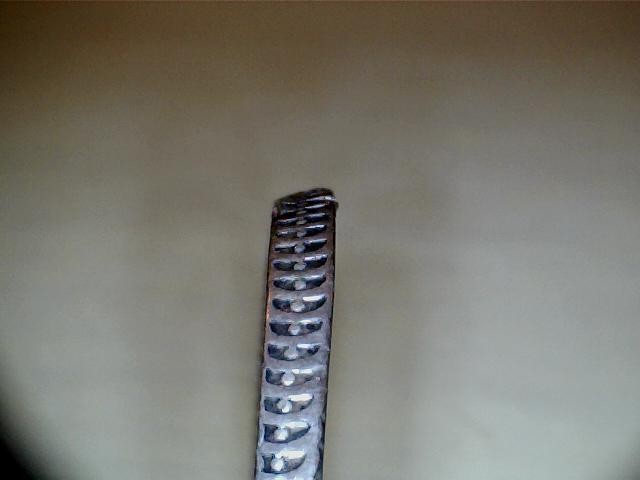 Edited by bobstam
03/01/2012 10:49 pm
|
|
Valued Member
United States
329 Posts |
Those are great pictures of the edge.... I wonder if the pressure of the press could have caused this sloping? It would explain why the coin is thinner on the slopped side. It would have been difficult to mill the edge originally if the planchet had this angle on it I would think and the pattern is pretty even on the edge all around it.  (standing by to be educated) Larry |
|
Pillar of the Community
United States
5362 Posts |
The slope seen in the final picture is seen on a good many original coins from the 1834-1836 time frame at Zacatecas and was caused by worn "cookie cutter" blanking punch in the blanking room. A dull (worn) cutter does NOT make a square cut through the silver stock but rather tends to tear through the metal and results in many sprues and in this case a sloped edge. The edging operation often rolls the torn edge into a fold or simply a slope as seen here.
This is normal and seen during periods when the apparatus was in bad need of replacement.
The "appearance" of the segments being at an angle to the faces of the coin is as I said earlier mostly an optical illusion due to the fact that they are located on the surface curving away from view. The detail actually remains square to the faces of the coin but follows the sloped edge of the planchet. The edge mill did this when wear allowed for some "travel" or play in the dies.
Do not worry about it being a forgery in this particular case - that appearance is quite normal.
|
|
Pillar of the Community
United States
1962 Posts |
Quote:
A dull (worn) cutter does NOT make a square cut through the silver stock but rather tends to tear through the metal and results in many sprues and in this case a sloped edge. The edging operation often rolls the torn edge into a fold or simply a slope as seen here. Presumably the edge effect shown below (obv of 1832-Zs, rev of 1833-Zs) is the effect of the that? Bob, would you mind briefly addressing my assumption that the debased Zacatecas issues were (die)struck? Got buried on Pg. 1... https://goccf.com/t/108186#958377 |
|
Pillar of the Community
United States
5362 Posts |
It is possible that the cutter could have produced the lines seen on the edge of that coin. It is also possible that it represents the edge of the rolled sheet.
The sheets of rolled silver used in the days of hand powered rollers were just over one blank in diameter and blanks were punched one at a time. If the width of the sheet did not allow for a full punch - the workman often made the blank anyway to see if it met standards. Payment was based on the number of units completed so they would have made the punch and if it was rejected it represented little extra work comparatively.
The "debased" issues were die struck - that is an established fact. They are not castings made from casts of original coins. The fact that they use "real" mint design dies is the major issue and reason behind the question of who made them and were. Were they made in the mint or outside? Were real mint dies or punches used? These are the two primary questions.
There are two nearly equally plausible theories of where these debased strikes came from. The first is that debased planchets or blanks were substituted for real examples in the mint. The second is that old dies were sold as scrap without being defaced.
The second cause is well documented in period sources as actually occurring. The first is alluded to as well. So in either event which is the actual source is uncertain in the contemporary record. But both may have taken place.
My belief is that the worn die theory is far more plausible unless the deception had support at the level of the assayer and refiner at the least. Substitution of a planchet or blank from outside the mint is less likely than corruption of the officials because the silver and the resulting blanks were accounted for at every step.
So I do believe that most of the "matching" die debased coins were made outside the mint using scrap dies. They can be identified in some cases by the edger used, but I am also certain that some debased examples using the correct edge design and methods of application do exist so an origin in the mint is possible as well.
|
|
Pillar of the Community
United States
1962 Posts |
Bob, it might be difficult because the quality of manufacture seems pretty low as is on the genuine mint product... but shouldn't a die state analysis help point to a more likely scenario (at least for a given subset of pieces)? I believe you've mentioned before that some of the confirmed "debased" specimens appear to be die matches to what seem to be genuine mint-produced specimens whose planchets are of proper weight/fineness... If it turned out that most of the "debased" pieces were of a later die state than those genuine pieces, that should mean that debased ones were made on old dies that left the mint (w/o defacing), no? Of course, getting the old dies/punches out without defacing them is of course also obviously corrupt, but that's besides the point.
IF, however, you're finding confirmed debased specimens which are definitely earlier die state than matching-die "known genuine" pieces, that would seem to point pretty strongly towards the debased pieces being done in the mint directly by rogue workers, (steathily?) in between runs of "official" pieces...
Besides the evidence of how they were edged, is this part of why you think they were (mostly anyway) done outside the mint on discarded dies?
|
|
Pillar of the Community
United States
5362 Posts |
The problem with these particular years are that there were so many dies used that a match would be pure luck.
The edges lead me to believe that some were made outside the mint because the edges are AWFUL. But others do have better edges. None of the dies are near terminal state (at least the ones I own).
It is definitely an are that needs much more study than I have time for right now.
|
|
Page 2 of 2
|
Replies: 22 / Views: 4,051 |
Page 2 of 2
|





 First Page


 Posted 01/19/2012 5:47 pm


