| Author |
 Replies: 22 / Views: 4,796 Replies: 22 / Views: 4,796 |
Page 2 of 2
|
|
|
|
Pillar of the Community
527 Posts |
That reminds me; I found a 1964d in very nice shape. I think it's graded either EF or AU.
|
|
Valued Member
United States
493 Posts |
The problem to me is that the top AU grade is near MS. And, up to an MS-67 can have contact marks on it, surface and rim. Grading allows for some normal wear and tear. Example: one of my 2011 RP ASE, a visible scratch on the surface, from the factory, graded MS-70 by NGC. I liked the vertical scratch, giving character to an otherwise seemingly boring coin, so I traded it off. |
|
Pillar of the Community
United States
1361 Posts |
Markn,
Even I'm still having trouble telling between an MS and AU coin. I tend to be too critical and undergrade things, I guess.
With some of the coins posted on the grading forum, I see some Lincoln cents with thin scratches on his cheek. I think "Definitely AU" but the others go and say MS-64...
I don't really get it..
|
|
Pillar of the Community
United States
594 Posts |
I've even found proofs, while roll searching halves.
|
|
Valued Member
United States
123 Posts |
Just this week I found a Kennedy 1976 S (so-so condition)and what appears to be an MS grade 1938 nickel. After searching 5 rolls of Kennedys and 20 rolls of Jeffersons that was pretty much it except for a Buffalo nickel with no date and was promptly seized by my granddaughter. Only one nickel from the 1940s and one from the 50s. The 1938 nickel is one of the best looking coins in the granddaughter's coin book. |
|
Pillar of the Community
United States
1361 Posts |
Did the Buffalo have a mintmark? You might want to try soaking it in vinegar to bring the date out.
Ya never know...
|
|
Valued Member
United States
123 Posts |
I tried your suggstion. The mint makr is an S. All that remains of the date appers to a slant of a 7. If I were to guess, it would be 1917 because of the placement of the 7 is correct for 17 and is straight without a slight curve you see in 27. The placement of the slanted line is slightly more to the left than what there is for a 37. But my guess only.
|
|
Pillar of the Community
United States
1361 Posts |
Congrats!  1917-S is one of the lower-mintage dates. Still not much in terms of value, though... |
|
Valued Member
United States
275 Posts |
I've machine sorted over 1/4 million cents in 6 months. That's appx 5000 rolls (107 boxes ) and found 2 proofs, maybe 5 BU wheats, 1 Indian head, 1 silver dime. I did get 1 entier roll of 63 wheats BU in a CWR. (MS to me is a mint state coin, dirt or nicks makes that pretty much an AU to me.)THe AU numbers are alot bigger. I have unwrapped new 2011 rolls and those have nicks and roller damage. Truthfully, I have boxes of good looking coppers many close to AU but not perfect. This is because they turn black carbonish just from touching and be handled in the dirty stuff,and of course nicked up too. They have to go through sort and roll machines at brinks etc. The high luster ones are what I consider AU for those boxes. Alot of the AU zinc I dumped back at first, but I have boxes of the high luster ones of course, which are very easy to get in a box. Just throwing a number out there but at least 10-15% of a box is AUish zinc Id guesstiamte because sometimes I get boxes of old cruddy ones and sometimes I get lots of better ones .... but this gives you a perspective on my percentages in a massive hunt.
Edited by Coppertop
01/21/2012 11:52 pm
|
|
Pillar of the Community
United States
6447 Posts |
This half came from a roll of mixed dstes I got at a bank and the toning was so nice I sent it to ANACS. They confirmed mint state status: 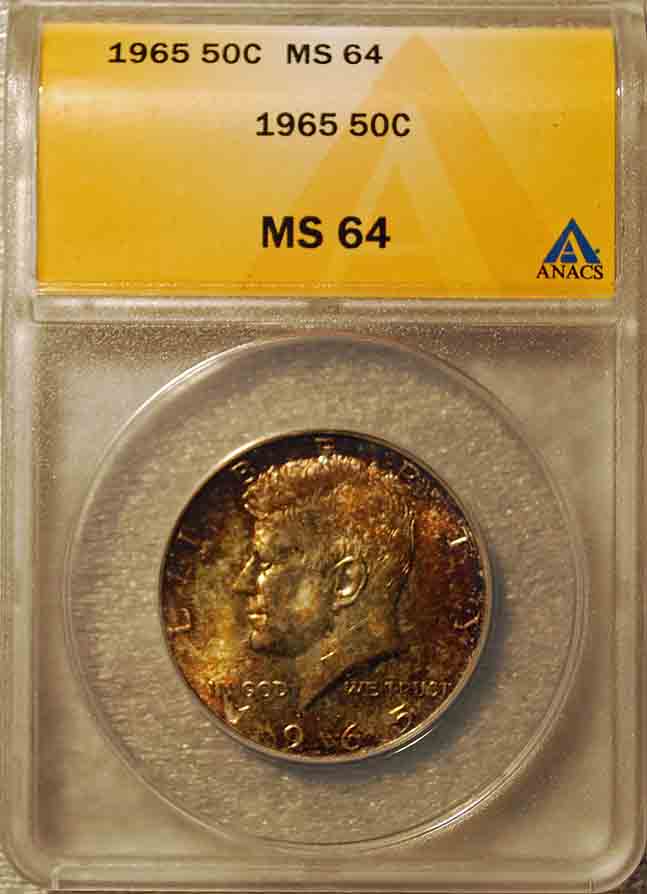 |
|
Pillar of the Community
2226 Posts |
For discussion purposes only and not for argument, I've never understood how a coin found in a roll, say from a bank or for that matter a private seller, packed with other coins with all degrees of circulation wear, be termed MS. By definition: Quote:
Mint State
The term corresponding to the numerical grades MS-60 through MS-70, used to denote a business strike coin that never has been in circulation. A Mint State coin can range from one that is covered with marks (MS-60) to a flawless example (MS-70). Someone please enlighten me. Just trying to understand the thinking here.  |
|
Pillar of the Community
United States
3592 Posts |
southsav, it all has to to with condition and wear (or lack of), after all, you can hand me a BU coin directly from the mint and consider it circulated using the definition above.
|
|
Pillar of the Community
United States
1450 Posts |
If you look at the question from a purely pragmatic standpoint,if someone hands you a coin and tells you nothing about it,how do you determine if it is uncirculated? My guess is,you would look at the condition of the coin. You would look for wear on the high spots and rim,scratches,etc. that normally occur from handling and collision with other materials. That being said,if a coin has those characteristics(and some in bank rolls do)then it is reasonable to call it Bu. I don't really care if it has been in circulation or not so long as it doesn't show signs of wear.
|
|
Valued Member
United States
275 Posts |
I don't understand it either that's why I say they are all AU! MS to me is exactly that, a mint coin still in the package or obviosly uncirculated but I do know some circuoateds may slip through the cracks and look good enough to be graded as such, even though they are technically circulated
|
|
Pillar of the Community
United States
1944 Posts |
Edited by dbrablec
01/24/2012 1:26 pm
|
|
Page 2 of 2
|
Replies: 22 / Views: 4,796 |
Page 2 of 2
|








 First Page

 Posted 01/20/2012 03:45 am