| Author |
 Replies: 31 / Views: 5,463 Replies: 31 / Views: 5,463 |
Page 3 of 3
|
|
|
|
Pillar of the Community
Canada
590 Posts |
Quote:
No dyes are used for this. The colours are achieved by creating a thin oxide layer on the niobium You are correct. Niobium is anodized without dies. Very strange metal. |
|
Pillar of the Community
Canada
933 Posts |
that is why no two coins are alike...each coin will be different because of the way niobium was anodized.
|
|
Pillar of the Community
Canada
3690 Posts |
I have two of the Wolf coins - one from the mint and one from CP - and they look exactly the same; even magnified. The others that I've seen look the same. Does anyone have one that looks significantly different than say, the picture on mint.ca. If so, please post a picture. Curious to see the degree of variations. |
|
Pillar of the Community
Canada
933 Posts |
Thats interesting, maybe It will be hard to find a truly "different" looking coin. But part of their whole thing with this coin at RCM was that "no two coins will be alike" because of how each piece of niobium reacts Edited by RoyalSilver
05/25/2012 10:46 am
|
|
Valued Member
Canada
207 Posts |
I think any differences would be in subtle variation in colour. May be pretty difficult to see the difference with the naked eye.
|
|
Pillar of the Community
Canada
590 Posts |
You would not anodize each component separately, you would do it in batches. When I do anodizing at home I would do 10 to 100 parts. Industrial anodizing may have batches of hundreds or thousands of parts. That being said you can not anodize every part the same even in a batch. The bulk of the parts will be the same but you get will get some variation. The fact that niobium's color is dependent on process more than anything else and all the coins look the same makes me wonder how they are oxidizing these parts and if they are treated with color after or if the parts are just aluminum. Niobium is not magnetic so unless you do a hardness test or a chemical test you can never tell.
|
|
Pillar of the Community
Canada
3690 Posts |
Quote:
I think any differences would be in subtle variation in colour. May be pretty difficult to see the difference with the naked eye. That's kind of what I'm getting at. The mint is marketing these with the assertion that 'Each niobium core was selectively oxidized to create a unique finish--no two coins are exactly alike!'. Yet if a person cannot see a difference, are they truly unique? If you have to go to a molecular or microscopic level to see a difference, then IMO, that is not really a fair statement by the mint. I'm hoping someone has one that is really different. |
|
Valued Member
Canada
60 Posts |
Marketing ploy... Is it the difference between the "truth" and the "whole truth"? :)
|
|
Valued Member
Canada
63 Posts |
Would the selective anodization really be the deciding factor in getting this coin? I think the most interesting thing is the cool case it comes in.
|
|
Valued Member
Canada
396 Posts |
@fkl118, the case feels cheap in hand, in my opinion. It's wood but there's no weight to it and it lacks details
|
|
Pillar of the Community
United States
2408 Posts |
I like the case, but yeah it looks like some resin, polymer or something - not real wood.
Way better than the 2005-2006 style cassette tape case IMO.
|
|
Pillar of the Community
Canada
1502 Posts |
|
|
Valued Member
Canada
396 Posts |
@poboxw, I think the cassette looks better. BTW, are you still waiting for your hunter's moon?
|
|
Pillar of the Community
Canada
862 Posts |
speaking of case, these are the best I have ever owned 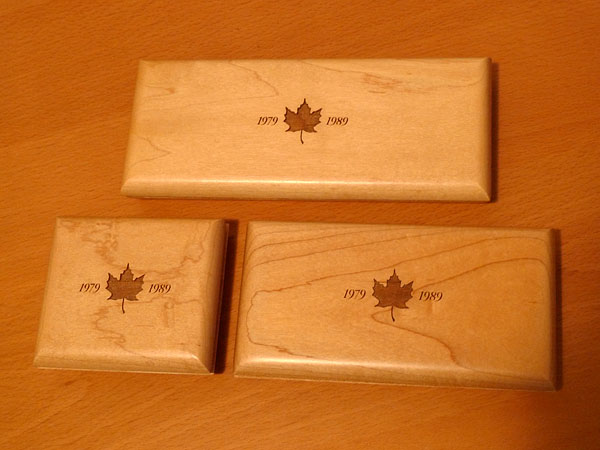 |
|
Pillar of the Community
Canada
1502 Posts |
@tocoins: Actually, I'm not a big fan of the niobium coin set. I canceled mid-subscription but somehow they still sent me and charged me for the wolf and april moon. So, I'm selling as oppose to buying to complete
|
|
Page 3 of 3
|
Replies: 31 / Views: 5,463 |
Page 3 of 3
|







 First Page
 Previous Page

 Posted 05/25/2012 10:31 am





