| Author |
 Replies: 39 / Views: 4,435 Replies: 39 / Views: 4,435 |
Page 3 of 3
|
|
|
|
Pillar of the Community
United States
5362 Posts |
An original 1807 Mo TH 8R is worth about $50 in this grade - but there is always a possibility that the coin is NOT real.
There are 7 known die pairs made prior to 1830 which were used to make debased counterfeits another 4 die varieties made after 1830 that were struck in full assay silver and one recently made Chinese forgery of the coin which is also full weight silver.
1807 was a popular date for US forgers. To be certain you would need to die type the coin against all the counterfeit varieties and check the details to see if it was made correctly.
The first question with an 8R is always:
Does the coin have TWO overlaps in the edge details that are exactly OPPOSITE one another?
|
|
Pillar of the Community
United States
1801 Posts |
Realeswatcher, I have always known these coins as Portrait dollars, I am not familiar with the term "modified pillar dollar" however people have been calling them "pillar dollars" since I began collecting them around 1972. The available reference books at that time (Harris "Pillars and Portraits",and Bruce "Standard Catalog of Mexican Coins" referred to them as "Portrait" and "Bust". The other popular reference book, Elizondo "Eight Reales and Pesos of the New World" gave them no name that I can recall. The collector that got me started taught me they were "Portrait Dollars" so that is how I have always referred to them. However anyone can call them anything they want, I am certainly not the final say. Whatever they are called, I love them and will always be a collector of them. And I agree with you, the one in question makes me nervous, seen many questionable coins in those holders
|
|
Valued Member
 United States
442 Posts |
|
|
Valued Member
United States
442 Posts |
That's the best pic of the rim I could get but I can try to post better ones later
|
|
Valued Member
United States
110 Posts |
Extremely interesting coin. I've got a fondness for old Mexican silver. It just seems right, since Mexico is such a silver rich area.
I have no opinion on whether it's real or not. However with the price you paid, you're well ahead of the game. Good for you.
|
|
Valued Member
United States
442 Posts |
Hum I just checked back on this thread and noticed that one of the pictures is not the one I posted but has changed when I posted that pic on another thread. Very odd!
|
|
Valued Member
United States
442 Posts |
Ok so I took the coin to the fun show and I had multiple dealers and even the CCF'ers at the fun show and all of them said that it is genuine and that it has never been holed. That made me happy :) ok so because its genuine and never holed what would the value be?
|
|
Pillar of the Community
United States
1801 Posts |
I would place the value of your coin at between $35 and $50, it is a common date * reales in heavily circulated condition. Great coin and a great entry coin into the world of "8 Reales" collecting.
|
|
Valued Member
United States
442 Posts |
Ok cool I showed it to one dealer and he offered me $20 and said that collectors don't like the chop marks that only chop mark collectors do. Is that true?
|
|
Pillar of the Community
United States
5362 Posts |
In my experience the answer varies with the person you are asking.
|
|
Pillar of the Community
Hong Kong
1270 Posts |
Quote:
1807 was a popular date for US forgers SwamperbobI have a portrait 1807 also and want you to see it is a contemporary counterfeit or a real one. The coin weights 26.48 grams, 39.3 mm in diameter. The reserve side is moderately corroded and part of edge is seriously torn. Luckily, there are still two opposite overlap seen. The coin was bought from a German seller on ebay a few months ago. 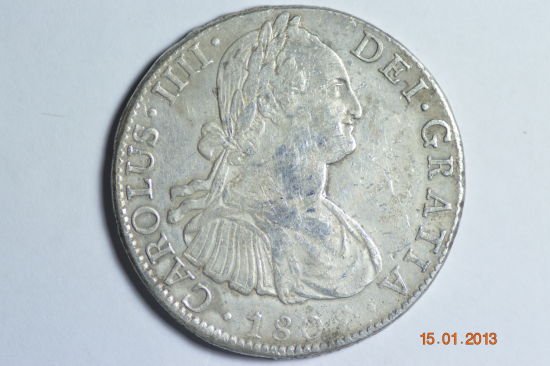 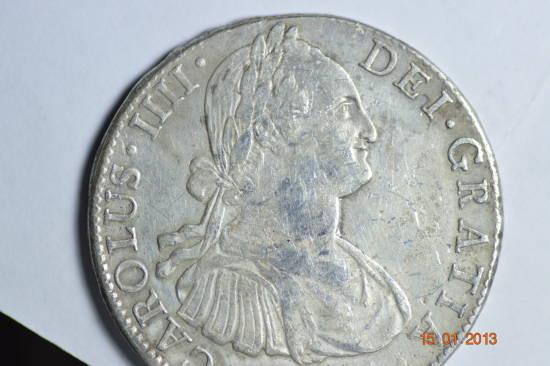 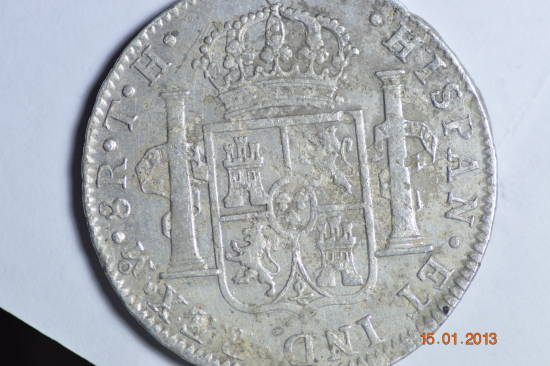  Two oppo. edge overlaps below:   |
|
Pillar of the Community
United States
5362 Posts |
The coin is NOT a Class 1 contemporary circulating counterfeit - that is absolutely certain.
The coin is also very unlikely to be a Class 3 Forgery based on the appearance of the surfaces and the edge.
That leaves two possibilities Genuine or Class 2 which is a Contemporary Silver restrike (a type of counterfeit made between 1830 and 1930). This class is discussed in detail in our book. There are visual clues that can increase suspicion of a counterfeit. To help decide which coins are probable Class 2 varieties we have created a listing of 20 clues. The more clues the more likely a coin is counterfeit. But to be 100% sure only metal testing (like XRF) can decide.
This coin has very few indicators pointing to Class 2 so it is likely real, but without testing the trace contaminants in the alloy you can not be absolutely POSITIVE.
|
|
Pillar of the Community
Hong Kong
1270 Posts |
Thank you swamperbob, I am looking forward to reading your book. Is it true the number of class 1 and class 3 contemporary counterfeits survive today are much much less than that of the class two silver restrikes? I suppose the Chinese at that olden days would never be cheated by those debased counterfeits so those debased specimens should be circulated in some other places. Old Chinese would accept those so-called class 2 silver restrike because they knew they were made of real silver. I supposed they knew there were many restrike but they didn't mind that once they were capable of differentiating the counterfeits from the real. So it is reasonable to believe there were a large number of portrait 8R restrikes from 180 to 1930 as you said. But it is regretted this fact had never been recorded in our Chinese numismatic or historical documents (at lease I never seen). I really hope to know more about this topic and reflect this historical fact to our people. Another question for you swamperbob, in ebay now, which one the origianl portrait 8 reales or the class 2 silver restrikes are more in number (more easy to find) ? Can you make a guess? |
|
Pillar of the Community
United States
5362 Posts |
The Class 1 counterfeits are rather rare on ebay or anywhere else - they run less than 1 % of posts on ebay long term. The Class 3 forgeries (new ones) are not that prevalent - I track 2 or 3 a day on ebay. But they are also harder to spot in photos so I am likely missing a few. The Class 2 coins are the most common type of the 3. But they are VERY hard to spot in photos, plus most sellers do not put photos of the edges. There are 28 portrait 8Rs posted on ebay a day (average for the past 200 days). I spot Class 2 at about 4-5 a day in the same time frame but I think twice as many are actually there. You understand the reason behind the Class 2 coins very well. They were successful coins because the target audience did not care that they were not genuine as long as they were real silver. That simple point is missed by most professional dealers. They have no idea that a large percentage of what they sell as genuine is really NOT. That is one reason I expect push back on the book. I make no claims in the book as to the percentage of Class 2 versus genuine coins. It is also why I say that genuine 8Rs and Class 2 counterfeits are priced on a par. Typically at the shop I buy all the Class 2 coins and I pay $ 25-30 for class 2 coins. I get 2-3 a month sometimes more. The number of genuine coins that come in in the same interval is always LOWER - under 1 a month. So based on what we see walking into the store in NC at least 3/4ths of all the 8Rs are Class 2. I think only time will tell how many Class 2 coins have survived versus genuine examples. |
|
Pillar of the Community
Hong Kong
1270 Posts |
Quote:
To help decide which coins are probable Class 2 varieties we have created a listing of 20 clues. I must buy one copy of the book written by swamperbob and his partners. I hope it will come soon. As a coin collector for South American Portrait 8R, it must be helpful to have an expertise to differentiate a genuine 8R from the class 2 silver restrike. |
|
Page 3 of 3
|
Replies: 39 / Views: 4,435 |
Page 3 of 3
|








 First Page
 Previous Page


 Posted 12/05/2012 11:27 pm