| Author |
 Replies: 19 / Views: 3,119 Replies: 19 / Views: 3,119 |
Page 2 of 2
|
|
|
|
Pillar of the Community
United Kingdom
2932 Posts |
These large silver coins are very satisfying to collect. Unfortunately everyone else thinks so too and nice examples can get quite pricy - particually once you get the common ones and have to search for less common types. As with every other coin collecting area I'd really advise getting the nicest example you can afford, you forget about the purchase pain very quickly but you never get tired of a beautiful coin. Everyone knows this but it's worth repeating, be careful on ebay - these crown sized coins are heavily counterfeited and I see fakes all the time. I think everyone should print out a "Do not bid on that bargin you have just seen that ends in 5 minutes" sign and staple it to their computer screen :) I like the Naples one - it's one I have on my to get list. Great edge photography too! Happy collecting. |
|
Valued Member
 United States
462 Posts |
Thank you, swamperbob and Bacchus2. These are all good advise , specially to a novice like myself.
|
|
New Member
United States
3 Posts |
I like the big silver coins... crowns, 8 reales, dollars, thalers, etc. The detail on some of the thalers is simply amazing (assuming you can get your hands on an AU/UNC specimen).
I'm not a big fan of the first two coins you listed (boring designs), but the bottom two are nice. How many do you have in total?
|
|
Valued Member
United States
462 Posts |
Mkivtt, thank you. I have about 25 Thalers and 3/5 mark coins. I agree that these have far better design than most if the other crowns. I also have British crown, 5 francs from FR,Belgium, Switzerland. Most of the coins are common types and not that expensive. However I like the feeling of owning them :)
8 Reales , Russian roubles and Swedish spicie Dalar are in my wish list.
|
|
Pillar of the Community
Sweden
729 Posts |
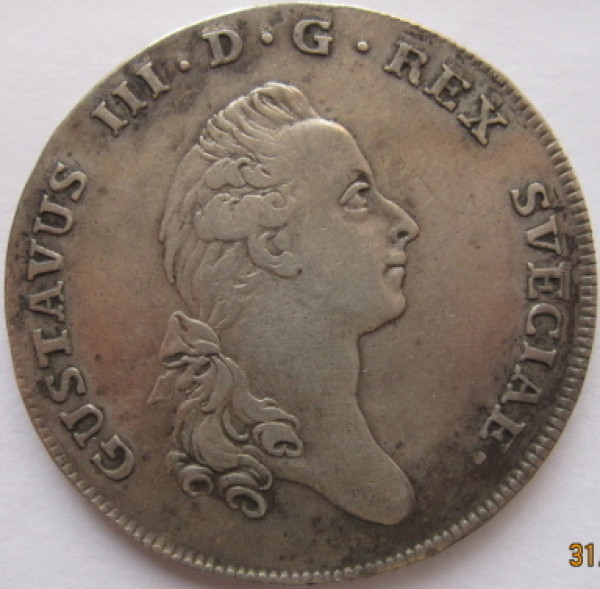
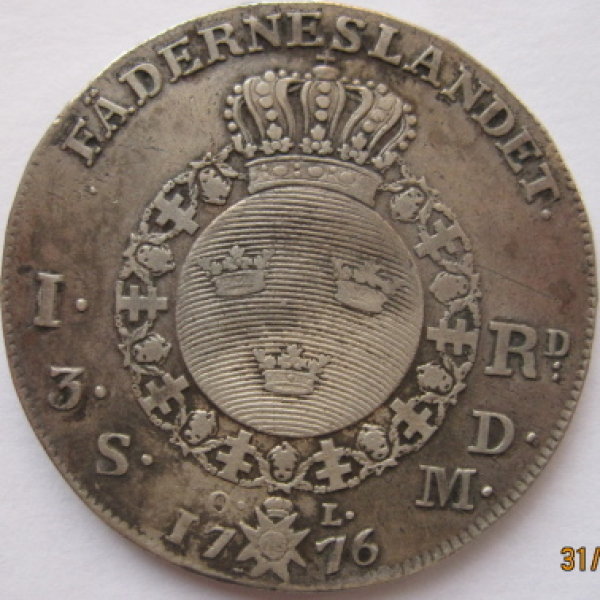
Here's my favourite large silver coin... Swedish 1777 Riksdaler. Too bad about the pitting on the obv though. Have been thinking about upgrading but it gets kinda pricy after a while   |
|
Pillar of the Community
United States
5362 Posts |
epikur I hate to be the one to point it out, but the coin you posted appears to be a cast copy - recently made using a transferred impression.
Is that your take as well?
|
|
Valued Member
United States
462 Posts |
epikur, that is an awesome looking coin. This one is in my wish list :)
|
|
Pillar of the Community
Sweden
729 Posts |
Quote:
epikur I hate to be the one to point it out, but the coin you posted appears to be a cast copy - recently made using a transferred impression.
Is that your take as well? I'm pretty sure it's genuine. Bought from a very reputable coin dealer here in Sweden. Lettering on the edge show no evidence of it being a cast copy. Size and weight correct. Might just be the lightning that makes the surface look odd. Will try to take better pictures in daylight, but since it's so darn dark up here close to the arctic circle, I only have a few hours on weekends to take good pictures |
|
Pillar of the Community
United States
5362 Posts |
It is not JUST the surfaces - I am very concerned about the appearance of the Kings head, The chin in particular is effected by what I refer to as a "soft die" break. It is the type seen on plastic transfer dies and NEVER on steel original dies. I have checked several on line sources of recorded auctions and I conclude the coin is actually a forgery. 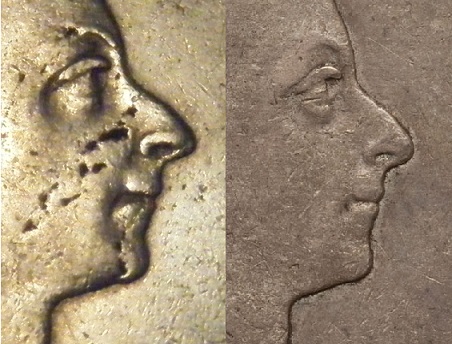 The big problem as I see it is how do you explain the Chin, nose and eyebrow die breaks? Those die displacements are not post strike damage in my opinion but point to a cast copy made from a damaged mold. There are numerous other very subtle clues involving the tops of letters and the extraneous lumps caused by die chips, but a close point by point evaluation against 6 real examples does not come out good at all. Heritage has several great examples of this precise coin in high grade and each of those coins essentially matches within the limits of period die making techniques. However, I do not see a match with the coin shown above. The face at the right is from a real 1777 Swedish Riksdaler. |
|
Pillar of the Community
Sweden
729 Posts |
Thanks...I'll bring the issues to the dealer and see what he says about them
|
|
Pillar of the Community
Sweden
729 Posts |
Hey Swamper. I talked to the dealer and he had no problem taking it back for a full refund. He was curious regarding the differences you found though..
Is there a possibility you can circle the problem areas and specify what to look for...or not to look for?
That would be much appreciated, both for me and the dealer himself.
thanks in advance
|
|
Pillar of the Community
United States
5362 Posts |
The problems are shown on the attached sketch; Yellow circles are around raised lumps and marks on the coin's surface which mean they correspond to holes in the die or mold. They must be appropriate to originals of the era. On the 6 originals I examined (all at a larger scale than you photo and all clear) there are VERY FEW such anomalies and all look like chips that have developed in steel dies. These tend to form in clusters very typical of plastic casts. They are seen on the fields and on high point details (die recesses). The worst in my opinion are the lines on the neck and the single line in the hair left of the eye. This curved line crosses the outer curl and crosses it in a reversed s shape to the curl above. It is not the only one but is terribly incorrect. Looks like an object like a string was on the host coin before the cast was made. When the cast was pulled off the string left a hole in the mold resulting in a raised impression of the string. The neck feature several parallel lines RAISED look like small splits seen in plastic casts that were removed early causing surface breaks. They could also ce accidental post cast damage to the mold (which is softer than a steel die). The blue circles point out the soft breaks in the mold where literal chips or surface strips of the mold's surface have peeled away at some point before this coin was made. Looks like they added just a bit to the length of the nose and the portion under the nose which appears slightly raised on the coin but should not be. The chin looks like it was damaged possibly slightly displaced. The eyebrow shows conclusive evidence of a loss of mold/die material resulting in a higher than normal relief of the eyebrow. The red circles show the problems with the letters that I raised. Often cast transfer images share this precise feature a RAISED margin at the edge of the letter as if metal was dragged upward. On the coin itself it will be identifiable as part of the cast. A slightly similar feature is often seen on modern coins because of high speed apparatus and ejectors. But in the 1770's these features are a real warning. On fakes they usually are accompanied by hollow letter tops. These areas should be examined (because they are protected surfaces). On an original coin this would be a portion of undisturbed surface from the pre-strike planchet - look for lamination lines that are PARALLEL across the whole surface of the coin NOT RADIAL. The green circles are on anomalies of the dentils. This could be attributed to a number of causes and some are clues to forgery. If the coin is a contemporary counterfeit - those lines could indicate the coin is a Sheffield plate and the circular depression is associated with a ribbon edging system. They coul also point to post strike edging which would be anomalous in 1770's because most mints had adopted pre-strike edging (milling) as a method of applying the edge lettering. So I have a question were these coins edged before or after they were struck? In a more general way I was also bothered by the seeming lack of die erosion lines at the edge. 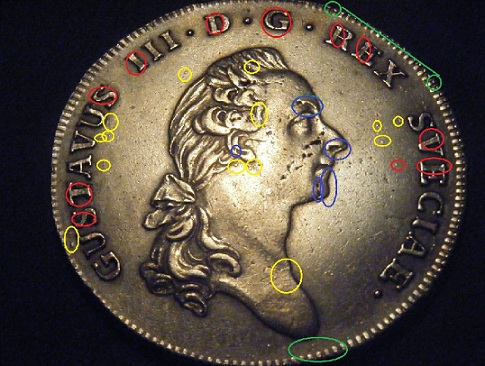 |
|
Pillar of the Community
Sweden
729 Posts |
thanks so much for the detailed explanation.
You are making some valid arguments and I will return it...
Now I know what to look for when purchasing another riksdaler
|
|
Pillar of the Community
Hong Kong
1270 Posts |
|
|
Pillar of the Community
United States
5362 Posts |
It certainly looks a lot better and based on the "cleaned" spot on the reverse looks like it passed an "acid test" only loosing some dirt in the process.
I am not a fan of the color, toning or the way the light reflects but I would not jump up and scream counterfeit either.
This kind of coin needs a close in hand inspection for any degree of certainty.
|
|
Page 2 of 2
|
Replies: 19 / Views: 3,119 |
Page 2 of 2
|






 First Page


 Posted 12/17/2012 6:36 pm