| Author |
 Replies: 42 / Views: 5,488 Replies: 42 / Views: 5,488 |
Page 3 of 3
|
|
|
|
Valued Member
50 Posts |
Would you presume that the counterfeiter deliberately attempt to produce an error coin, or did he try to produce a normal Morgan and the process was imperfect?
In other words, is the clash intentional on the part of the counterfeiter, or not?
|
|
Moderator
 United States
23522 Posts |
I'm thinking unintentional; it probably cost them a reverse die that took a lot of work to prepare.
|
|
Pillar of the Community
 Canada
2531 Posts |
It looked OK to me, that's why I bought it. It would be pretty horrible if I had paid the full $75 he asked for. It. I knew 1887-P wasn't a rare date so I sort of let my guard down.  How thick is a Morgan supposed to be? Closer to 2mm which is about the thickness of an Ike? Edit: I'm not away in the day today so here's a couple of better pics. It's actually pretty bright. I don't know what they plated it with but I'm positive it's not mercury. I don't think it's aluminium either, not bright enough. The guy had two Morgans on his table and the other one looked polished very bad. 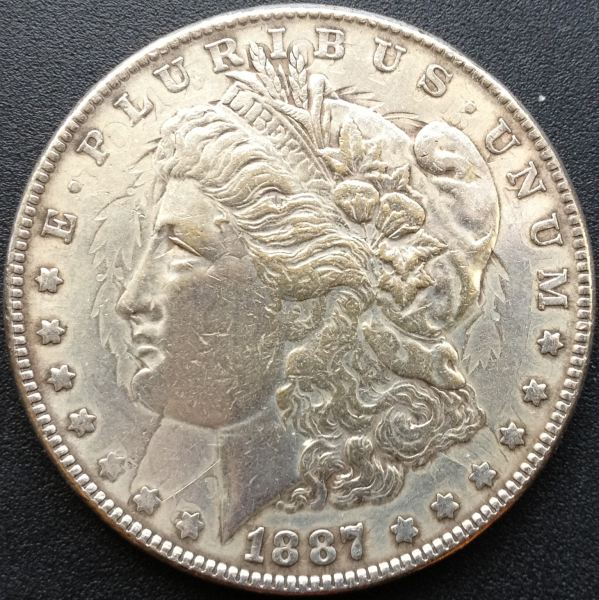 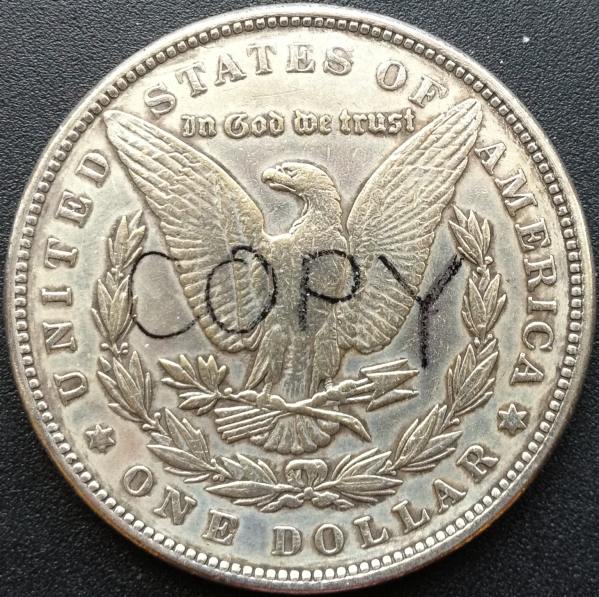 Here's the result of the tissue test. On the left is a MS silver. 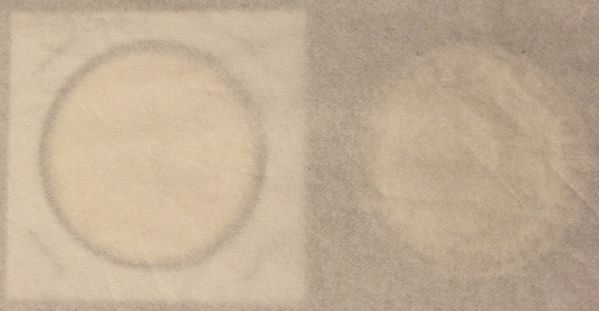 On the left is aluminium. 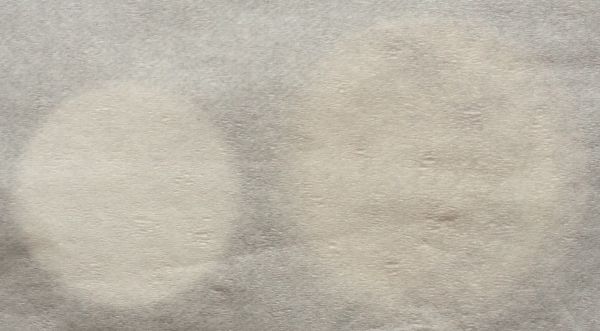 Edited by Altaira
12/30/2014 3:13 pm
|
|
Moderator
United States
23522 Posts |
Thickness is discussed but not really standardized among Morgans - I'm not sure if a realistic tolerance is possible between striking differences.
|
|
Pillar of the Community
United States
1796 Posts |
Alerted to this thread by SsuperDdave I must say I'm impressed. This is *certainly* a counterfeit, but I like it!
That's a beautiful clash. :-)
As for metrics, the date and the denticles are off. I'd pass a magnet over it and see if it sticks. Clashes are very common among base metal counterfeits, but rarely this dramatic. It could very well be a deliberate attempt to make an "error" coin.
|
|
Pillar of the Community
Canada
2531 Posts |
No attraction to the magnet. It rings like some copper alloy when tapped with another coin, not like a silver coin at all. The ring is higher than a clad Ike.
|
|
Pillar of the Community
United States
1215 Posts |
Try using a strong neodymium magnet and putting it on the surface, then picking up the magnet quickly. The coin should momentarily stick if the coin is silver. This works almost all the time for telling silver from copper or lead.
Of course, if the coin sticks for a long time, you can assume an iron or nickel composition.
A coin dealer in Shanghai showed me this trick. It works in one of a city with the most counterfeits, and should work for your coin.
|
|
Pillar of the Community
Canada
2531 Posts |
I only have a tiny magnet that looks to be the right size for something that fell out of a magnetic chess piece. I don't even remember where I found it. I stick it to a nickel so it won't get lost. It's strong enough to pick up four pennies though.
|
|
Pillar of the Community
United States
1215 Posts |
I was quite shocked when you say 4 pennies. I was thinking US penny. Then I remember you reside in canada!
Edited by 0xDA71D
12/30/2014 8:23 pm
|
|
Pillar of the Community
United States
1796 Posts |
It's easier to get a medical grade neodymium button magnet (1/2" diameter x 1/8" thick) and slide it down the face of a coin through a slip or piece of paper.
That way you don't risk damaging the coin from a drop. :-)
It slides slowest over silver and gold, but not as slow over other metals. (Although pure copper and aluminum slide slow*er*.)
A ferric magnet or lesser magnet doesn't produce a strong enough field to provoke the diamagnetic reaction.
Edited by SteveCaruso
12/30/2014 8:25 pm
|
|
Pillar of the Community
Canada
2531 Posts |
I have a copper round, a silver round, and lots of aluminium coins so I should be able to test that out. I don't like shopping online so I'll probably ask my LCS if they sell those. Or find someone on CCF with neodymium magnets for trade.
|
|
Pillar of the Community
Canada
2531 Posts |
I just got it weighed at the PO. It weighs 27 grams, the scale at the PO doesn't have any more decimal points. Considering a real one should weigh 26.73g, I might know if this fake weighs right if the scale was more accurate.
|
|
Pillar of the Community
Canada
2531 Posts |
Just a follow up, I got this weighed in the chemistry lab and it weighs 26.972 grams. And a new photo comparing its thickness to an Ike. 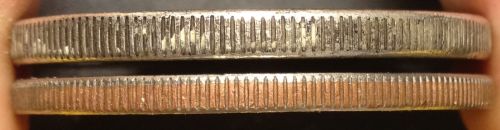 No, the "Morgan" is not closer to the camera. It's that thick. |
|
Pillar of the Community
United States
1704 Posts |
In the event of clashed dies at the Mint the coin press operator would remove both of the dies and they would be inspected. If either or both of them were deemed to be reusable the die would be polished to remove as much of the clash marks as possible then the die would continue to be used to strike coins. That is why on many Morgan dollars the letters and other features of the opposing die are barely visible. There would also be die polish lines indicating that the dies were resurfaced prior to use again. Anyone who collects Morgan dollar VAM's should know that die polish lines are a diagnostic on virtually all dollars with clashed die marks. At first glance this coin had red neon lights saying I am not from the U. S. Mint because the clashing is far too strong. Given that this dollar was for sale in Indonesia would have been enough for me to pass on buying it. |
|
Pillar of the Community
Canada
2531 Posts |
I didn't buy it in Indonesia, I bought it in Canada. Indonesians don't use Dollars (unless you're in Bali where there are a lot of Westerners).
I mentioned Indonesia because if you are buying stuff in Indonesia (especially Bali), you are supposed to haggle because the people usually set high prices to rip off people who are unfamiliar and got lots of money (plus the exchange rate is sweet).
As for buying a Morgan, I have never even seen a real one before. It's an impulse buy, stupid of me to do that...
|
|
Page 3 of 3
|
Replies: 42 / Views: 5,488 |
Page 3 of 3
|







 First Page
 Previous Page


 Posted 12/30/2014 07:49 am





