| Author |
 Replies: 20 / Views: 5,129 Replies: 20 / Views: 5,129 |
Page 2 of 2
|
|
|
|
Bedrock of the Community
Canada
21912 Posts |
|
|
Pillar of the Community
Canada
2531 Posts |
Looks like I'm wayyy off again.
|
|
Pillar of the Community
Canada
1049 Posts |
Slurexe, it's like other's have said ya have to keep trying, me too I get it way off as I'm also learning, cheers
|
|
Valued Member
 United States
143 Posts |
Thanks everyone. I'm still transfixed by the reverse on this thing, toning and all. I just love it.
|
|
Pillar of the Community
 Canada
2361 Posts |
Flat Back 9 appears in the 1941. Narrower date.
|
|
Valued Member
United States
143 Posts |
SilverDon, I'm not very familiar with Canadian coins, so I'm not sure I understood your comment. I did some googling and see references to "flat back 9" and narrow dates, but am not understanding what I'm finding. I'm only getting back into my coin collection after a 35 year respite, so I'm still a bit new here. :-) If someone could explain the significance of his comment, I'd appreciate it. Thanks.
|
|
Pillar of the Community
Canada
2531 Posts |
The presence (or lack) of toning, seen from one angle, often throws me off. That's why whatever I try to photo-grade is usually all over the place. I think SilverDon is talking about this: 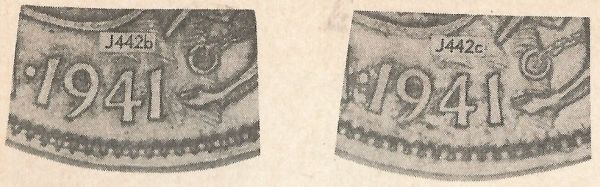 J442b: Narrow date, 41 close J442c: Wide date, 41 apart Just keep in mind this came out of a 50-year old catalogue, I'm not sure how accurate this is at the present. |
|
Pillar of the Community
Canada
2361 Posts |
So the reverse die was re-used and subsequent dates were made by punching the last two numbers of the date,
the 1 and the 9 were on the die as constants and the 4 and the 1 were punched in. In the process of die refurbishment
the round back of the nine was flattened to a flat back nine. Some dates in the 40's were narrower
some dates wider. Some dates within the same year have wide and narrow varieties depending on how widely
spaced the last two digits of the date are, close to the Unicorn's hoof and the ring above it.
Many die varieties and combinations exist for both the reverse and the obverse for George VI 50 cent coins.
Thanks SlurExe97 for the pics.
Edited by SilverDon
01/16/2015 01:55 am
|
|
Valued Member
Canada
456 Posts |
To clarify what SilverDon said....
From 1941-1949 the last two date digits for the 50 cent coins were entered into the dies individually.... this meant that there is a lot of oppotunity for different date configurations... some widely spaced and some closely spaced.
While preparing the dies, some of the 9's resulted in a flat appearance on the back edge and some had a rounded appearance...
See Charltons 2014 68th in the Varieties section where this is discussed.
Edited by pginrh
01/16/2015 08:32 am
|
|
Pillar of the Community
Canada
2361 Posts |
Thanks pginrh for the clarity.
|
|
Pillar of the Community
Canada
2786 Posts |
photos appear VF20 but silver is hard to get good photos of, wouldn't surprise me if it looked much better in hand
|
|
Valued Member
United States
143 Posts |
That's really interesting about the date. I noticed that the 19 and the 41 were too far apart, but then didn't think anything of it. And I've found silver difficult to photograph as well. It's hard not to overexpose or underexpose parts of the photo, then there's the toning, which can change color as the light source shifts. I may try an HDR photo next time, to see if that helps.
|
|
Forum Kid
Canada
1074 Posts |
|
|
Valued Member
United States
143 Posts |
I just realized that I have a second of the same coin (a bit more worn). So this would be the wide date, I assume? It definitely looks wider than my other coin's date.  Edited by jakesis
01/17/2015 5:41 pm
|
|
Valued Member
Canada
456 Posts |
The Canadian Mint reported that 32 Reverse dies were used in 1941. Because the last date digits were individually entered that means there are 32 potential configurations. This is certainly one of the widest ones....
|
|
Page 2 of 2
|
Replies: 20 / Views: 5,129 |
Page 2 of 2
|







 First Page


 Posted 01/16/2015 12:01 am





