| Author |
 Replies: 20 / Views: 5,076 Replies: 20 / Views: 5,076 |
Page 2 of 2
|
|
|
|
Pillar of the Community
Canada
2784 Posts |
Mass production Speed meets precision The Winnipeg Mint is Canada's high-volume coin production powerhouse. Here, the industry's most technologically advanced processes and equipment produce up to 15 million plated coins each day for Canadian and foreign circulation. Our adherence to the highest manufacturing standards is what makes the Royal Canadian Mint a valued provider of coins to countries worldwide. How circulation coins are produced Circulation coins are minted using the world's most advanced minting techniques, patented technologies and rigorous statistical sampling to ensure the highest quality standards. Producing blanks Large coiled strips of core steel are fed into a high capacity punch press, which can produce over 13,000 blanks per minute! Refining the raw materials The core metal blanks are deburred to remove any rough edges, then rimmed (a raising and slight rounding of the edges), annealed (heated to better receive the strike), and cleaned. Enhanced security Electroplating is the practice by which steel coin blanks are coated with nickel and copper plate for protection. The Mint's exclusive patented multi-ply plating technique is the world's only multi-ply layer process that can match the electromagnetic signature of any traditional alloy coin - an enormous security advantage for the coin-operated vending industry. Exacting standards After plating, the coins are dried, polished and then sorted by a state-of-the-art inspection camera which examines up to 180,000 blanks per hour for blistering, colour variations and surface defects. Now the coins are ready for striking by a high-speed coining press. Once the coins have been rolled and wrapped, they are shipped to the Mint's coin pool sites across words from the mint this is how they make them |
|
Pillar of the Community
Canada
2784 Posts |
thank you SlurExe97. I understand how they work . copper plated zinc. used in pennies 1997 to 2012 that's why some of the 2006 are worth so much
|
|
Valued Member
Canada
219 Posts |
Quote:Strong Machine Doubling, which is a product of the strike - it is not a doubled die. Hi SPP-Ottawa, can you tell me how you came to this conclusion?  If I look at the rim beads they do not look like MDe to me. Below is an illustration to show how I see it. The doubling of the 2014 quarter extends outward from the relief (highest point) of a normal bead, where for Mechanical Doubling the relief is always smaller than normal.  |
|
Pillar of the Community
Canada
2531 Posts |
|
|
Pillar of the Community
Canada
2632 Posts |
Quote:
Too many true doubled dies? I thought moderns use single-squeeze hubbing which means that there can't be a doubled die anymore. Actually it can because a single squeeze is done in progressive successions with continuous pressure being applied, making it at least 2 squeezes or more in one. Slowly builds to max pressure. Old way was squeezed a couple times with pressure released between squeezes. added http://www.error-ref.com/centrally-...ed_doubling/Edited by Alexer
02/18/2015 02:56 am
|
|
Moderator
 Canada
10476 Posts |
Quote:
Hi SPP-Ottawa, can you tell me how you came to this conclusion? Sure. Absolutely no splitting of the other die elements, like the serifs on the numbers. If it was true die doubling, the doubled element would be at the same elevation as the first element, with a crease between them - yours has the standard shelf-like appearance. Stanton's paper is an excellent one to read: http://www.coinbidders.com/Strike%2...0-%20PDF.pdfThe effect on the beads in your photo is no different than what you see in the word LIBERTY in the 2nd page of that article. That 2014 25-cent is not a "doubled die" in the truest definition of that term. "Discovery follows discovery, each both raising and answering questions, each ending a long search, and each providing the new instruments for a new search." -- J. Robert OppenheimerContent of this post is licensed under a Creative Commons Attribution-NonCommercial 3.0 Unported License. See: http://creativecommons.org/licenses...0/deed.en_USMy eBay store
|
|
Pillar of the Community
Canada
1505 Posts |
Thanks for sharing the link SPP, interesting read.
|
|
Valued Member
Canada
219 Posts |
Quote:
The effect on the beads in your photo is no different than what you see in the word LIBERTY in the 2nd page of that article. Is this the image you are referring to?  source: http://www.coinbidders.com/Strike%2...0-%20PDF.pdf If it is, it is very different than what I presented. All the letters on the word LIBERTY have thinner relieves than the normal letters. Also observe how flat the doubling looks like spreading in all directions similar to when you squish play-doh on a desk! What would happen if the working hub shifts while pressing the working die? In this situation, I'm sure there would be no splitting of the sherif. Now, for "the standard shelf-like appearance", I do admit that it is a characteristic of Machine Doubling, but it can also be a characteristic of a true double die! The american coins have rounded edge finish on the relieves where canadian coins have mostly sharp edges relieves, thus, canadian coin double dies will have a self-like appearance. Below is an illustration that shows the creation of a double die having different finishes on the relieves. 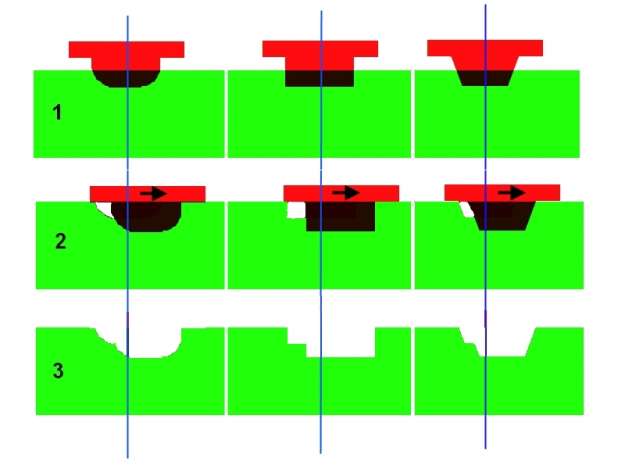 Edited by numidan
02/18/2015 12:15 pm
|
|
Moderator
Canada
10476 Posts |
Quote:
What would happen if the working hub shifts while pressing the working die? In this situation, I'm sure there would be no splitting of the sherif. Then it is not a doubled die, in the established meaning of that word... "Discovery follows discovery, each both raising and answering questions, each ending a long search, and each providing the new instruments for a new search." -- J. Robert OppenheimerContent of this post is licensed under a Creative Commons Attribution-NonCommercial 3.0 Unported License. See: http://creativecommons.org/licenses...0/deed.en_USMy eBay store
|
|
Valued Member
Canada
219 Posts |
Quote:
Then it is not a doubled die, in the established meaning of that word... Really that is your answer! You read "shifts" and automatically discredited the rest? Wexler writes http://doubleddie.com/144822.html : "Unlike genuine doubled dies for which the doubling is on the die itself (hence the term "doubled die"), Mechanical Doubling is the result of loose parts in the coining press. These loose parts allow the dies to shift and/or bounce slightly at the moment of impact when the coin is being struck." What I have written was " while pressing the working die" not the coin! Also, in the PDF you have indicated above, it is written: "Typically, die doubling will almost always exhibit splits in the serifs of the letters and/or numerals, with rounded, secondary images." the word use here is almost always and not just always and further you will read: "There is one class of doubled die which would not exhibit the normal characteristics mentioned for die doubling." --> "normal characteristic" referring to "splits in the serifs". Thus, one can conclude that there are situations where double die won't exhibit "split serifs" characteristics. P.S. It does indicate that there is "one class", but this is base on American coins and not on Canadian coins. Lets not forget that not long ago people thought single- squeeze process would eliminate double dies. Edited by numidan
02/18/2015 4:53 pm
|
|
Pillar of the Community
Canada
4912 Posts |
The coin is Machine Doubling, if it were a double die or even a regular strike for that matter than the devices would be of Norman(for standard) or wider(for a double die) the coin presented has thinner elements where doubling is shown which means that it is without a doubt a machine doubled coin!. The only way a doubled die can occur and have thinner devices is if the design/writing is incused which is not the case with this coin. Feel free to call me Will.
Edited by thedollarman
02/18/2015 8:12 pm
|
|
Moderator
United States
23522 Posts |
This has been brought to my attention, and I can't honestly tell you I'm sure what I'm looking at. It presents the classic form of shelving associated with Machine Doubling, yet in far greater strength than you'd expect. MD is rarely that strong. Yet there's nothing whatsoever that looks to me like die doubling, either. When die doubling is so perfectly aligned that all the doubles show absolutely zero offset - rare indeed - it just doesn't get this strong. Have a look at how the light is playing on the doubling features. First, to illustrate the depth of the shelf but second to note those spots of light at some of the corners. Those are raised points. How do they come to be? Interesting. |
|
Valued Member
Canada
219 Posts |
Quote:
the coin presented has thinner elements Here is a montage of Pierre V's picture and a regular 2014 quarter. This is the best I came up. The red outline is that of the normal coin. I am convinced that the elements are not thinner but of the same size and thus a double die. Anyways, I will keep my eyes out for this one and report back with better pictures.  Edited by numidan
02/18/2015 10:24 pm
|
|
Pillar of the Community
Canada
2632 Posts |
I too see nothing that would indicate DD. This coin looks like it took a bounce to one side either through ejection doubling or maybe 'push doubling' which is often mistaken for DD. You can read about PD at error-ref.com. If it was DD then a lot more of them are out there somewhere, you'd think we be finding more of them by now... just my opinion
|
|
Valued Member
Canada
219 Posts |
|
|
Page 2 of 2
|
Replies: 20 / Views: 5,076 |
Page 2 of 2
|







 First Page
 Posted 02/17/2015 9:03 pm





