| Author |
 Replies: 33 / Views: 8,241 Replies: 33 / Views: 8,241 |
Page 3 of 3
|
|
|
|
Pillar of the Community
 United States
4051 Posts |
If you look at the link I posted earlier in this thread, I compared the look of a Mercury dime with several lighting techniques, and definitely prefer the foil reflector over white. It might make sense just to add some foil to the white reflector surface to increase the amount of direct reflection, while keeping flexibility of having diffusion depending on where you point your lights. Another option that might work just as well is simply to block areas of the diffuser surface with black tape. It's not so much the surface type but the "size" of the apparent light source that makes the difference. With the whole surface being diffusive, light comes from everywhere sort of like a ringlight. Blocking certain areas, especially those around 6:00, would make a more directional diffusion and likely improve the look. |
|
Pillar of the Community
 2087 Posts |
Quote:
Another option that might work just as well is simply to block areas of the diffuser surface with black tape. Yes here is one take on that approach, of a number I use : 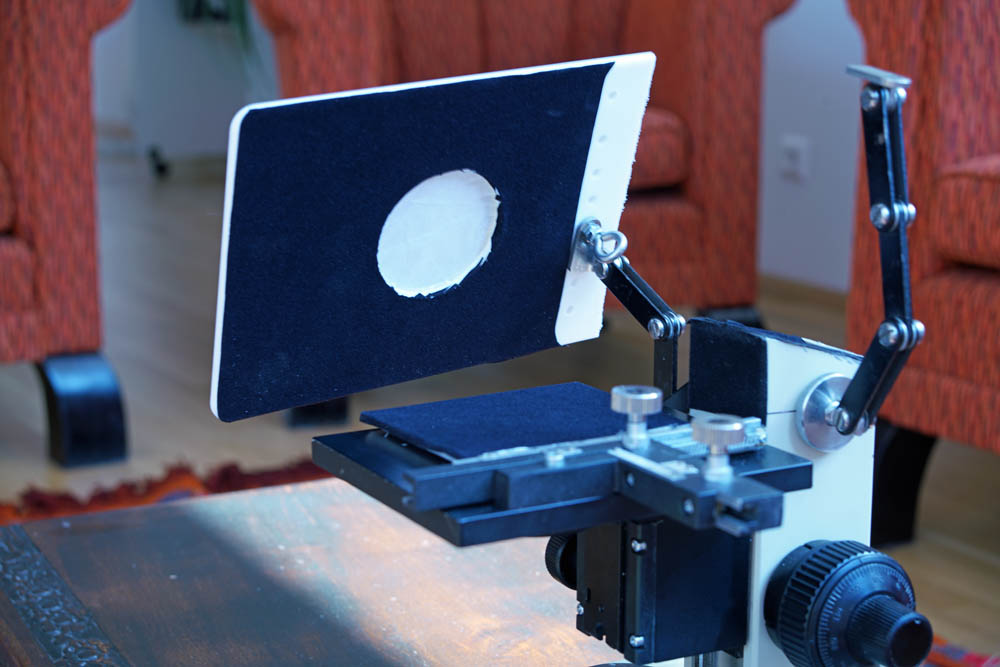 Its one of the small cutting boards with a circle cut in the middle which was then covered by nylon diffusion material. I direct the lights( using the snoots minus the honeycomb) to shine through the "window". One side of the board is left white the other is covered with camera flock. I have a variety of these boards, constructed in pairs, and I can mix and match boards according to how each coin responds to the lights. the board here has one hole I have another pair of boards with five smaller holes and I will be adding a pair of boards with two holes. Another pair has no holes just one side black the other white. I constructed these boards because the commercially available diffusers and reflectors were too large for coins ( as well as too expensive). As you can see from the photo it will be very simple task to construct a pair of Aluminium foil covered reflectors. The local supermarket staff must wonder why I buy so many of those boards (LOL) Edited by austrokiwi
08/08/2015 10:31 am
|
|
Pillar of the Community
United States
4051 Posts |
Now if you just cut those with a curve-shaped hole you'll have "smile directors"!
|
|
Pillar of the Community
2087 Posts |
Quote:
Now if you just cut those with a curve-shaped hole you'll have "smile directors"! I will try in a few weeks. I will make the aluminium reflectors this coming week... then I am off to Jordan for a couple of weeks( with some coin hunting planned) Then I will see if my hand is steady enough with the dremel |
|
Pillar of the Community
2087 Posts |
th alumium reflectors took all of half an hour to make. This photo cant be compared directly to the others as I used a different lens : Rodenstock Rodagon APO 90 mm F4 enlarger lens set to F8. I can see why you would prefer an aluminium relfector with proof and DMPL coins. the hardness and metalic quality of the light really compliments such coins. Although it all comes down to Aesthetics I think I prefer the soft "reflectors" for circulated coins... and "impaired" coins. The aluminium foil reflectors seem to highlight every fault  |
|
Pillar of the Community
United States
4051 Posts |
Looks like the majority of the light is coming in at a low angle rather than reflected from above. This might be why you don't like it as it's not presenting the coin in a natural way. Did you modify the 45-deg diffusers to have foil, or the horizontal diffuser? I found that the foil increases illumination so I would have expected a more vertical lighting presentation if the horizontal had been "foiled". Anyway, this image is also still showing too much diffusion, as indicated by the lack of surface luster. Couple problems to fix.
Contact me for photographic equipment or visit my home page at: http://macrocoins.com |
|
Pillar of the Community
2087 Posts |
Well spotted. I made two new reflectors out of medium sized boards. They were mounted either side of the stage so that the light was coming in at about 30 degrees. My wording may have been poor I quite like the effect on this coin.
The other issue is there was too much day light around.
I may be proved wrong but I suspect I won't like it on old circulated silver. To night I will mount the boards horizontally above the stage. so the light is coming from a near vertical angle. We definitely have different "eyes" I would like more diffusion. But as already stated I will try tonight with the boards mounted horizontally.
|
|
Pillar of the Community
2087 Posts |
Here are the evening shots. The first combined picture shows two shots that were taken with the aluminium foil reflectors placed horizontally so that light is reflected down on the coin. I spent some time setting up both shots. I even used two boards covered with camera flock to block any side lighting with the aim of trying to maximize the amount of light being reflected down on the coins. I don't like the left picture that much it has some spectacular highlights but it just doesn't appeal to me. The right hand picture, the one I like, was taken after the left, but I adjusted the angle of the two reflecting boards until I had the coin looking they way I liked.  |
|
Pillar of the Community
United States
4051 Posts |
The edges of the devices are still brighter than the surfaces. Definitely not the preferred look.
|
|
Pillar of the Community
2087 Posts |
a different approach with alumium foil: 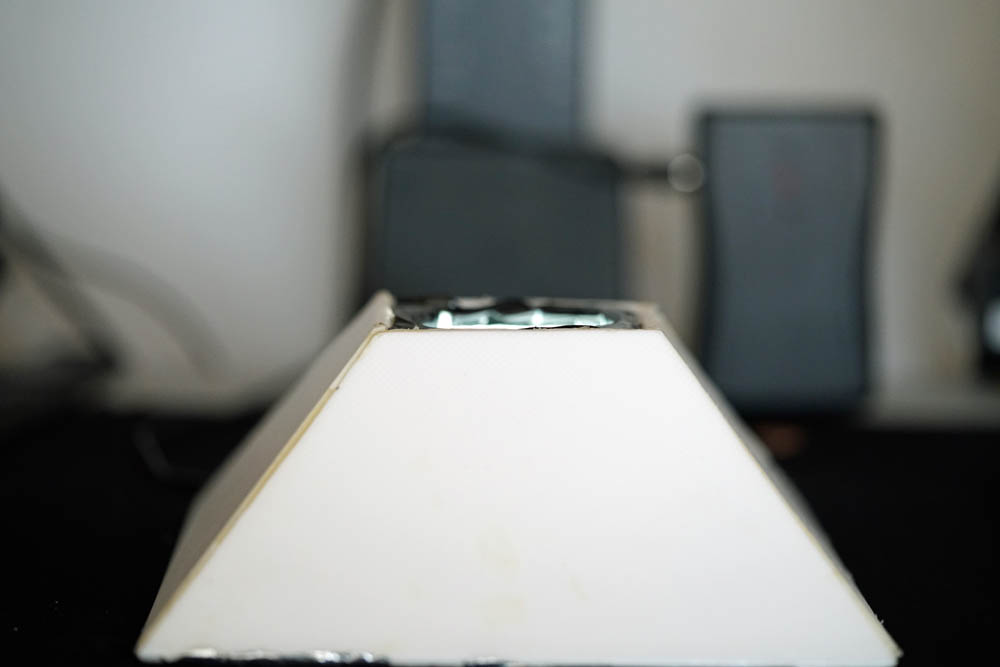 the pyramid is foil lined and sits over the top of a medal light. Coin is placed on the medal light:  |
|
Pillar of the Community
United States
4051 Posts |
45-deg is classic "museum lighting" style. It is good for medals and such since it accentuates surface details well and gives a nice, even illumination. Normally it only comes from one side, possibly two, but from 4 sides it is completely even. For coins, this creates an unnatural look, with highlighted emphasis on the edges of the devices. Most coin photographers try for the "in-hand" look to their coins, and when a coin is held in-hand there is usually one light, and the coin is held so that the light is axial or nearly so.
|
|
Pillar of the Community
2087 Posts |
I am not looking for an in hand look but a look suitable for article and book illustrations. Hence my different approaches. Still not sure if I like aluminium. I had tried that pyramid was plain white and to be honest a polystyrene cup with the bottom cut out of it did the same job with a lot less hassle. I was planning to dump it and this thread made me think of one last attempt with sticking foil on the inside. It was fun trying it out not sure I will use it again but for now that pyramid won't be going in the Rubbish tin.
|
|
Pillar of the Community
United States
4051 Posts |
I assume the articles and books are non-numismatic in nature, correct? Only non-numismatists would prefer the look you're achieving versus the in-hand look.
|
|
Pillar of the Community
2087 Posts |
Wrong I write for collectors...... but I write in a much more academic style than many are used to, my December numismatist article and the one in the International Numismatics bulletin were exceptions( both were written with American collectors in mind) Pictures in both are not great I have developed a lot since then. My aim with photographs is clear detail for identification purposes. Accordingly I was very pleased when you noted the lighting was extremely even because that is what I was aiming for
Note in Europe, particularly Vienna, a numismatist does not necessarily equal coin collector, a coin collector can be a numismatist, but to be called such, one preferably should have a degree in numismatics. Its not wrong, its not elitist its just different. Many of the larger auction houses and shops employ people with post graduate degrees in numismatics
Edited by austrokiwi
08/15/2015 05:43 am
|
|
Pillar of the Community
United States
4051 Posts |
I missed the article in Numismatist, will need to check it out.
Even lighting like you're doing is very good for identification / attribution purposes. I use ringlights for all my higher magnification work, though I do block certain directions to improve shadow detail and the overall "look" of the photo. You may try blocking just the bottom 1/4 of the reflector, or a portion of it, to have similar effect. It won't significantly degrade the even-ness, but in fact I find it improves identification and attribution by improving the resolution of details. Flooding light from all directions reduces or eliminates many of the shadows that are required to properly visualize features and details.
In the US, "numismatist" has a much more inclusive meaning. With the European definition, there would probably only be 10 "numismatists" in the entire country! Sorry, hyperbole again. Maybe 20...
|
|
Page 3 of 3
|
Replies: 33 / Views: 8,241 |
Page 3 of 3
|







 First Page
 Previous Page

 Posted 08/08/2015 09:45 am


