| Author |
 Replies: 33 / Views: 8,243 Replies: 33 / Views: 8,243 |
|
|
|
Pillar of the Community
 2087 Posts |
I thought of a better way of wording to describe what, I believe, is unique with the reflectors I am using. They are translucent, but obviously, having a white pigment, not as translucent as un-pigmented polypropylene. They are not "hard" reflectors like Aluminium foil. The best analogy I can think of is they are akin to using a cloud as a reflector, with the added advantage of constant absorbency, transmission and reflection of light. With direct lighting my lights with snoots (a light funnel) are producing 3500K, with the reflectors that temperature drops( from the coins perspective) to 3000K. I would not be surprised if the white pigment in the boards is also fluorescing slightly with the lighting I am using ( LED warm white). I suspect the pigment is titanium dioxide ( a UV absorber) which does fluoresce at 410 nm. These reflectors also perform well with ordinary coins...for example see the following picture. The lens Sony FE 90mm F 2.8 Macro G is new so I didn't hang that huge white reflector off its filter threads. Instead I used the earlier set up ( in the manner suggested by rmpsrmps) and you can see that I didn't quite get the lighting right for the obverse. As an aside; The lens, designed to perform with high mega-pixel sensors( 42mp plus), is performing almost on par with my printing nikkor 105mm. The printing nikkor at 1-1 has a very slight edge on it. The advantage the printing nikkor has is so slight that for Sony E-mount owners the sony 90mm may actually be the better buy.
 Edited by austrokiwi
08/08/2015 04:49 am
|
|
Pillar of the Community
 United States
4051 Posts |
I think you might have missed the point I was making...I gave up on the all-white diffusers in favor of aluminum since the all-white caused too much diffusion, which is exactly what I'm seeing in the Cent and ASE shots above. The Medal looks good, and in general medals benefit either from highly diffused or even axial lighting in order to show all their detail, but the extreme diffusion eliminates all luster presentation so is not appropriate for coins. I use ringlights for their extreme-diffusion characteristics to eliminate shadows and show surface details on my higher mag shots, but even in this extreme situation I still often block parts of the ringlight in order to get a bit of specular contrast to make the image look more like a normal coin shot. The flat nature of extreme diffusion looks "unnatural" and is sort of the opposite of the so-called "in-hand" look most coin photographers are going for. edited...I wrote the above before seeing the post on 2nd page. These shots are showing less diffusion, but have the problem of light coming in at too low an angle. I suspect this is due to the secondary reflectors that might be giving too much side-lighting. Contact me for photographic equipment or visit my home page at: http://macrocoins.comEdited by rmpsrpms
08/08/2015 08:56 am
|
|
Pillar of the Community
2087 Posts |
I not sure if I missed your point or was more focussed on pointing out what I like about this technique. My rig has been developed so I can switch from one lighting technique to another. So in that respect we are on the same wavelength, For the results I like the white reflectors but they are never going to be my only tool. You last response has now switched me to thinking about constructing some aluminium foil reflectors.... the effort is minimal and it will be interesting to try again after so many years of ignoring Aluminium foil. Our differences in approach and preferences can also be due to the coins we focus on.Copper is not my usual subject matter Old silver is what I am photographing the most.
Like you I use a ring light ( currently a Microscope ring light) or on axis lighting for other coins. Lenses with long working distances ( such as my oly 135) see a ring light giving results very close to those of on axis lighting. I have some preference for that lens when wanting to avoid the bending of the image light path by a beam splitter. { Even more preference since I have found it copes quite happily with the demands of a high resolution sensor} That said when it comes to rainbow tones, with my skills and techniques, on axis lighting works best. With gold, to date, on axis and ring lights are, for me the most successful lighting approaches. I have been experimenting with diffusion to see if I can develop another technique
Edited by austrokiwi
08/08/2015 09:26 am
|
|
Pillar of the Community
United States
4051 Posts |
If you look at the link I posted earlier in this thread, I compared the look of a Mercury dime with several lighting techniques, and definitely prefer the foil reflector over white. It might make sense just to add some foil to the white reflector surface to increase the amount of direct reflection, while keeping flexibility of having diffusion depending on where you point your lights. Another option that might work just as well is simply to block areas of the diffuser surface with black tape. It's not so much the surface type but the "size" of the apparent light source that makes the difference. With the whole surface being diffusive, light comes from everywhere sort of like a ringlight. Blocking certain areas, especially those around 6:00, would make a more directional diffusion and likely improve the look. Contact me for photographic equipment or visit my home page at: http://macrocoins.com |
|
Pillar of the Community
2087 Posts |
Quote:
Another option that might work just as well is simply to block areas of the diffuser surface with black tape. Yes here is one take on that approach, of a number I use : 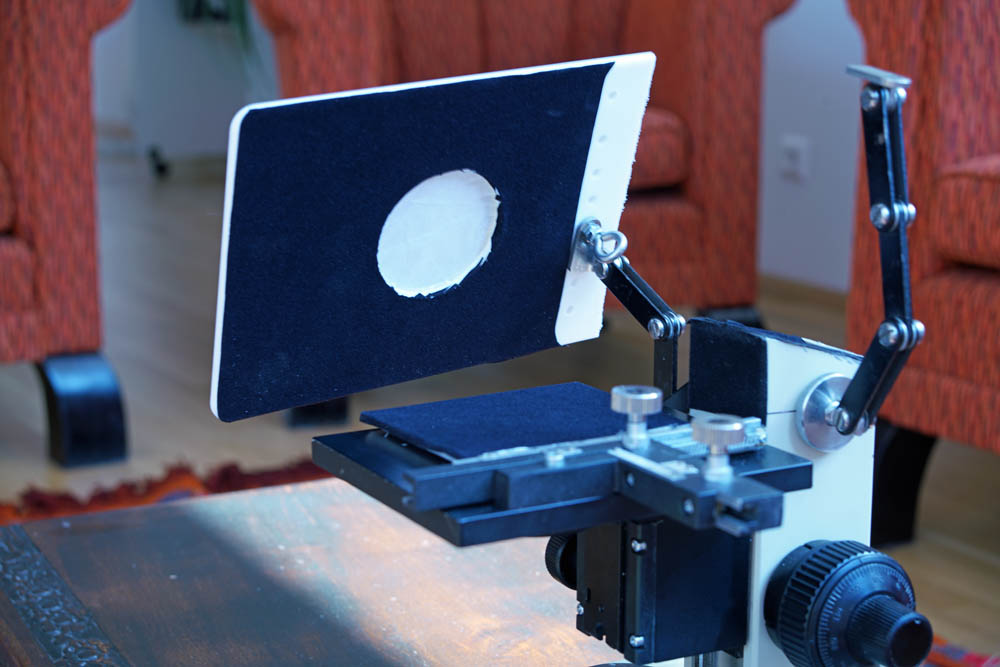 Its one of the small cutting boards with a circle cut in the middle which was then covered by nylon diffusion material. I direct the lights( using the snoots minus the honeycomb) to shine through the "window". One side of the board is left white the other is covered with camera flock. I have a variety of these boards, constructed in pairs, and I can mix and match boards according to how each coin responds to the lights. the board here has one hole I have another pair of boards with five smaller holes and I will be adding a pair of boards with two holes. Another pair has no holes just one side black the other white. I constructed these boards because the commercially available diffusers and reflectors were too large for coins ( as well as too expensive). As you can see from the photo it will be very simple task to construct a pair of Aluminium foil covered reflectors. The local supermarket staff must wonder why I buy so many of those boards (LOL) Edited by austrokiwi
08/08/2015 10:31 am
|
|
Pillar of the Community
United States
4051 Posts |
Now if you just cut those with a curve-shaped hole you'll have "smile directors"!
Contact me for photographic equipment or visit my home page at: http://macrocoins.com |
|
Pillar of the Community
2087 Posts |
Quote:
Now if you just cut those with a curve-shaped hole you'll have "smile directors"! I will try in a few weeks. I will make the aluminium reflectors this coming week... then I am off to Jordan for a couple of weeks( with some coin hunting planned) Then I will see if my hand is steady enough with the dremel |
|
Pillar of the Community
2087 Posts |
th alumium reflectors took all of half an hour to make. This photo cant be compared directly to the others as I used a different lens : Rodenstock Rodagon APO 90 mm F4 enlarger lens set to F8. I can see why you would prefer an aluminium relfector with proof and DMPL coins. the hardness and metalic quality of the light really compliments such coins. Although it all comes down to Aesthetics I think I prefer the soft "reflectors" for circulated coins... and "impaired" coins. The aluminium foil reflectors seem to highlight every fault  |
|
Pillar of the Community
United States
4051 Posts |
Looks like the majority of the light is coming in at a low angle rather than reflected from above. This might be why you don't like it as it's not presenting the coin in a natural way. Did you modify the 45-deg diffusers to have foil, or the horizontal diffuser? I found that the foil increases illumination so I would have expected a more vertical lighting presentation if the horizontal had been "foiled". Anyway, this image is also still showing too much diffusion, as indicated by the lack of surface luster. Couple problems to fix.
|
|
Pillar of the Community
2087 Posts |
Well spotted. I made two new reflectors out of medium sized boards. They were mounted either side of the stage so that the light was coming in at about 30 degrees. My wording may have been poor I quite like the effect on this coin.
The other issue is there was too much day light around.
I may be proved wrong but I suspect I won't like it on old circulated silver. To night I will mount the boards horizontally above the stage. so the light is coming from a near vertical angle. We definitely have different "eyes" I would like more diffusion. But as already stated I will try tonight with the boards mounted horizontally.
|
|
Pillar of the Community
2087 Posts |
Here are the evening shots. The first combined picture shows two shots that were taken with the aluminium foil reflectors placed horizontally so that light is reflected down on the coin. I spent some time setting up both shots. I even used two boards covered with camera flock to block any side lighting with the aim of trying to maximize the amount of light being reflected down on the coins. I don't like the left picture that much it has some spectacular highlights but it just doesn't appeal to me. The right hand picture, the one I like, was taken after the left, but I adjusted the angle of the two reflecting boards until I had the coin looking they way I liked.  |
|
Pillar of the Community
United States
4051 Posts |
The edges of the devices are still brighter than the surfaces. Definitely not the preferred look.
Contact me for photographic equipment or visit my home page at: http://macrocoins.com |
|
Pillar of the Community
2087 Posts |
a different approach with alumium foil: 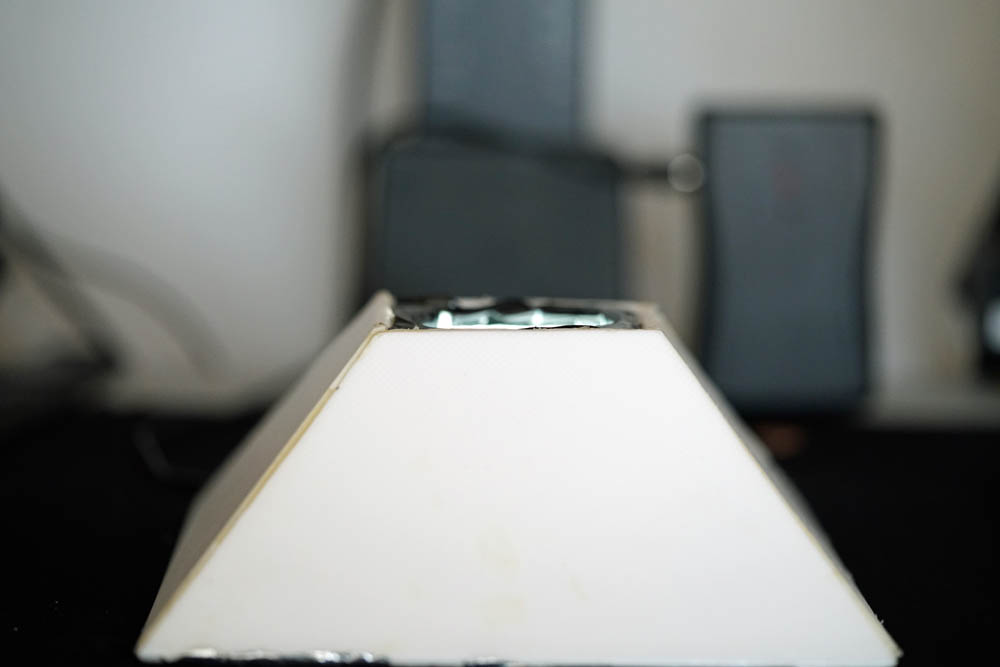 the pyramid is foil lined and sits over the top of a medal light. Coin is placed on the medal light:  |
|
Pillar of the Community
United States
4051 Posts |
45-deg is classic "museum lighting" style. It is good for medals and such since it accentuates surface details well and gives a nice, even illumination. Normally it only comes from one side, possibly two, but from 4 sides it is completely even. For coins, this creates an unnatural look, with highlighted emphasis on the edges of the devices. Most coin photographers try for the "in-hand" look to their coins, and when a coin is held in-hand there is usually one light, and the coin is held so that the light is axial or nearly so.
Contact me for photographic equipment or visit my home page at: http://macrocoins.com |
|
Pillar of the Community
2087 Posts |
I am not looking for an in hand look but a look suitable for article and book illustrations. Hence my different approaches. Still not sure if I like aluminium. I had tried that pyramid was plain white and to be honest a polystyrene cup with the bottom cut out of it did the same job with a lot less hassle. I was planning to dump it and this thread made me think of one last attempt with sticking foil on the inside. It was fun trying it out not sure I will use it again but for now that pyramid won't be going in the Rubbish tin.
|
| |
Replies: 33 / Views: 8,243 |






 First Page


 Posted 08/08/2015 08:53 am


