| Author |
 Replies: 24 / Views: 5,085 Replies: 24 / Views: 5,085 |
Page 2 of 2
|
|
|
|
Pillar of the Community
 Hong Kong
1270 Posts |
Thank you for your input, alphaNumis. I wonder why Malaya or Malaysia don't have their own language but use Arabic? Can you explain more? How about the language used on today's banknotes?
|
|
New Member
Malaysia
31 Posts |
In Malaysia, our national language is Bahasa Malaysia. For the pre-independence (1957) it was referred to as Bahasa Melayu.
The language itself is not very different from Bahasa Indonesia. If you know the Malay language, you shouldn't have a lot of trouble figuring out Bahasa Indonesia.
We have our own language but made use of the Arabic alphabets to write in Bahasa Melayu. It's called Jawi, look it up in Wikipedia you will find :
Jawi is an Arabic alphabet for writing the Malay language, Acehnese, Banjarese, Minangkabau, Taus and several other languages in Southeast Asia.
Sometime after independence in 1957, the use of English alphabets for Malay language gained popularity in Malaya.
The banknote posted here was printed by the British in 1953 - either TDLR or Waterlow & Sons.
So today, all our banknotes do not have Jawi on them anymore.
As for myself, I'm ethnic Chinese, I'm the 3rd generation, a Malaysian citizen by birth.
I don't read Jawi but I do speak and write Malay, which is a required subject in local schools. I also speak/write English (obviously!), Mandarin, Cantonese, Hainanese (both are Chinese dialects).
Most of us here are bi-lingual and being tri-lingual is quite normal.
Hope this answers your question.
Edited by orion68
10/17/2015 01:10 am
|
|
Pillar of the Community
Hong Kong
1270 Posts |
Sincerely thank you orion68. My historical knowledge about Malaysia or South East Asia started from two years' ago, there is a famous documentary DVD made by Mingpo (a Malaysian based News Group), it is called "#19979;#21335;#27915;" (translated in English : Going Down the South Sea). I am also a native Chinese in Hong Kong. From the documentary films, I know the reason why and when the Chinese from Mainland went out to the South Seas. That's a fascinating and epic history of Chinese in another part of the World. Now I use bank notes and coins to learn about the history of Straits Settlements and Malaya. I will post another note here later.
|
|
New Member
Malaysia
31 Posts |
My ancestors were educators and teachers. My grandfather emigrated to Malaya at the turn of the previous century and he was a headmaster in a few of the local Chinese schools. A vast majority of the mainland Chinese were brought over here by the British to work as tin miners. Many later became businessmen - especially the Hokkiens. One Yap Ah Loy later founded the small town called Kuala Lumpur and he became Kapitan. Most have settled here permanently and as a result about 25% of the Malaysian population is ethnic Chinese.
There were Indians from India brought in by the British for the rubber industry. So in Malaysia today we have 3 main ethnic groups Malays, Chinese and Indians. When Sabah and Sarawak joined the Federation in 1963, the population include the natives there - Dayak, Kazadan and Dusun people. So as a nation we are ethnically very diverse.
Besides collecting banknotes and coins, I collect old books and history books as well, all related to Straits Settlement and the British administration, World War II which makes this hobby very interesting. Lots of history here and I collect Japanese Invasion Money too.
Edited by orion68
10/17/2015 05:15 am
|
|
Pillar of the Community
Hong Kong
1270 Posts |
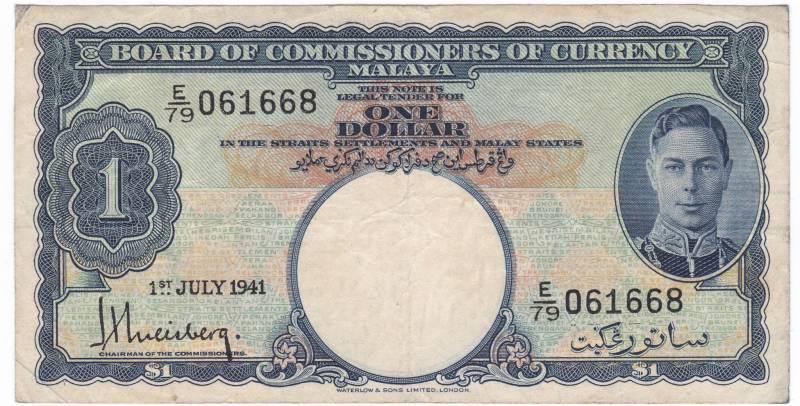 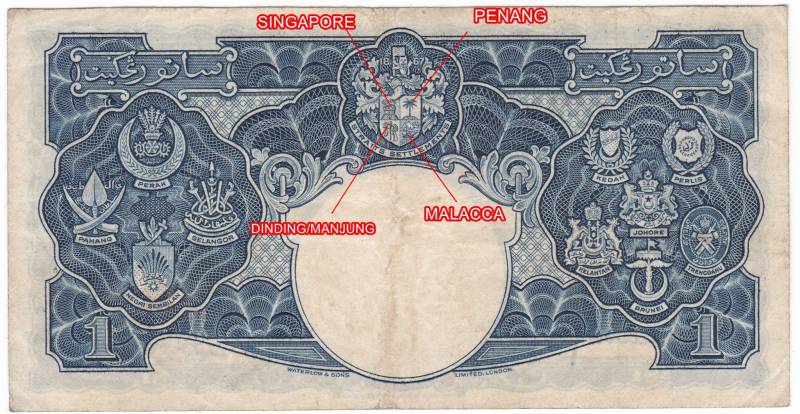 QEII 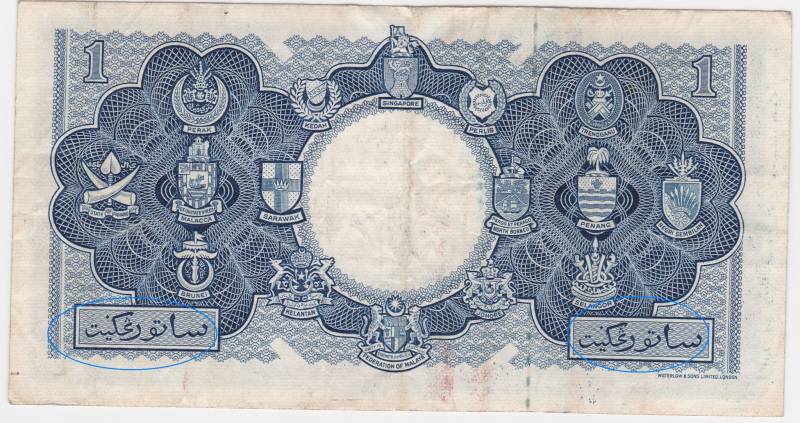 I love these two notes very much for their old design. At the back of the notes, there are a number of coat of arm of the states that were controlled different governments. The CoA on the back sides of the notes told some historical facts, that's are what I want to know. First, I hope those interested in these notes to have a look with my interpretation of the Main Arm (written in red) on the KGVI note? Agreed or tell me what I am wrong. KGVI's note has 14 CoA. Both Sarawak and North Borneo are not present here as they joined the Malaya Federation in 1963. QEII's note does not have the CoA of Dinding/Manjung on it, I think this city had been included in the Malaya Federation so it was not shown individually. Both notes do not show the CoA of Sabah because Sabah is part of the British North Borneo. The CoA of North Borneo was not found in KGVI's note as it was controlled by a franchised British company rather than a Crown Colony. Is that right? Dinding or Manjung is a city not as famous as Penang or Malacca, can you tell something about this city for us, orion68? Henry P.S. I am sorry that my English is not as good as you are orion68. Though HK and Malaya were both British colonies, I have to admit the standard of English is poorer for ourself. We are too close to mainland China so we use Chinese much more frequent than English. Do you read Chinese orion68? I am glad to meet an expert in Asian's history here. I have also heard about the story of Yap Ah Loy from other source. |
|
New Member
Malaysia
31 Posts |
I am running some checks on the Straits Settlements Coat of Arms. These are some views that state the fruit and tree does not represent Dinding/Manjung.
The note was printed in 1941. Dinding/Manjung was returned to Sultan of Perak on 16 Feb 1935, almost 6 years prior.
I will get back to you with the findings here.
FYI In 1941, North Borneo and Sarawak was not part of Malaya. Those 2 states and Singapore did not come in until 1963, that made Malaysia. The Malayan peninsular (including Malacca and Penang, excluding Singapore) gained independence on 31 August 1957.
Malaysia today is a constitutional monarchy consisting of 14 states. All subjects are under the Federal government, only 2 - land and religious matters come under the State government.
Yes, I do read Chinese, which I studied until early Secondary school (it was Traditional Chinese in those days, not Simplified) but it really needs some brushing up on. I speak Mandarin at home, Cantonese & Malay with my friends and English at work. Pretty mixed up eh?
Edited by orion68
10/18/2015 11:56 pm
|
|
New Member
Malaysia
31 Posts |
OK, here's the story. The Coat of Arms for Straits Settlements (SS) : 1. Lion atop of fort on top left - Singapore 2. Leaves and fruit on bottom left - Malacca (Melaka tree) 3. Tree - which is "Pokok Pinang" or Penang Tree (Areca catechu) - Prince of Wales Island & Province Wellesley (today's Penang Island and Seberang Prai) 4. The ship - Labuan, it joined the colony in 1907 a new coat of arms was granted on 25 March 1911. 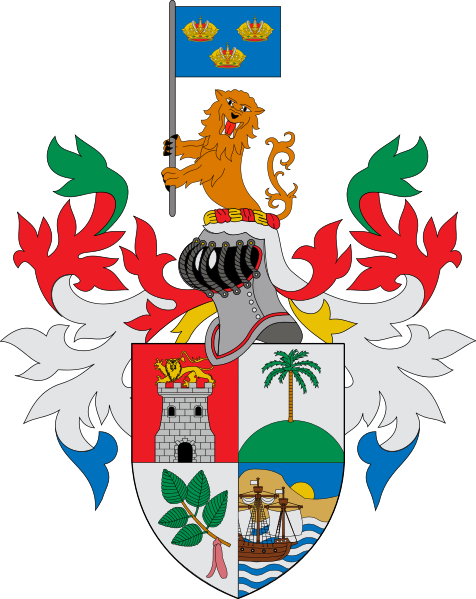 Edited by orion68
10/19/2015 04:34 am
|
|
Pillar of the Community
Hong Kong
1270 Posts |
Orion, thank you so much for your detailed description of the CoA of SS. Your information is awesome and let me "open the eyes". I need some time to digest this thread and reply later. Henry
|
|
Pillar of the Community
Hong Kong
1270 Posts |
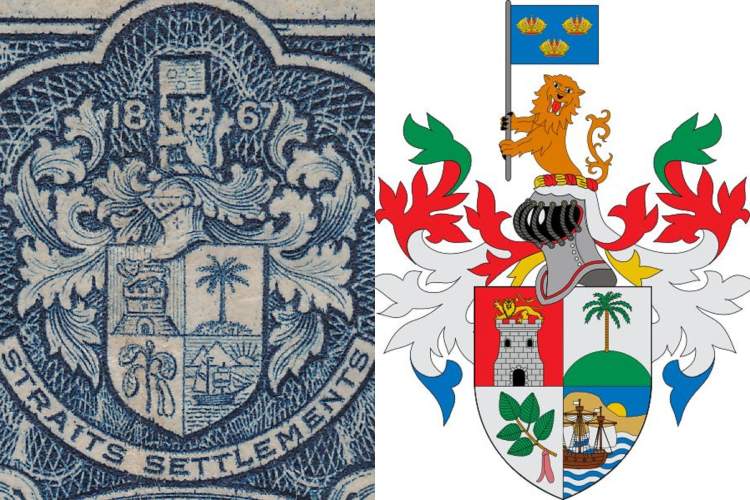 The lower left quadrant looks different for there are different plants here. So I think both CoA were from different era for Straits Settlements. The left one was the CoA in 1867 (as shown on the note) while the right one (presented by Orion) was used from early 20th Century. From what I read in Wikipedia, Dinding or Manjung was one of the major constituent of Strait Settlements in the early days so it became part of the emblem of the whole. Do I interpret it wrong? |
|
Pillar of the Community
United States
1285 Posts |
Found this chart to be quite interesting: ==  == == my favorite note from there  == This is a GREAT thread; quite informative and I've enjoyed the conversation. Such is the purpose of this forum: sharing knowledge and insights. Thanks for everything you have posted.  |
|
Pillar of the Community
Hong Kong
1270 Posts |
Techwriter, don't just say you like this thread. Please consider my question: is the lower left quadrant different or the same for the two CoA at different era.
If they are different, this means the CoA of Straits Settlements changed for some reasons at the early 20th Century.
The note printed in 1941 used the old CoA of SS, I suppose.
|
|
Pillar of the Community
United States
1285 Posts |
Apologies, but I'm trying to do some research to determine exactly what and why the differences. Am looking into what happened from 1941 to 1953; and thus why the change in the COAs that appear on the notes.
|
|
Pillar of the Community
Hong Kong
1270 Posts |
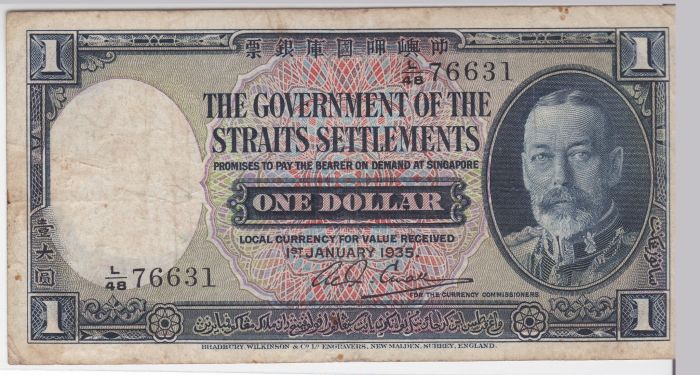 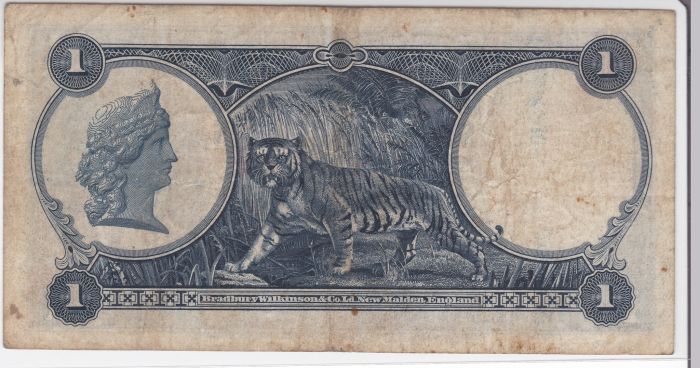 This is another my beloved paper note for the Straits Settlements and Malaya. There are two questions see whether you can give me an idea? This note was issued for the use in the capital city of the British Straits Settlements, Singapore (as shown on the note). Was it also circulate in other parts of the Malaya Peninsular such as Penang and Malacca. Or the latter British footholds used coins rather than paper notes? A tiger image on the back of the note, does it represents an icon for something or actually there were tigers found on the Peninsular? Thank you for any comments. |
|
Pillar of the Community
United States
747 Posts |
The 1935 note would have circulated throughout the Straits Settlements. The reference to Singapore is the location of the seat of the government where the note could be redeemed.
|
|
New Member
Malaysia
31 Posts |
I think the plant on the lower left quadrant are the same plant on both the CoAs, though they are drawn differently.
Edited by orion68
11/05/2015 8:32 pm
|
|
Page 2 of 2
|
Replies: 24 / Views: 5,085 |
Page 2 of 2
|





 First Page

 Posted 10/17/2015 01:00 am


