| Author |
 Replies: 33 / Views: 11,920 Replies: 33 / Views: 11,920 |
Page 3 of 3
|
|
|
|
Pillar of the Community
  United States
1950 Posts |
I know quite little about banknotes in general, so I cannot help much on that...
I do know the notes are quite readily available UNC in Europe to this day, so I would guess that many did not circulate...
|
|
Valued Member
Canada
71 Posts |
I'd never heard of these coal dust marks, really very cool. I'd love to get my hands on one just to see how they feel (and as for the coal smell, I love it!).
|
|
Pillar of the Community
Norway
1358 Posts |
I recently got offered the chance to buy a series of 3 times 3 leather slabs with print on them, which apparently were used as Notgeld, where the colors used and the size apparently determined the value of the slab. As the price was 250 Euro, I left them there. Still I like the idea of so many different creative solutions for having a currency. I just wonder how Germans kept up with knowing what was 'legal' tender and what not, as there have been way over 100.000 different pieces in circulation in the interbellum.
|
|
Valued Member
United States
333 Posts |
Pardon the old bump but these aren't a common thing. I just got ahold of my third one of these and was wondering if anybody else has handled them. There's something a little strange about my latest one... 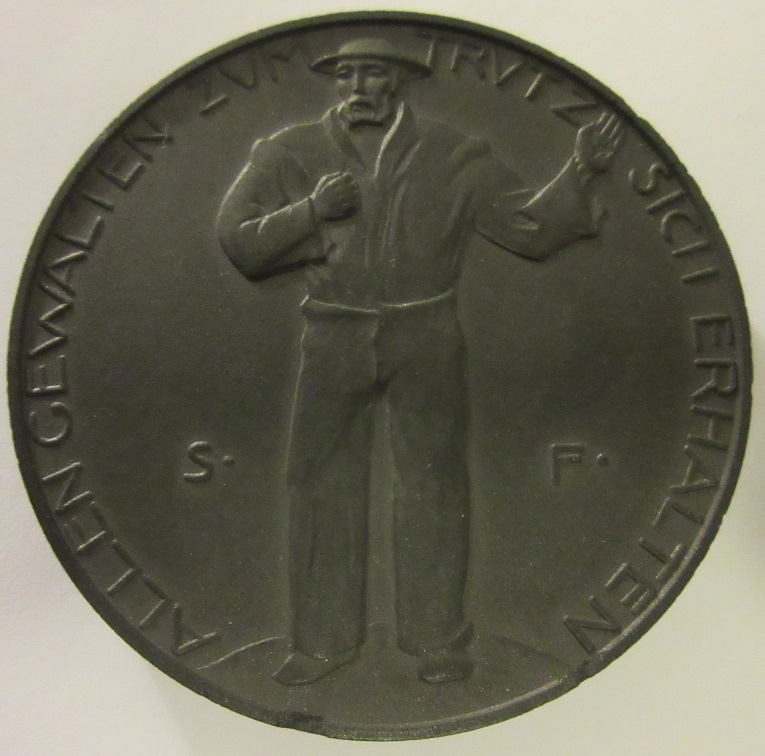 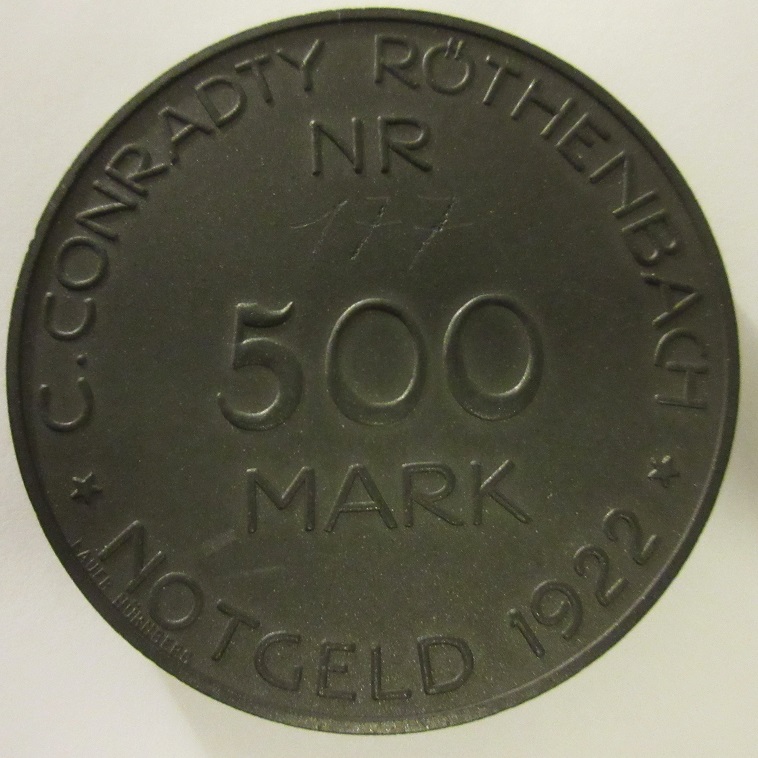 |
|
Pillar of the Community
United States
574 Posts |
@nautilator,
Let me guess, your latest one seems to have a slightly to somewhat glossy finish? While your other ones have a matte finish?
Edited by casualcoincollector
03/18/2018 03:32 am
|
|
Pillar of the Community
United States
574 Posts |
@nautilator, Ok, now that I have found the photos that I was looking for I think I can explain why your newest one looks like it does. Everyone seems to be under the impression that these "coal dust" Notgeld coins are made of just compressed coal dust and nothing else (I used to think that too) but from my experience that is not entirely correct. These coins are indeed made of compressed coal dust but I'm almost positive that they also contain a wax binder as well. I assume that this was to give them some added strength and to stop from disintegrating to easily. I came to this conclusion after the biggest numismatic screw-up that I have ever had. I had actually purchased the 1000 mark coal Notgeld coin that was featured earlier in this thread from jdmern when he listed it on ebay a while back (please see the first photo). Then one night I accidently left the item on my desk out of its case next to a window. The next day was an unusually hot day and the sun shined directly on that desk for several hours during the day. The next time I looked at the coin I noticed to my dismay that the coin had definitely over heated and had sweated some form of clear wax (please see the second two photos). This gave the coin a slightly glossy sheen/finish. So, the moral of the story here is that these coal Notgeld coins seem to be relatively sensitive to high temperatures and if you let these coins over heat they may damage themselves and start sweating wax. I have yet to find any official proof or documentation that a wax binder was used but based on what I have seen I'm pretty sure this is the case. Please let me know if you have any questions for me or would like any clarification. 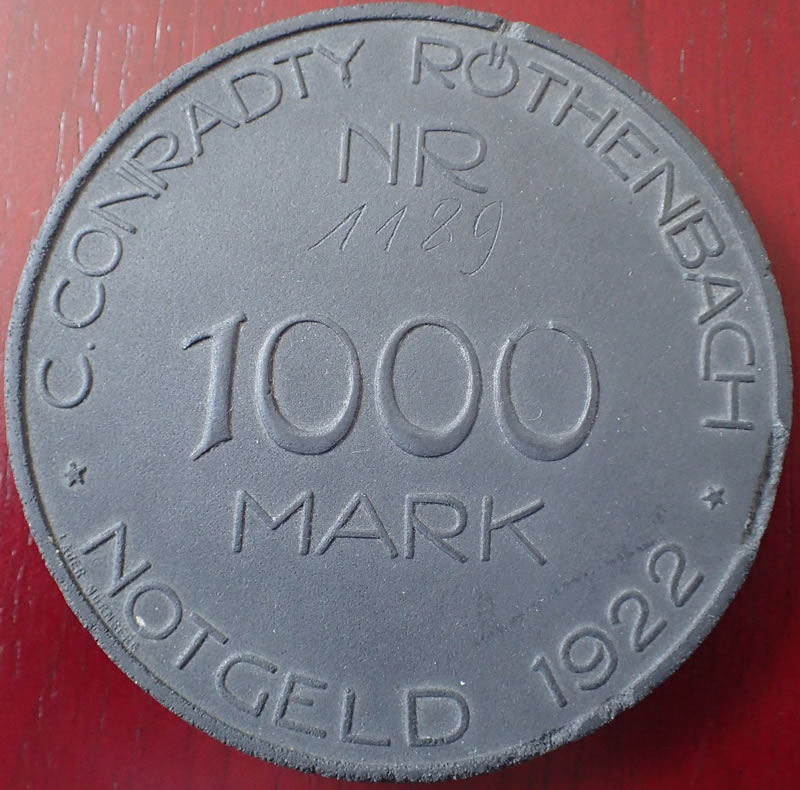 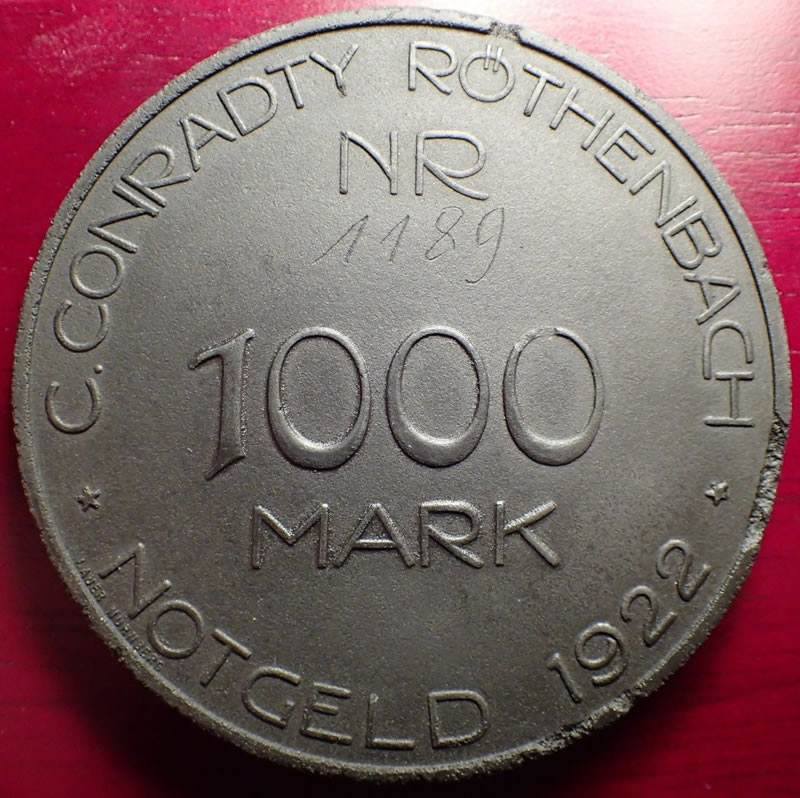 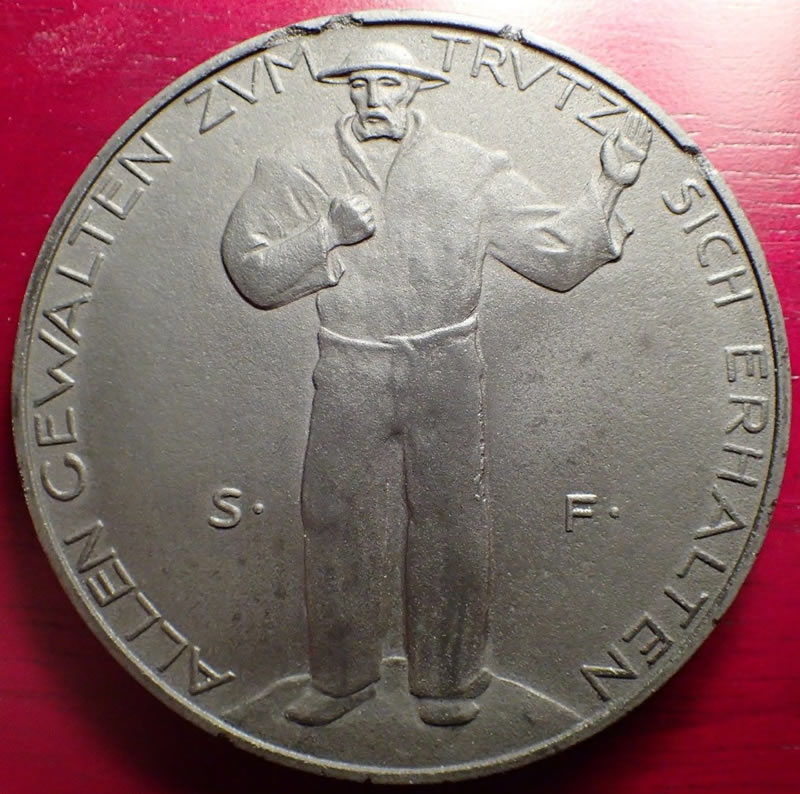 Edited by casualcoincollector
03/20/2018 7:48 pm
|
|
Valued Member
United States
333 Posts |
The glossier finish is indeed one thing. But there's quite a bit more... and I really don't know what to make of it. Check this out. 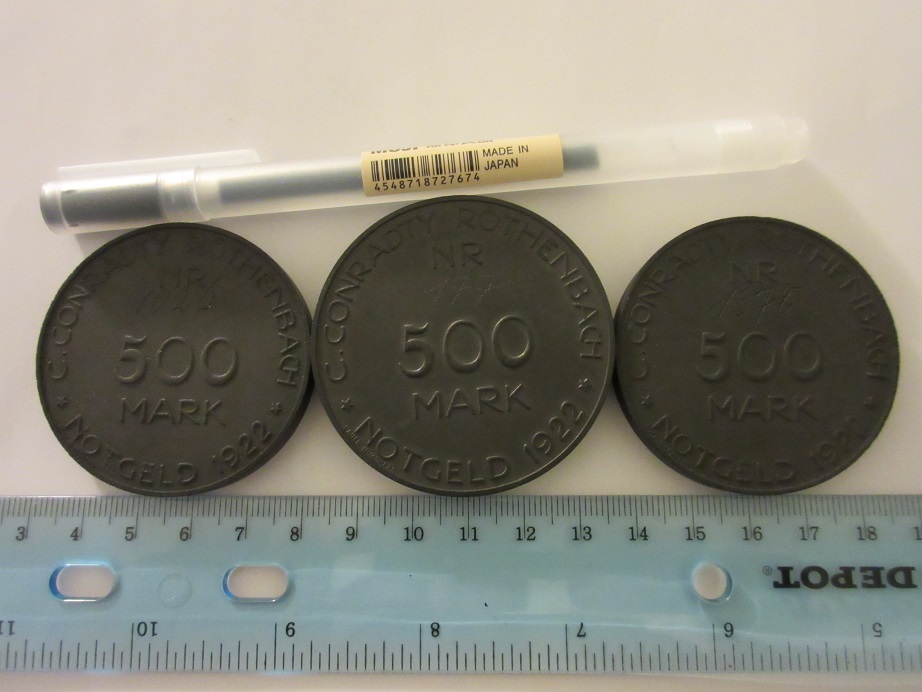 |
|
Pillar of the Community
United States
574 Posts |
@nautilator, Hmm. I see what you mean. an original Coal 500 Mark should be approximately 50mm in diameter and approximately 5mm thick. I haven't heard or come across any records of any that were larger or smaller than that being made and I'm kind of doubting that there would be more than one legitimate size of the 500 Mark since I just don't see why someone would make two different sizes for a coin that had a total mintage of only 2,499 but then again I just don't know. I can't tell from your photos but is there a period carved into the coin after the carved serial number? All of the originals that I have seen have a period after the serial number. One thought does occur to me though. I'm wondering if it could be a museum replica or something along those lines since I have heard that in order to get around the laws that require that a replica coin must be stamped with the word "copy" or "replica" the producing entity would change the size of the coin so that it could not be confused with an original when compared but once again that's a complete guess and I just don't know. Below are photos of the two Coal 500 Marks that I had gotten certified by PCGS last year for your comparison. They are exactly the same size and approximately 50mm in diameter. I wish I could be of more help here but this is outside my knowledge on these coins. Please let me know if you have any questions for me. 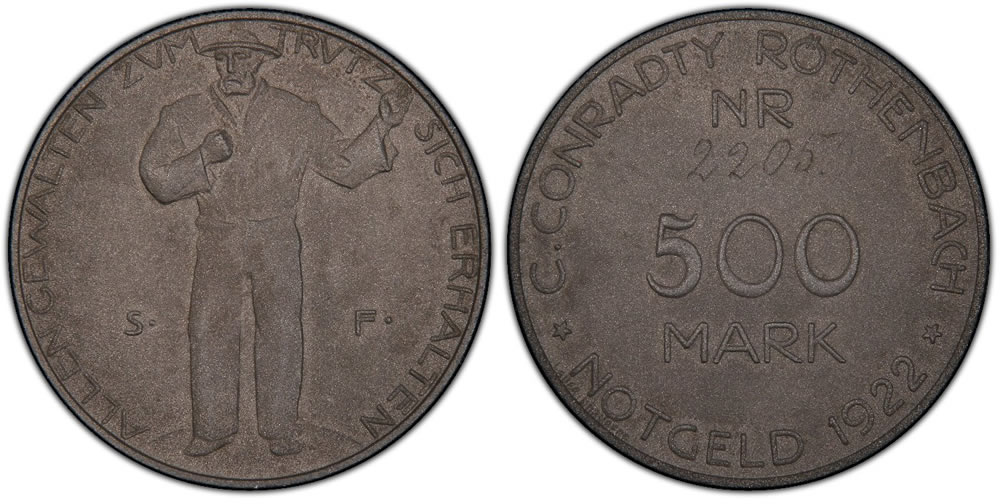 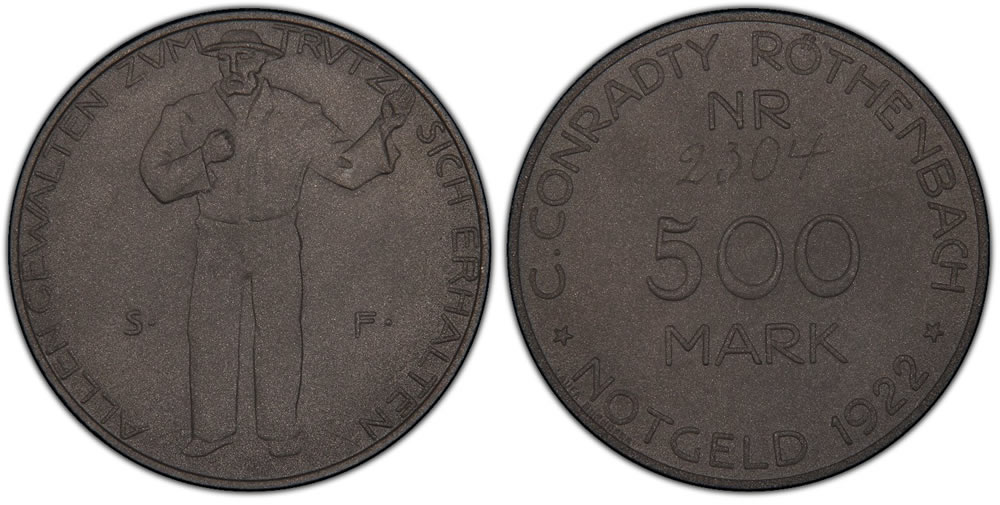 |
|
Valued Member
United States
333 Posts |
I did not notice the period until you mentioned it. My smaller ones have it, this larger one doesn't. It's probably not easily visible, but the serial number is much shallower than the other two as well.
And the weight is almost exactly 33% more than the smaller numbers. I was thinking lower serial number = earlier issue, which may have been downsized later, and thus there may be varieties to this.
|
|
Pillar of the Community
United States
574 Posts |
Ok, now I'm confused. I just came across this Coal 500 mark on the PCGS website (link and photo below). The serial number is 2516. All of the mintage records that I have come across for these state that the total mintage is 2499. So, there shouldn't be a 2516 serial number. right? So are the mintage records wrong? Is this one fake? Was this one a blank and some scratched a random serial number into it and PCGS accidently certified it? https://www.PCGS.com/pop/valueview.aspx?s=623376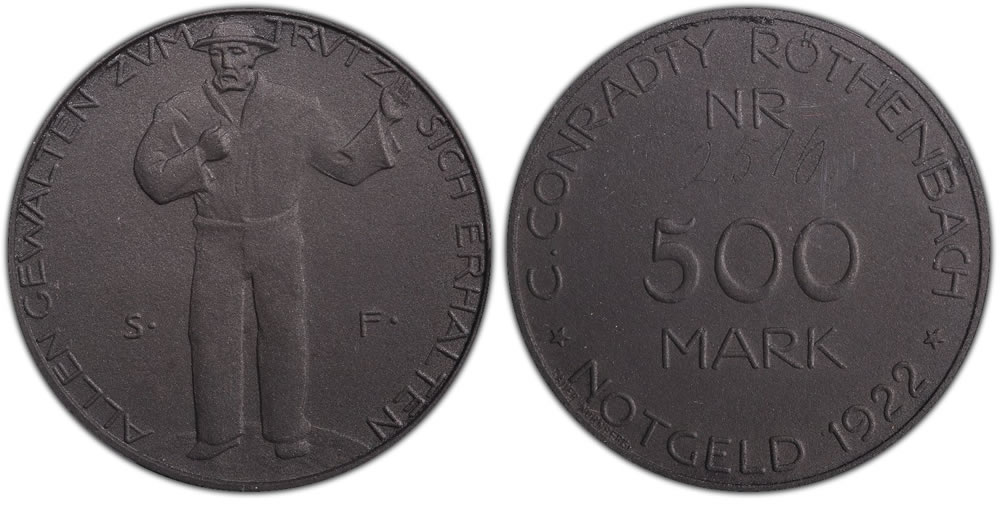 |
|
Pillar of the Community
United States
6514 Posts |
Great thread  |
|
Pillar of the Community
United States
1950 Posts |
I am convinced the numbers listed for mintages are wrong. There are absolutely genuine pieces with no 'kontrolnummer' etched. I have also read somewhere, that mintages for 2 of the denominations were closer to 10,000 pieces, while another source had listed 3500 pieces for one denomination, and 3,000 for the others.
|
|
Valued Member
United States
333 Posts |
The serial number thing wouldn't necessarily surprise me. These don't seem to be very well-studied, perhaps because of their scarcity, and with the one I discovered recently I'm 99.99% sure there are uncataloged major varieties to this. Here -- look at this one. Picture dug out of worthpoint, which saved it out of ebay 4 years ago. Look at the serial number -- it's a) very low b) not hand-carved. These things probably went through a few adjustments over their mintage. 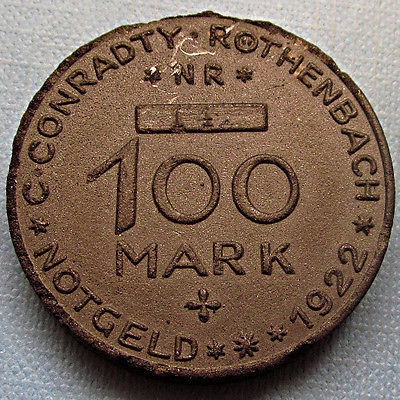 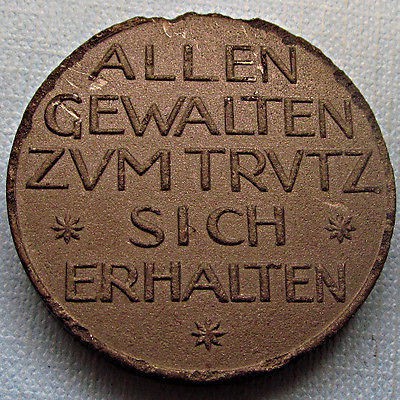 |
|
Valued Member
United States
333 Posts |
The commonly cited mintages for these are 2500, 3500, and 3500. Here's a 1000 mark with a serial number of 3506. 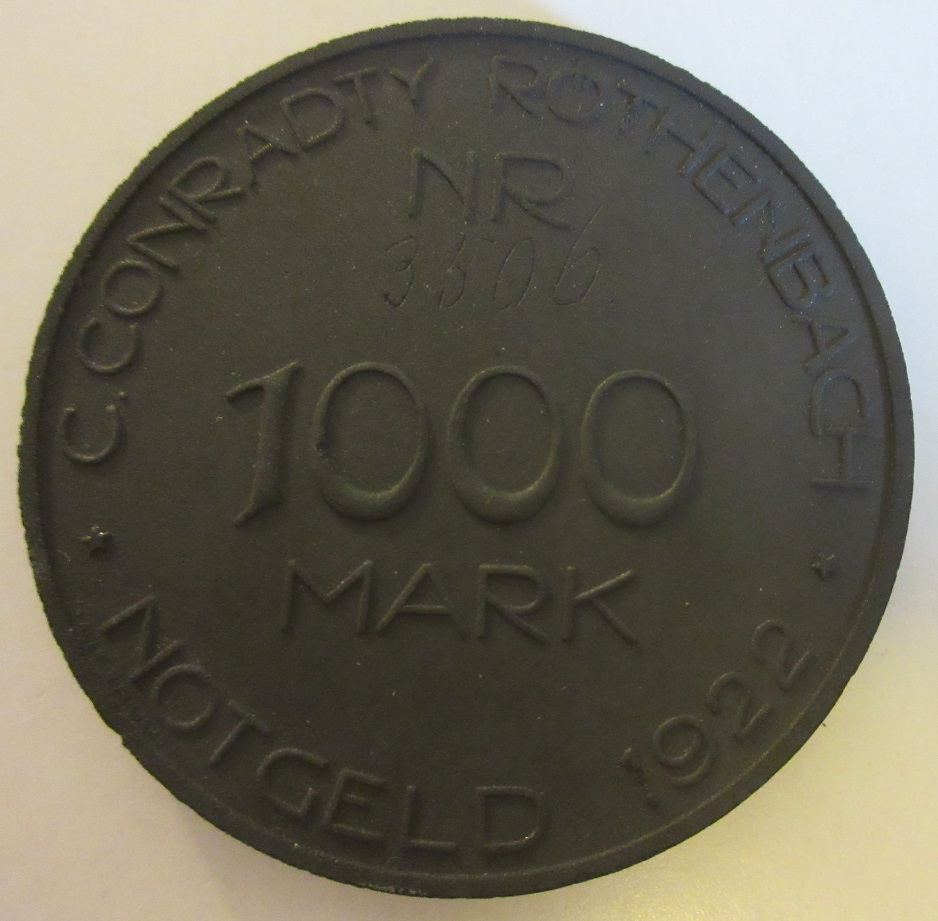 |
|
Pillar of the Community
United States
574 Posts |
@nautilator,
Interesting, yeah at this point I have come across quite a few coal Notgeld coins that are serial numbered outside of the supposed mintages.
|
|
Page 3 of 3
|
Replies: 33 / Views: 11,920 |
Page 3 of 3
|






 First Page
 Previous Page


 Posted 06/20/2016 2:36 pm





