| Author |
 Replies: 67 / Views: 17,513 Replies: 67 / Views: 17,513 |
|
|
|
|
Moderator
 United States
54300 Posts |
Thank you for the explanation.
Show your financial support of the Coin Community Family (click here)See my topic on Mexican Numismatic Medals (click here) |
|
Pillar of the Community
United States
4051 Posts |
Well, 0.3mm is a fairly big number. The method I use is qualitative. I simply focus high, center, and low to see what the effect is on hue. Comparing these tells me what effect the CA will have on the final image, given single images rather than stacks. This is not so different from the "tilted ruler" technique used by Mark Goodman in his lens reviews. Un-toned silver coins are the most telling, since they show the shift from the normally grey-ish color often very dramatically. Also, since the effect of the loNGCA depends on aperture (DOF) it's often necessary to shoot wide open as well as stopped down to normal shooting aperture. Shooting wide open has of course the strongest presentation of the loNGCA effects. Note that while Mark does not mention it (that I can find), in the various photos he takes using each lens, the ones of the un-toned ASE are excellent for showing the loNGCA effects in real-world shots. In many of the reviews, for lenses with large-ish loNGCA, the ASE has tone shifts from high points to low points. Edited to add: I don't know why the forum software changes "long CA to "loNG CA". Contact me for photographic equipment or visit my home page at: http://macrocoins.comEdited by rmpsrpms
03/15/2016 5:15 pm
|
|
Pillar of the Community
United States
9395 Posts |
Quote:
Well, 0.3mm is a fairly big number.
The method I use is qualitative. I simply focus high, center, and low to see what the effect is on hue. Qualitatively, when the USAF test target is in best focus to show the highest resolution (I guess mainly shorter-wavelength blue + green light?) it looks like there is more red in the image with the Olympus 50mm f/2 than with the Micro-Nikkor 55mm f2: Olympus 50mm at f/2 (0.5x):  Micro-Nikko 55mm at f/2.8 (0.5x):  Perhaps it's best to compare the Olympus 50mm at f/2.8 rather than f2, although the image is a bit fuzzier: Olympus 50mm at f/2.8 (0.5x):  These are the usual images for this thread, magnified by a 10x microscope objective. I don't know how meaningful the amount of red color is in these images. You can move the focus and see blue rather than red, but the resolution is lower then. |
|
Pillar of the Community
United States
4051 Posts |
Is this without a filter? If so this seems like very severe longitudinal / axial CA.
Contact me for photographic equipment or visit my home page at: http://macrocoins.com |
|
Pillar of the Community
United States
9395 Posts |
Quote:
Is this without a filter? If so this seems like very severe longitudinal / axial CA. There's no color filter in this shot. Some of the blue color (and lack of contrast) might be from light leaking in from the blue windows desktop background of the nearby monitors. In this setup, there's quite a bit of daylight between the top of the bellows (where the camera was removed from) and the bottom of the microscope objective. Here's what it looks like without the microscope objective:  This photo is only a 500% crop (rather than 1000%) so it shows 4x the area of the earlier photos. It's also unclear if the focus point is the same, since you can't focus as well with the huge pixels in the sensor. |
|
Pillar of the Community
 2087 Posts |
Note this is a completely reedited post. After rmpsrmps post( below this one) I disassembled the rig with the two two bellows on it. I then used a micrometer, set square and electronic calipers to reassemble it. I then took three different test shots for each lens. The final shots posted here are repeatable shots. Unlike my first post the Schneider Kreuznach APO 40/2.8 HM performed impressively well( at F 4) As I noted originally my testing rig just isn't as good as pepactonius's the issue may be skill but also the microscope objective is a real weak point. Both final test shots were taken at 1-1 magnification through a five times objective. With this more rigorous test the Agfa 80mm F4.5(@5.6) is performing at about the same level as the SK. I am sure with a better set up Both lenses would be showing better resolution This is the Agfa ( F4.5 @5.6) Note this was not the F4 lens 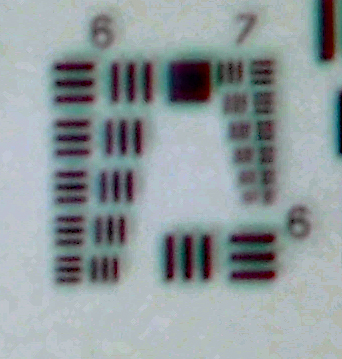 This is the SK APO 40/2.8 @ F4 Comparing the two I think the SK would with a better test rig be resolving very close to group 7 element 5 where are the Agfa might only make it to group seven element 4. given the differences in prices( second hand on ebay) the Agfa is a winner. 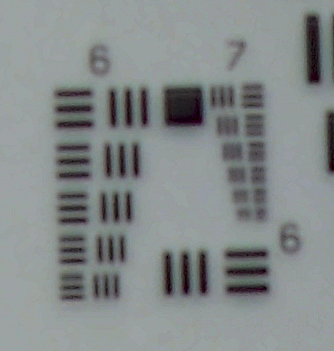 Note While the rig is tuned I will add a test shot from the AGFA F4. Here is that shot from the Agfa 80/4 also at 5.6. 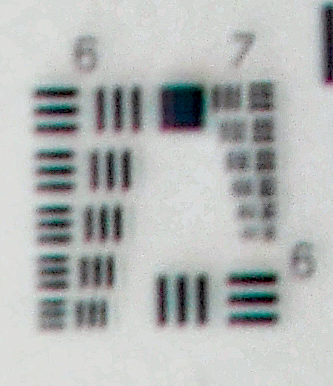 Edited by austrokiwi
05/10/2016 3:09 pm
|
|
Pillar of the Community
United States
4051 Posts |
Hard to compare with them being a different size.
|
|
Pillar of the Community
2087 Posts |
I recall pepactonius mentioning the oly 80mm bellows lens could out resolve other lenses at 1-1. I tried it just now. it resolves to about the same level as the Agfa and SK perhaps a little more. but what was really noticeable was the Chromatic aberration, just moving the focus too far one way would see the image turn red, and the other direction it would go green. This final shot has a purplish tinge which shows how different it is to the APO lenses( I am assuming the Agfa is APO). I know the other shots I have posted seem to have a slight red tinge but the Agfa 80mm process lenses and SK 40mm and 45 mm lenses are far better than the oly as far as CA goes. ( of course the PN 105mm beats them all) Oly 80mm at 5.6 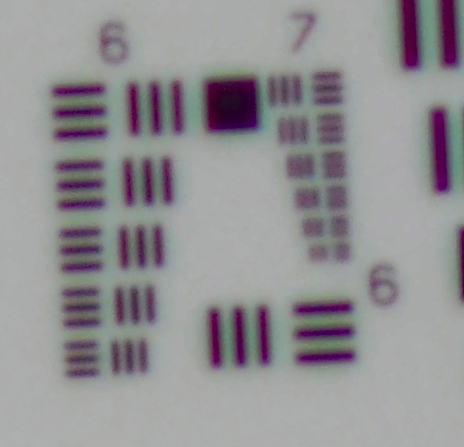 Edited by austrokiwi
05/10/2016 11:23 pm
|
|
Pillar of the Community
United States
9395 Posts |
Quote:
As I noted originally my testing rig just isn't as good as pepactonius's the issue may be skill but also the microscope objective is a real weak point. The big difference in setup may simply be that I'm using a 10x objective vs your 5x. I never used any micrometers or electronic calipers to set things up, so I don't think there's anything overly precise about my setup. Does your setup allow you to focus using 10x magnified live view on the computer monitor? (10x live view was better than 5x for these tests.) |
|
Pillar of the Community
United States
9395 Posts |
Quote:
I recall pepactonius mentioning the oly 80mm bellows lens could out resolve other lenses at 1-1. I think the 75mm APO Rodagon-D 1x (now called the 75ARD1V or 75ARD1/V on these forums?) slightly outresolved the Olympus Zuiko Auto macro 80mm (80ZAM?) at f/4. |
|
Pillar of the Community
2087 Posts |
Here is the beast( my resolution testing set up) with the Oly 80mm attached: 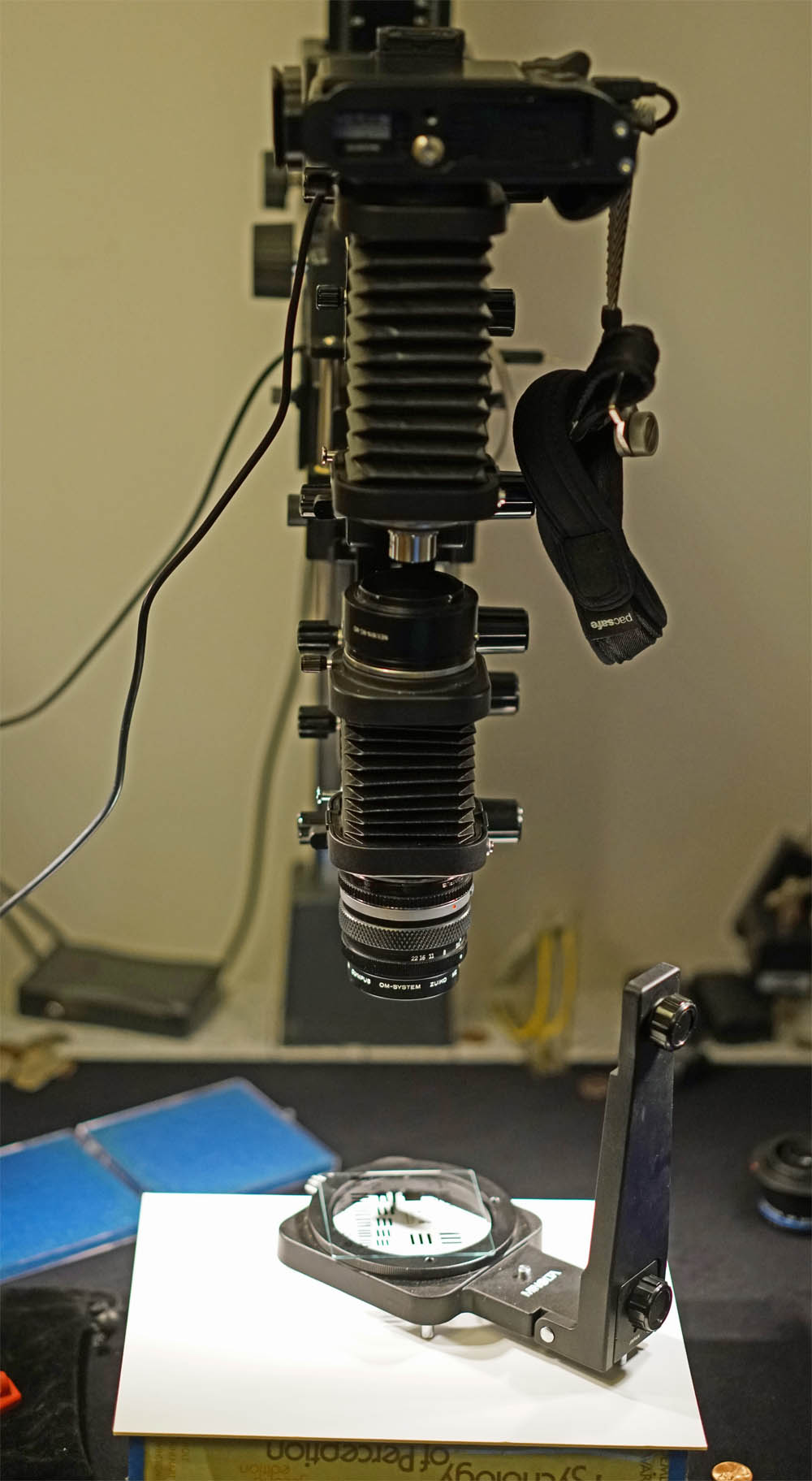 It consists of two Minolta III tilt shift bellows each mounted on focusing rails ( one Minolta another Generic( but the same type). The focusing rails are then positioned on a 200mm (300mm would be much better) double sided Swiss Arca standard rail. The assembled double bellows rig is then mounted to the copy stand via a Chinese made panoramic arca clamp which is attached to the stack shot focusing rail. The rotating clamp allows me to adjust for level( just in one direction). I can mount the testing rig side ways using some further Swiss Arca rails and a second rotating clamp. That mounting style allows me to adjust for level in both X and Y directions. But it adds too much weight and vibration into the system (when I attach this double bellows set up). I know from previous testing the amount of bellows extension I need for each objective, so I use the Calipers to adjust the extension on each bellows. ( my most important tool is a note book in which I record those details) I use the micrometer to adjust the position of the upper bellows so that the microscope objective front element is positioned where the camera sensor would be on the bottom bellows. The set square just ensures the two bellows are lined up so there is a straight image line from the lens being tested through to the camera sensor. I have been using the oly OMD-EM10II for the testing of the last few objectives. Its smaller and lighter than the Sony A7rII and it has smaller pixels so its resolution is slightly better than the A7rII ( but noise is a really annoying issue) Using the Olympus or the Sony I don't use tethering for the resolution testing. The reason being that, even though the Sony can tether, the 5X or 12.5X manual focus assist combined with the higher screen resolution on the camera makes focusing much easier with the camera than on the computer screen. The Olympus can't tether and it has 14X magnification for manual focus assist. The weakest points of the rig: 1. The microscope objective it is a cheap generic 5X( but its heaps better than the 10X example I have) 2. The two focusing rails for each bellows. They don't have fine enough adjustment and as I discovered yesterday at least one of them has a tendency to creep when left alone for a while. 3. Weight: the copy stand I have can easily cope with the weight of the rig, but at the magnifications being used the added vibration really is a huge issue. The Sony when used is set to EFCS and I have taken to using the Oly in fully silent mode with full noise reduction( it needs it in this situation). Triggering of either camera is via the stack shot shutter control. As you can see I mount the resolution slide on an old macro stand( after removing the grey subject glass from that stand). The resolution target is chrome on glass so I need to raise it above the white background to avoid shadows which would make the test image confusing Edited by austrokiwi
05/11/2016 01:08 am
|
|
Pillar of the Community
United States
9395 Posts |
Quote:
I use the micrometer to adjust the position of the upper bellows so that the microscope objective front element is positioned where the camera sensor would be on the bottom bellows. I would have thought with an RMS-threaded DIN objective, that the back of the objective (where the threads start) should be 45mm above where the camera sensor would normally be? I'm my case, I didn't do any measurements. I just put the camera on the rear of the bellows, and used live view to get the front bellows standard and the test target positioned to give good focus at 1x (showing about 22.3 mm visible on a ruler). Then I removed the camera and attach an assembly with the microscope objective, pre-focused tube lens, and camera above the bellows, and position it as close as possible so that the test target is sort of focused. Then I adjust the position of the test target (on a microscope stage) slightly to get best focus (using the 10x live view) before snapping the pic. Of course, this changes the magnification slightly, but hopefully the change is small. |
|
Pillar of the Community
2087 Posts |
I finally got around to testing my Mamiya sekor C 80mm macro lens. Its not an enlarger lens. Originally I had purchased it for use as a tilt shift macro lens... but It never really impressed. I have always planned on replacing it with he 120mm macro but never got around to it. I thought I would test the lens to see if it is as bad as I thought and it is. It suffers from CA, and only resolves to Group 6 element 3( 80.6 cycles per mm) which is less than what the sensor is able to resolve. Dust in the photos is on the targets 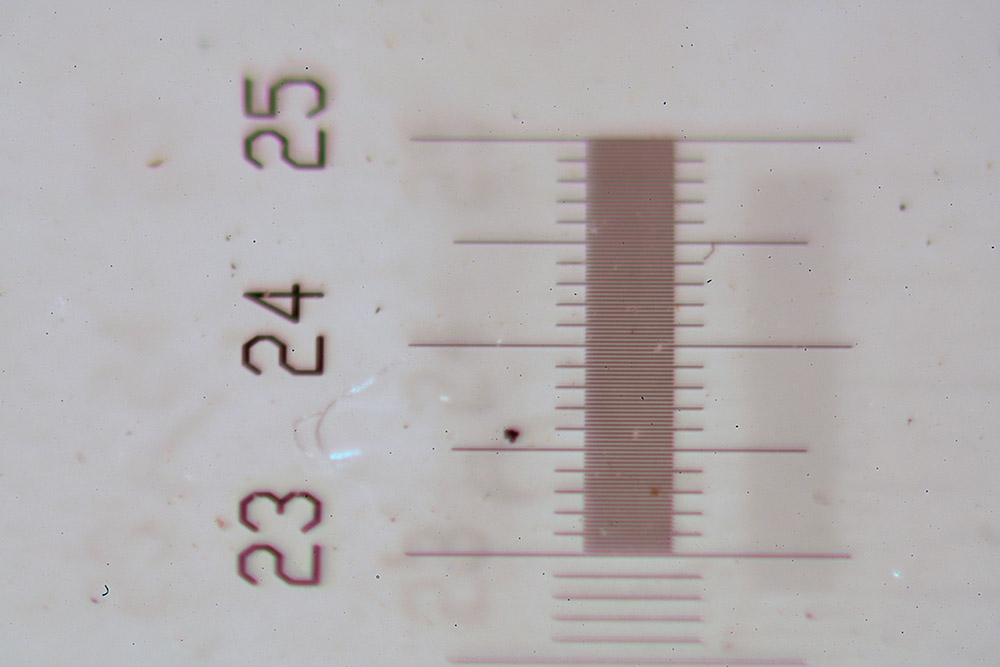 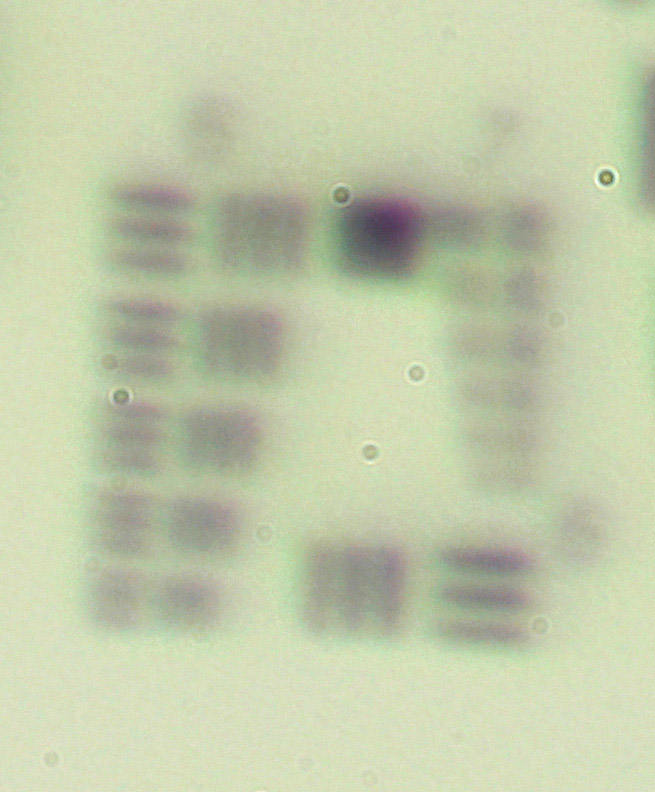 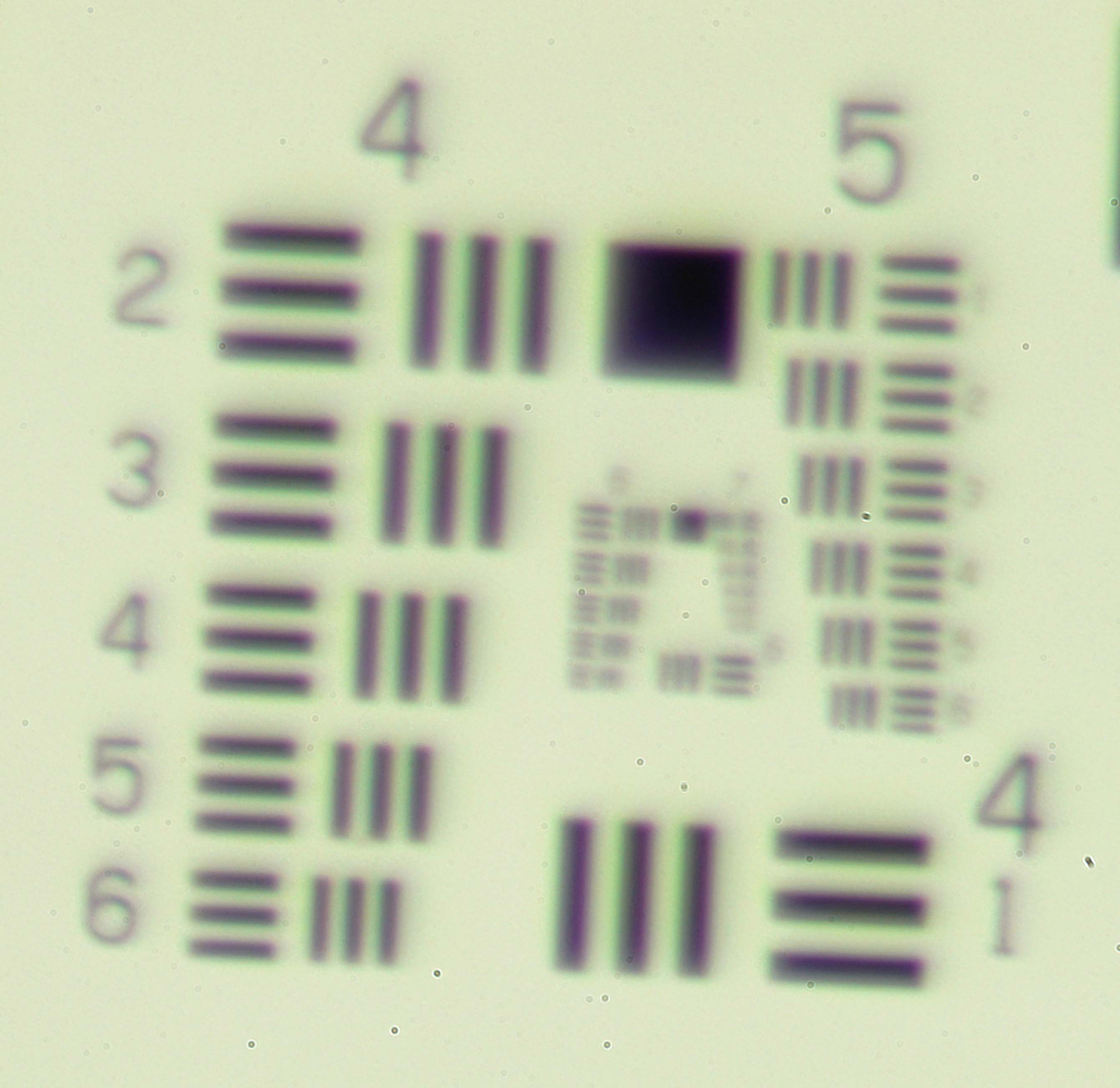 |
|
Pillar of the Community
United States
4051 Posts |
It seems like the entire target is out of focus, maybe enough to significantly skew the result. I found that to get a good focus on mine I needed to do a small stack. Without doing that, the focus shifts caused the smaller elements to merge. Quote:
I think the 75mm APO Rodagon-D 1x (now called the 75ARD1V or 75ARD1/V on these forums?) I would not call the variable aperture version 75ARD1V, just 75ARD1. I think I did that in a post just to be clear, but in general I would keep the original nomenclature, but calling fixed aperture version 75ARD1F to distinguish it. Contact me for photographic equipment or visit my home page at: http://macrocoins.com |
|
Pillar of the Community
2087 Posts |
Quote:
It seems like the entire target is out of focus That kind of sums up all my experience with the lens. Where other objectives take just the slightest nudge to come into (and out of) focus. This lens drifts into a region of "focus" and slowly drifts out of that same region. There is just no clear point of sharpness. My example is the earliest version and it is possible I have a lemon. I understand the "n" version is supposed to be better but from my reading every one states the 120mm is the lens to get. From my experience ( if it is typical) the 80mm is not a lens to get. Edited by austrokiwi
08/10/2016 12:30 pm
|
|
|
Replies: 67 / Views: 17,513 |
|





 First Page
 Previous Page


 Posted 03/15/2016 5:09 pm


