| Author |
 Replies: 20 / Views: 4,478 Replies: 20 / Views: 4,478 |
Page 2 of 2
|
|
|
|
Pillar of the Community
Canada
2632 Posts |
The sellers is very poor at making an accurate line in their pics I see no difference IMO.
Hows the KGV nickel hunt going Bill? I checked the few 23s I have but no difference there either.
|
|
Valued Member
Canada
306 Posts |
Quote:
TNSS-52 wrote
I used Photoshop, and overlaid the bottom image on the top image, and the only difference is the angle of the line drawn. TNSS-52 Hello I made the two superimposed pictures marked "PhotoScape" software and this is what I see. Is a near and far. For better see I put a picture without annotation and one other with annotations. 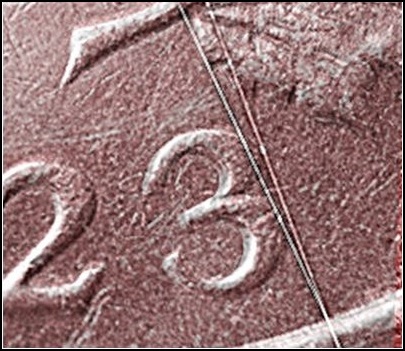 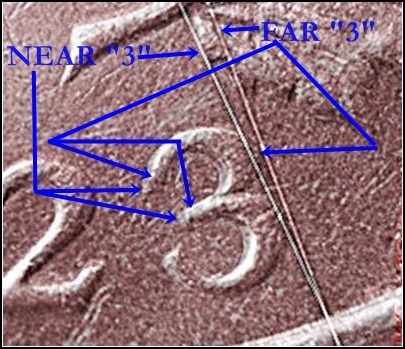 |
|
Pillar of the Community
Canada
2784 Posts |
wow so maybe a new variation do to a change of dies, or die wear.nice
|
|
Pillar of the Community
Canada
2845 Posts |
Quote:
Is a near and far.
Geometry 101, ever so slightly alter the angle of a line and then you can make it point in whatever direction you choose. |
|
Valued Member
 United States
214 Posts |
Thanks everyone for their opinions so far. Given that we have recognized different hubs used for 1926 and 1932, I think that it is totally possible that there are at least two different hubs used in 1923 (and maybe other years too - for example, I sometimes think I see a different looking 22s in 1922 but the difference is so slight that I usually give up and say what I'm seeing is Die Deterioration leading to smushy numbers. It's on my to do list to recheck this one day). As I mentioned in my initial post I think I see the difference with 6x magnification and Castor's overlay appears to confirm that a difference exists. But like the old men Statler and Waldorf said on the Muppet Show once, "The question is who cares?" At this point, I'm not excited about it. What I need 5centscanada or someone else to do is show us how uncommon this variety is and if possible have a story go with it. For me the 1932 Far meets this requirement. Personally, I came to the hunt for 1932 Far 2 late in the game as I didn't start collecting until 2014. I've read the historical posts for the 1932 Far 2 on this site and they are very interesting. I enjoy hunting for 1932 Far 2s. All the ones I've seen have the same die crack coming off the S of CENTS which suggests it is a single die (which originally was the specimen die for the year). I'm finding it hard to cherry pick them and I haven't cherry picked one since June of 2015 -- who's finding them all! My point here is that the 1932 Far 2 is an uncommon variety while the 1923 Far/Near 3 hasn't proved itself yet as being uncommon. And even if it did, I doubt it will excite many collectors because it is not very easy to see. Personally I'd rather have a big visible die crack than this hard to see hub difference. @pennyman007 - Not much to report on the KGV 5 cent front except I bought a nice raw 1934 with all 8 pearls showing which I'd like to say is MS64 but I might be seriously deceiving myself. More exciting for me was finding a 1953 SF FL mule in what I grade as AU50 in a mixed lot of KGV & KGVI 5 cents I bought a few weeks ago. It's the first one of these I ever found and I was really happy, for a day or two. In the same lot there were also a couple of 1936 in ICCS AU condition and a handful of 1937 in MS. Normally I get stuck with bulk lots of just VG/F coins. Thanks for asking :-) |
|
Pillar of the Community
Canada
2632 Posts |
Quote:
More exciting for me was finding a 1953 SF FL mule in what I grade as AU50 in a mixed lot of KGV & KGVI 5 cents Good for you Aswag..that's a nice find.  |
|
Moderator
 Canada
10477 Posts |
The differences are so minor with this coin, it is hardly relevant.
"Discovery follows discovery, each both raising and answering questions, each ending a long search, and each providing the new instruments for a new search." -- J. Robert OppenheimerContent of this post is licensed under a Creative Commons Attribution-NonCommercial 3.0 Unported License. See: http://creativecommons.org/licenses...0/deed.en_USMy eBay store
|
|
Valued Member
Canada
219 Posts |
In Blais's book "Price Guide for Canadian coins" (I know some of you don't like him), he regroups them into near and far 3. I had done a study on the positioning of the 3 for 1923 nickel a while back and identified 4 different varieties. Here is a picture showing the different positions.  Is it worth collecting? Most british will call this a micro variety. If you are into this, like I am, the rarest position (a sample of 212 coins) is the "yellow" 3 and it is the easiest to detect! The bottom of the 3 is almost perfectly alligned with the bottom of the 2. Here is what it looks like. 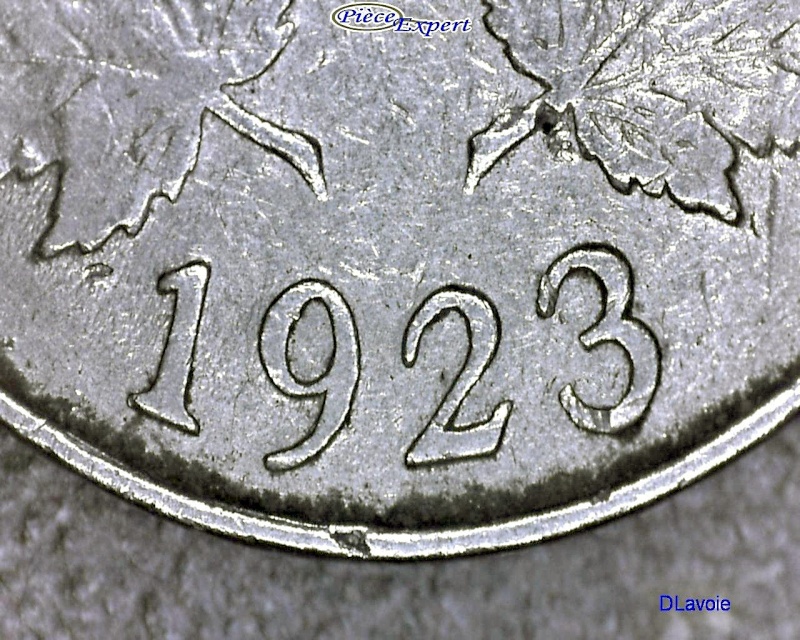 Happy hunting. |
|
Pillar of the Community
Canada
685 Posts |
I think it is interesting. My question is that with the 4 variations would there be a space difference from the S in cents to the rim also?
|
|
Valued Member
Canada
84 Posts |
I seached in my lots of 23 ies. And found 1 coin that we clearly see between far and near 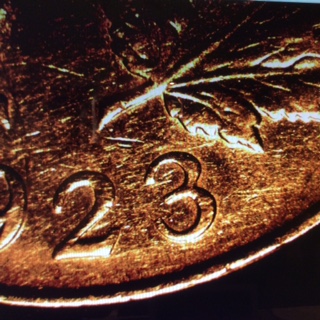 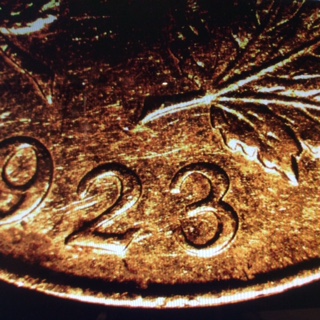 |
|
Pillar of the Community
Canada
2845 Posts |
This reminds me of the 1929 one cent - the high 9 and low 9 and somewhere in between.
|
|
New Member
Canada
19 Posts |
|
|
Valued Member
United States
214 Posts |
Dteam  I read the posts on 5centscanada this weekend. It's interesting that on the francophone site this variety (or should I say varieties) has/have been discussed on and off for the past few years. numidan really did give us a Full House of 4 different positions for the 3 to think about. For me this makes me want to better understand the use of hubs and dies in the 1920s. Specifically, when did the date get punched/engraved? On individual working dies - then there are probably a ton of different positions of the 3? Or more likely on the Master die? But does it make sense that 4+ master dies were needed for 1923? I have no clue to how many working hubs could be made from a master die and how many working die can be made from each working hub. A NASA saying I heard once was "The harder you look, the more you'll find." I wonder if someone looks harder at the 4s of 1924 or the last 2 of 1922 whether we'll see other date varieties like 1923 looks like it has. |
|
New Member
Canada
19 Posts |
Thanks Aswag for the welcoming  ! Like Numidan has said, the rarest position or variety is the one with the 3 at the same level than the 2 (like on my previous post) It could be interesting to have an idea of the population (or maybe I should say the percentage of probability) to get that nickel variety in a lot of 1923 5 cents. This variety is not visually less interesting or less spectacular than the 1932 or the 1926 (position of the 6). Maybe just a little bit more common !! We'll have to quantify It. Edited by Dteam
02/09/2016 08:52 am
|
|
New Member
Canada
19 Posts |
If we forget about the rotation and we focus on the near 3 from the rim, there's the difference on those two pictures. I think It's more than a micro difference. It's easy to detect without a magnifying glass ! 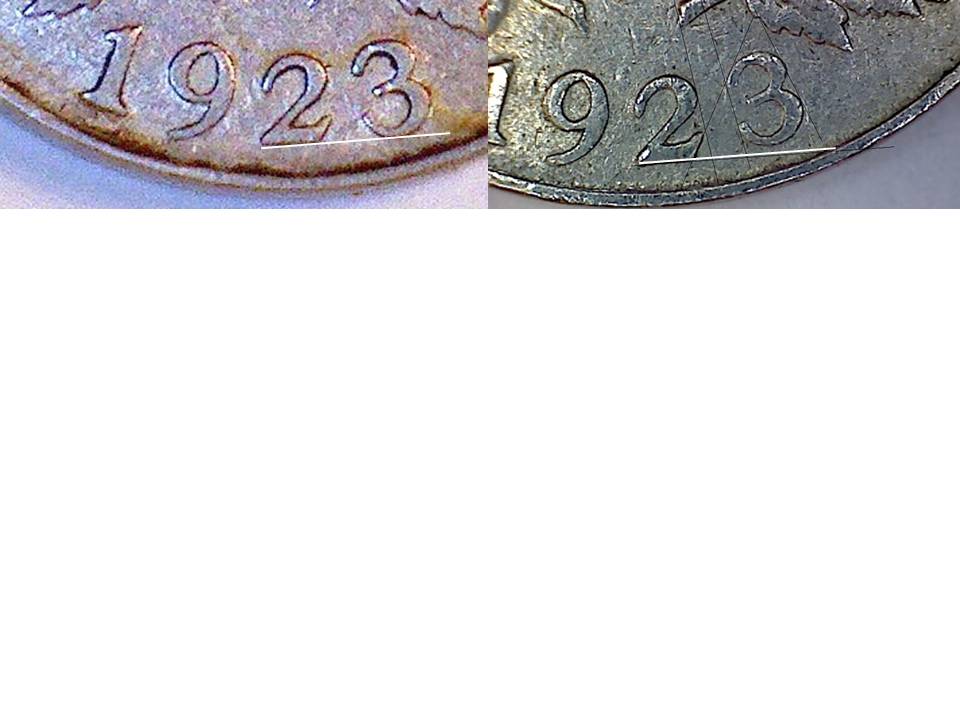 |
|
Page 2 of 2
|
Replies: 20 / Views: 4,478 |
Page 2 of 2
|








 First Page


 Posted 02/03/2016 2:08 pm


