| Author |
 Replies: 21 / Views: 3,624 Replies: 21 / Views: 3,624 |
Page 2 of 2
|
|
|
|
Pillar of the Community
Canada
4912 Posts |
just spit balling it here, the only thing I see causing such an effect is an extremely thin late stage die cap.
Feel free to call me Will.
|
|
Pillar of the Community
Canada
1442 Posts |
"who would cast a fake 1979 penny"
that is not a legitimate argument...
the coins have a very pasty look to them...would love to hear the small cent experts weigh in
Edited by canadian-varieties
03/05/2017 02:16 am
|
|
Pillar of the Community
Canada
2303 Posts |
Both look like they were struck through a late stage cap.
|
|
Pillar of the Community
Canada
2430 Posts |
Just tossing this out there...is it a possibility that these were split planchets before the strike or some sort of flawed planchet?
Edited by darryldarryl
03/05/2017 08:29 am
|
|
Pillar of the Community
Canada
695 Posts |
 with nickelsguy and thedollarman. It's a nice pair of coin errors - struck-through late stage die cap. |
|
Pillar of the Community
 Canada
1018 Posts |
In my original thread on the 1979, SPP said that it was struck through a late stage die cap. Both obverses are normal and the pennies aren't pasty looking, just my poor lighting when photographing. They are very cool looking in hand. Now I'm looking for a 1980.
|
|
Pillar of the Community
 Canada
9903 Posts |
I don't think the '78 was struck by a late stage die cap.
By the time the cap was pounded enough to form such clear devices the marks in the field should have been reduced to mere wisps only.
I think something else is going on there but I don't know what.
"Dipping" is not considered cleaning...
-from PCGS website
|
|
Pillar of the Community
Canada
2430 Posts |
Denny7000, can you give us a weight for these Two Cents please. |
|
Pillar of the Community
Canada
1018 Posts |
darryldarryl the pennies both come in at 3.16 grams each
|
|
Pillar of the Community
Canada
2430 Posts |
3.24 grams is spec weight.
|
|
Pillar of the Community
Canada
1018 Posts |
Yes I saw that in Charlton so I weighed a few others of same dates and they all ranged from 3.15 to 3.27. I would guess it would depend on amount of wear, they are circulated. It also shows that the mint pounded out a lot of pennies in these two years.
|
|
Pillar of the Community
Canada
843 Posts |
Cool ! Looks to me like all the stretched-look does not affect the raised details, so something or someone made a twisting, grinding circular mark on the die (the fields of a coin would be the highest part of the die, the raised part of a coin is lowest, incused into the die). I think maybe the marks were on the die before the coin was struck.
|
|
Pillar of the Community
Canada
1442 Posts |
So no one has figured out yet what's going on with these coins.
|
|
Rest in Peace
10197 Posts |
Put me in the trail die camp. Don't see a capped die at sll, even a late stage. The cap planchet would have to be so very thin or completely missing for the detail to transfer as it has in this manner. After reading this: http://www.traildies.com/the-theory...l-formation/I was impacted by the statement that traildies impact at least 10% of the surface area but NEVER 100%. Too much detail is unaffected on these examples, meaning altho these lines cover more area than the common trail die, they still "Trail", note the 45 degree angle trails on 79 1 & CENT then trails around date 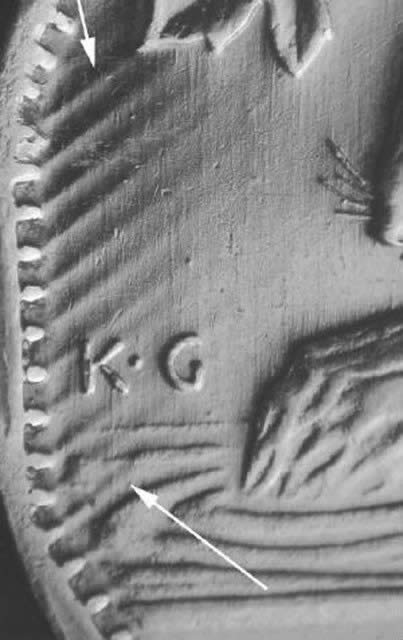 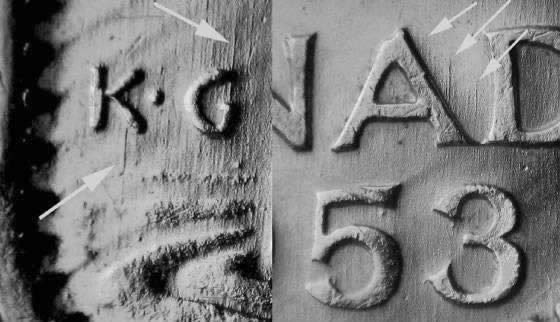 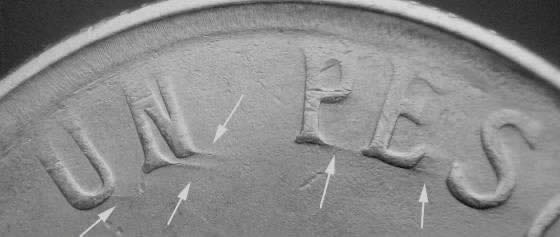 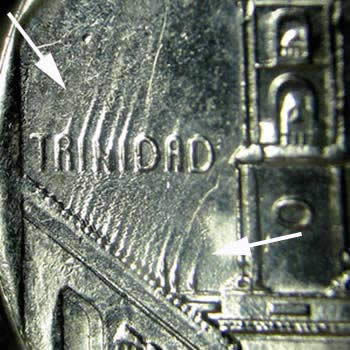 There's some trail dies, looking at 78, same thing. Just shows how you Canucks wring every available drop out of what you have!   |
|
Pillar of the Community
Canada
843 Posts |
I imagine that a type of metal lathe was used in 1978-9 when making dies. It looks to me that the marks on the 1978 could have been left by such a lathe digging slightly too much into the metal causing chattering ( if you've ever used a lathe and dug in a little too deep, you know ) and the marks were not sufficiently ground and polished off before using the die. Might be why they try dies.
|
|
Page 2 of 2
|
Replies: 21 / Views: 3,624 |
Page 2 of 2
|








 First Page


 Posted 03/05/2017 02:07 am


