Coin Community Family of Web Sites Join Thousands of Coin, Bullion, & Money Collectors
Royal Canadian Mint products, Canadian, Polish, American, and world coins and banknotes. 300,000 items to help build your collection! Specializing in Modern Numismatics Vancouvers #1 Coin and Paper Money Dealer Coin, Banknote and Medal Collectors's Online Mall Join Thousands of Coin, Bullion, & Money Collectors Royal Estate Auctions - $1 Coin Auctions


Username:
Password:
Save Password
Forgot your Password?


This page may contain links that result in small commissions to keep this free site up and running.

Welcome Guest! Registering and/or logging in will remove the anchor (bottom) ads. It's Free!

1794 Soda 8R C/S George III PCGS Genuine?

To participate in the forum you must log in or register.
First Page  Showing last 15 replies.
Author Previous TopicReplies: 18 / Views: 4,119Next Topic Page 2 of 2
Pillar of the Community
United States
1156 Posts
 Posted 01/09/2018  10:50 pm  Show Profile   Bookmark this reply Add jgenn to your friends list
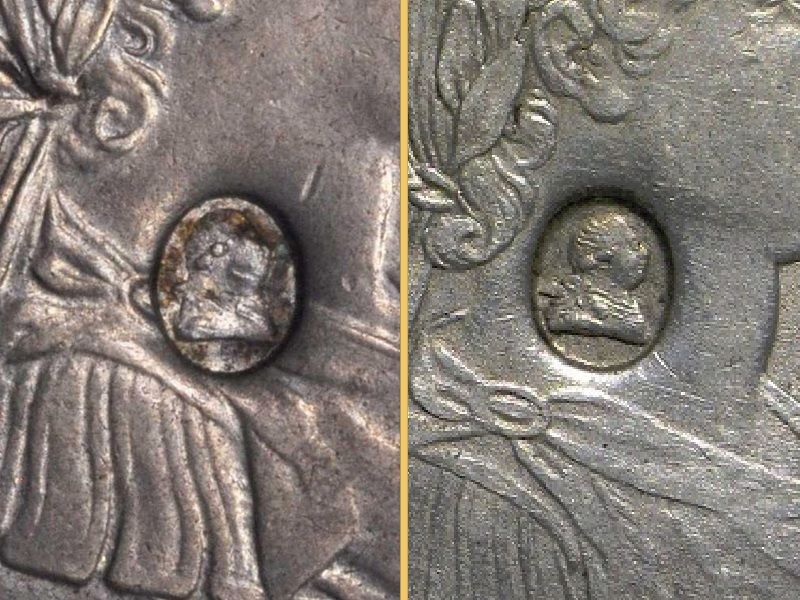
That's a bogus countermark. PCGS on left, one from my collection on the right. By the way, the lot has been withdrawn.

1794-Soda-8R-C/S-George-III--PCGS-Genuine?

The host coin details look pretty mushy so it may be a modern forgery -- certainly not contemporary.
Edited by jgenn
01/09/2018 10:54 pm
Pillar of the Community
United States
1666 Posts
 Posted 01/10/2018  12:34 am  Show Profile   Bookmark this reply Add Numismat to your friends list
If I recall correctly, these counterstamps that depict Georgie boy looking up at something in the sky are false. Host coin looks ok to me.
Pillar of the Community
United States
5362 Posts
 Posted 01/10/2018  01:02 am  Show Profile   Bookmark this reply Add swamperbob to your friends list
Partially correct JGenn and 20021sc. This is another case of PCGS getting the call completely wrong. The host is counterfeit (Sheffield Plate), the stamp is counterfeit.

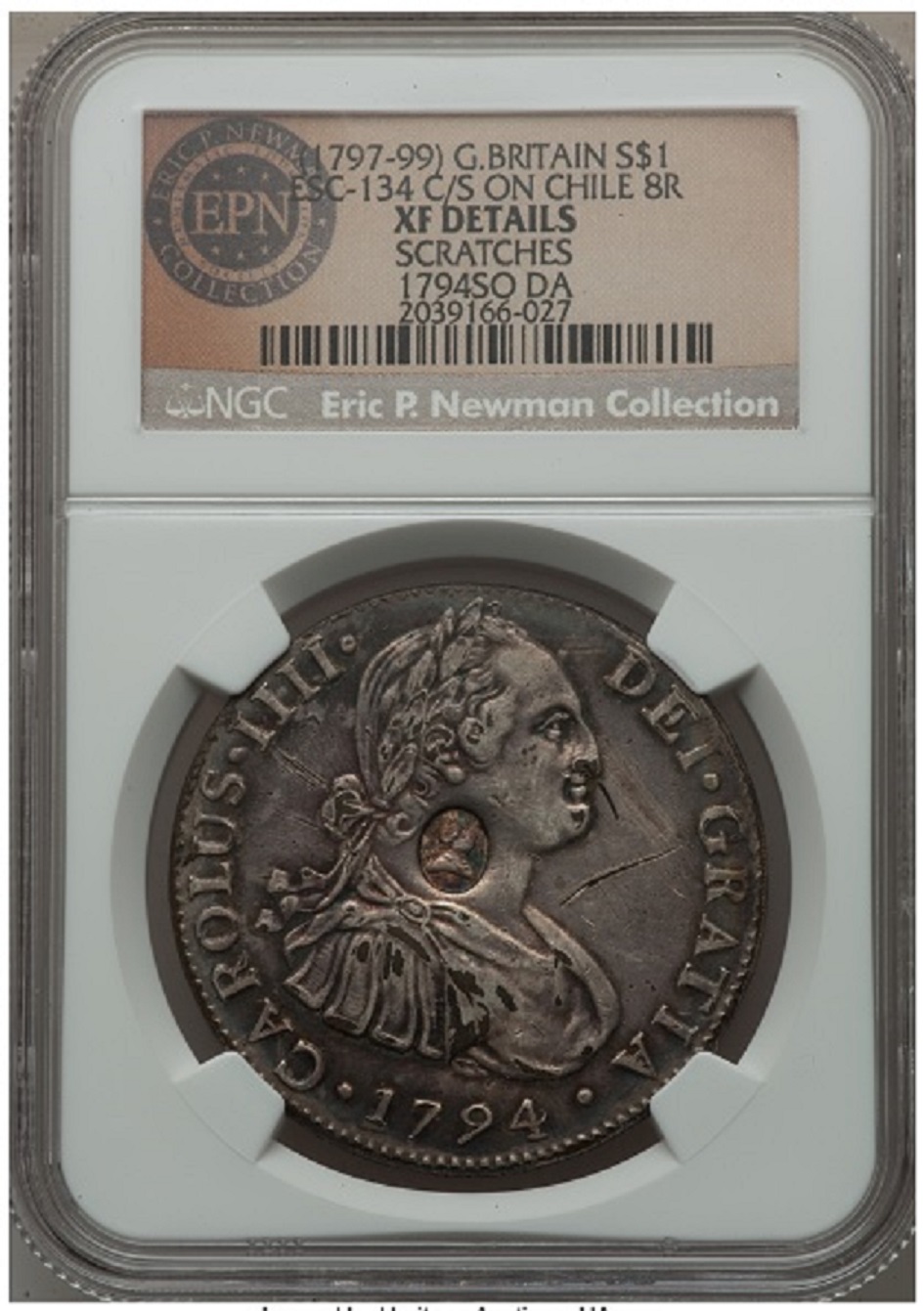
JGenn The host coin is counterfeit but it is not modern. It is actually one of the more common contemporary counterfeits that I know of. It is listed in my Book. I have now seen over 15 of them and the coin has been encapsulated several times at least twice by NGC (one from the Eric Newman collection). Numerous raw examples have been observed being sold as genuine.

The Newman coin is posted below. Look at that coin who can not see the copper exposed by wear?

1794-Soda-8R-C/S-George-III--PCGS-Genuine?

The George III punch is definitely a contemporary counterfeit. There are at least two different counterfeit stamps applied to this counterfeit. The way to tell is to compare the stamp to the correct privy punch used on silver table wear. A spoon from 1794 is far less expensive and counterfeiters did not make fake sterling spoons.

Based on a comparison with other known counterfeits I have assigned this coin to Birmingham. It is a thin Sheffield Plate but very successful. It uses a matrix set that is not a match to Chile.

I own several of these which show the copper through the silvering. The dies are all the same.

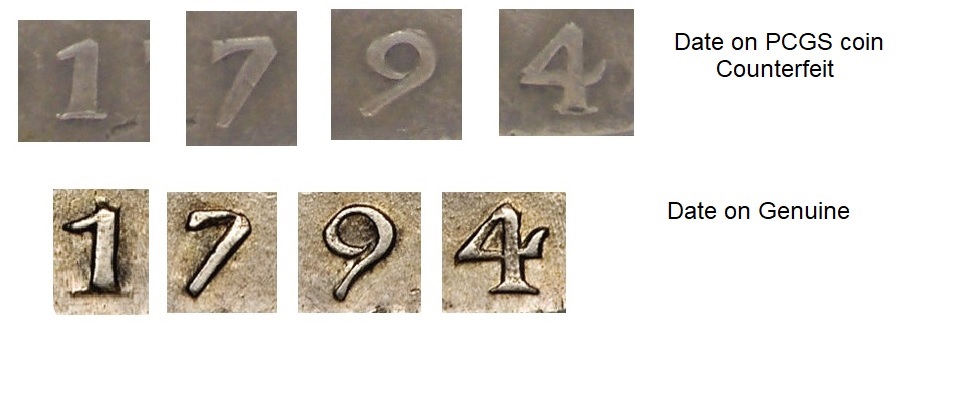
Here are a few comparisons to show that the punches used on the PCGS graded coin are simply incorrect. Starting with the date. The brighter picture is a genuine example the grayer is from one of the encapsulated counterfeits - they all match.

1794-Soda-8R-C/S-George-III--PCGS-Genuine?

Note the shape of the 1 totally different. The 7 on the counterfeit is too thick around the angle. The 9 on a genuine Chile coin is recurved - this is a Spanish standard. The 4 is closer to correct but the crosslet is a different shape at the terminal.

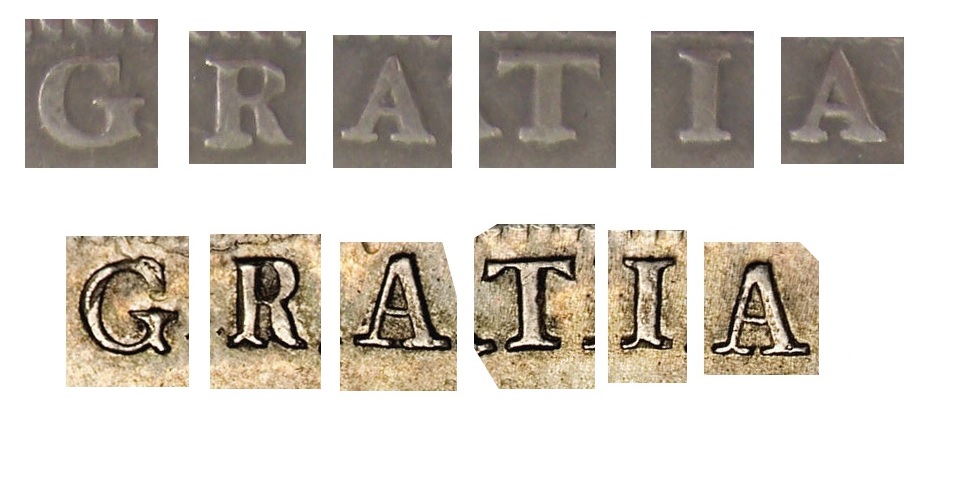
Next a comparison of the word Gratia.

1794-Soda-8R-C/S-George-III--PCGS-Genuine?

Note in particular the incorrect A. The counterfeit uses a pointed A without the truncation which was the style used on most Spanish colonial coins - that one letter was all I needed to suspect the coin as bad. You certainly do not need to be an expert to know that A is wrong. The G on the counterfeit is typically an English font not Spanish. The R here and in Carolus is out of balance a very poorly executed letter punch.

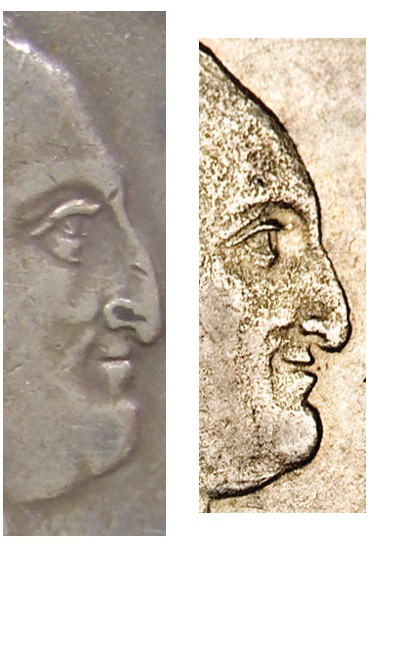
Next the face - look at the shape of the elements. This portrait was used on several counterfeit varieties. The fact that the counterfeit used a matrix for punch creation shows the counterfeiting ring was similar to operations in Birmingham - basically a factory meant to turn out thousands of counterfeits.

1794-Soda-8R-C/S-George-III--PCGS-Genuine?


Edited by swamperbob
01/10/2018 01:15 am
Pillar of the Community
United States
5362 Posts
 Posted 01/10/2018  01:36 am  Show Profile   Bookmark this reply Add swamperbob to your friends list
Eric Newman was not only a collector of genuine coins but owned many contemporary counterfeits. Nearly all of his counterfeit collection ended up in slabs. I do not know if this was intentional on the part of the TPGs but I suspect it was not because the labels never mention the coin is a counterfeit. By encapsulating counterfeits with no warning they violated several ethics rules of the ANA and possibly violated the laws of fraud in the US.

When the Newman collection went to market, I could only salivate as a great number of counterfeits all encapsulated went on the auction block and each and every one sold as if they were genuine for thousands of dollars more than they were actually worth.

This was absolute proof for collectors like myself that TPG authentication of older world coins was not very good at all.

The reason for this thread was to show that collectors who blindly rely on the grading services for authentication are making a serious error.
Moderator
Learn More...
United States
56855 Posts
 Posted 01/10/2018  04:27 am  Show Profile   Bookmark this reply Add John1 to your friends list
Perfect example of"buy the coin not the holder"
John1
Moderator
Learn More...
United States
34435 Posts
 Posted 01/10/2018  06:40 am  Show Profile   Bookmark this reply Add Spence to your friends list
Ok well I learned something today--thanks @SB!
"If you climb a good tree, you get a push."
-----Ghanaian proverb

"The danger we all now face is distinguishing between what is authentic and what is performed."
-----King Adz
Bedrock of the Community
Australia
21788 Posts
 Posted 01/10/2018  07:30 am  Show Profile   Bookmark this reply Add sel_69l to your friends list
Even expert auctioneers have been known to get it wrong by - their own admission. Looks like the same can happen with TPGraders.

So where does one stand, who considers themself less expert than the experts - which is almost all of us ?

With British counter stamped Spanish dollars, the coin and the counter stamp have to be assessed for authenticity and grade separately.
Pillar of the Community
United States
4883 Posts
 Posted 01/10/2018  08:28 am  Show Profile   Bookmark this reply Add Lucky Cuss to your friends list
Those deep scratches (gouges, really) - possibly done by somebody suspicious of the coin when it was circulating, to see if these was a base metal core? Red flags in and of themselves?

Colligo ergo sum
Pillar of the Community
Belgium
1185 Posts
 Posted 01/10/2018  4:16 pm  Show Profile   Bookmark this reply Add 1c5d7n5m to your friends list
interesting case indeed; also worrisome as the mixup of real and fake coins in auctions (with tradition and good reputation) may hurt the numismatic field
Pillar of the Community
United States
1757 Posts
 Posted 01/10/2018  5:09 pm  Show Profile   Bookmark this reply Add colonialjohn to your friends list
Darn it I was going to buy that Sheffield - can't you guys not talk of coins currently at the auction block - LOL.

Stacks/Bowers as well as Heritage have the GNL Book. There on it ...

JPL
Edited by colonialjohn
01/10/2018 5:12 pm
Pillar of the Community
United States
1962 Posts
 Posted 01/10/2018  7:39 pm  Show Profile   Bookmark this reply Add realeswatcher to your friends list
Really nice example for one of those 1792/94 Santiago BOE CCs...

This coinage is of much more interest/relevance to the Brits... and even their auctions miss some that are clearly contemp. counterfeit. I don't get it, myself... the stylistic differences should be obvious for someone who knows their stuff.
Pillar of the Community
United States
5362 Posts
 Posted 01/11/2018  05:22 am  Show Profile   Bookmark this reply Add swamperbob to your friends list
I can only concur with most of the comments. I can however add background.

I am doing this - exposing some of the shortcomings of the TPGs to break down the blind reliance on their opinions expressed by some collectors.

The example I chose for this thread was an absolute gift. The day I made the post I got a notice from Sixbid for postings of 8 reales. I spotted the 1794 in about a second as I reviewed all the 8Rs. It was only after I went to the actual auction page when I realized it was being sold by Stack's, Bowers and Ponterio. Don't get me wrong, I love that particular firm because they actually sell counterfeits. But because of comments made on the thread about the 1866 Ca 8R that shows some serious signs of possible forgery, I felt that some comments about my methods were as unfair as they were inaccurate.

So when this particular coin dropped in my lap so to speak I jumped on the opportunity. With this coin the king's profile is like an old buddy. This is one of the Birmingham counterfeits made using obviously one set of die punches.

When I first wrote my book one rather arrogant reviewer said I had included "many" duplicate coins as different die varieties. He was clueless. His examples were not from the same dies but were made from working dies using the same punches. In each case, the detailed original pictures could be used to measure alignments and prove that no two die numbers were in fact identical. In some cases almost identical but at least one measurement was different. His challenge actually made me realize that we might be dealing with early attempts at hubbing.

As a brief aside at least 6 of the 1794 counterfeit dies that I have assigned different numbers share the identical punch shapes. My detailed look at these actually added one new die number when I realized I had given the same numbers to a pair of half mules. They shared one die but with different mates. One of the mates was not originally included as a distinct entry. So instead of fewer coins the reviewer has actually added to the new count.

In any event, this particular counterfeit should be a piece of cake for any authenticator with minimal familiarity with the series - either English or Spanish. Yet it is also perhaps the most commonly spotted of the TPG errors. If you lump all of this family of dies together there are over 50 known copies. In my photographic files I have 6 examples of precisely this same coin being encapsulated in a holder and 4 are shown in TPG slabs with serial numbers visible. The other 2 did not show the actual slab - just the contact points.

I need to compare all of my photographic images with each slabed example to make sure I do not count the same coin twice for population statistics in the event it has been reholdered.

So I set up this thread as another warning because I have in hand experience with this variety in addition to scientific back up for my classification.

So far anyway no comments from the ardent supporter of PCGS.

I have approached each of the top 4 TPGs offering to review every 8R coin they have encapsulated in my area of expertise in the hopes of spotting and removing some of the counterfeits before they are returned to the owners. I would do so on live submissions daily but would need to charge $1 to per coin for the review because it would create a daily obligation on my part. If I got 20 a day no problem but if I got 2000 a day that would crush me.

I also have offered to go through at my leisure all of their previously encapsulated coins (same types) for just copies of the photographs that I could use later.

No takers yet.
Pillar of the Community
United States
1962 Posts
 Posted 01/11/2018  6:06 pm  Show Profile   Bookmark this reply Add realeswatcher to your friends list
Bob, if I you recall a few years back, there was the vintage (ca. 1900) fantasy imitation of a Lima "Royal" version of a cob - one that was stylized and not at all to be confused with a genuine regal emission - that PCGS slabbed as an actual genuine Royal. Such a piece in that type condition with that quality of execution would have been easily in excess of a $10,000 piece - a much bigger muff than this would be, and FAR more blatantly wrong.

Clearly, they eff up occasionally, particularly, as John noted, outside the realm of standard U.S. coinage (and that particular case was 110% inexcusable). Any intelligent coin person gets that they are not God and have flaws, especially in diverse world material that presents a wide array of minting technology.
Valued Member
United States
414 Posts
 Posted 01/15/2018  11:17 am  Show Profile   Bookmark this reply Add cableguy815 to your friends list
Bob - you're a good man.

I highly doubt any of the TPGs would reach out to you and accept your services as doing so would be an admission of guilt that opens them up to (A) potential liability and (B) massive reputational damage, which in their line of work is everything.

As always thank you for the great read. Always a pleasure to learn from your vast knowledge. This was a great reminder to myself to not rely solely on a word of the TPGs (something I am quite guilty of doing more often than I'd like to admit).
Pillar of the Community
United States
5362 Posts
 Posted 01/16/2018  12:43 am  Show Profile   Bookmark this reply Add swamperbob to your friends list
realeswatcher I agree with you, it is essentially impossible to be an expert in all series. I certainly admit that I am not.

I do not expect that level of perfection from any TPG but at the same time the TPG's represent the results of their process as "certain" by offering a guarantee. They do not disclose all of the loopholes in this "guarantee" except in the fine print of the agreement which they know most folks don't read in detail.

One serious problem with what they are doing is that they could avoid a great number of the errors (in particular those that I have spotted) by following three simple things.

1. Check the standard references on forgeries or originals to see if the coin looks right.
2. Weigh each coin accurately and compare it to standard weight.
3. Test the density of the coin and compare that to alloy.

I would add weight and SG to the label because that is valuable information that is not available after the coin is holdered. The tabulation of thousands or millions of such weights would be a valuable future authentication tool that all collectors would benefit from.

Some coins (10% tops) might need more than that for absolute certainty but even XRF needs to become a standard. Avoiding science only continues to produce and protect errors. The TPGs make tons of money when grading US coins and common modern world series because authenticity is less of a concern, so why not introduce scientific testing for older pre-modern foreign coins? Too costly? Hardly.

Perhaps it would be better for them to grade only when there is some uncertainty of authenticity and to return the bulk of the fees charged for older foreign material that they can not grade or guarantee.

Reliance on their absolute guarantee of authenticity WILL in the end cost many collectors a lot of money when they or their estate sells their coins. This is because most of the graded coins are safely tucked away as an investment. Many may not be resold for years. They become a time bomb that will continue to damage innocent people for decades.

In cases where I know the buyer of these forgeries (JUNK TYPES not valuable contemporary counterfeits) I have discovered an odd fact. Most of the buyers feel some level of shame at being duped and would prefer to hide these mistakes and eat the costs.

In one specific case where a buyer had spent well over $1,500 on a modern (likely Chinese) forgery, he did not get a refund because the TPG planned to contact the dealer who originally submitted the coin for grading so that they could recover the value from that party. The buyer did not want the TPG to do this because the buyer also had a reputation to protect. So the buyer ate the cost (or at least $1,500 of it). I bought the coin as an example of a flagrant error.

Does that make sense to anyone? If a dealer gets a rare coin, one he has never encountered before what does he do? If he sends it to a TPG that takes a fee and guarantees the coin is genuine why should HE REMAIN ON THE HOOK?

The answer seems to be yes, unless you want to lose access to grading. Why? Because the TPG says so that's why. Not fair. Just a way of protecting the image of the TPG.

Say the coin sells several times in prestigious auctions over a few years due in large part to it being slabbed and then it is finally discovered that it is a fake; should the original dealer be expected to pick up the cost?

This seems to me to constitute a "legal" form of extortion. The buyer has a choice of getting damaged monetarily by eating the TPG's error or, if they are a dealer, they will get damaged monetarily by not being allowed to submit any more coins?

Has anyone seen this stated clearly in the "boilerplate"?

Shame on all TPGs that follow this system.

Page 2 of 2   Previous TopicReplies: 18 / Views: 4,119Next Topic Page 2 of 2
First Page  Showing last 15 replies.
To participate in the forum you must log in or register.


Disclaimer: While a tremendous amount of effort goes into ensuring the accuracy of the information contained in this site, Coin Community assumes no liability for errors. Copyright 2005 - 2026 Coin Community Family- all rights reserved worldwide. Use of any images or content on this website without prior written permission of Coin Community or the original lender is strictly prohibited.
Contact Us  |  Advertise Here  |  Privacy Policy / Terms of Use

Coin Community Forum © 2005 - 2026 Coin Community Forums
It took 0.4 seconds to rattle this change. Forums