| Author |
 Replies: 17 / Views: 9,461 Replies: 17 / Views: 9,461 |
Page 2 of 2
|
|
|
|
Pillar of the Community
 United States
2843 Posts |
Seems to be pretty much impossible (of course, anything is possible) that a silver planchet ended up in the Philly mint in 1976. IIRC each mint creates their own planchets from scratch and 40% silver stock simply wouldn't be around in 1976 in Philadelphia.
Technically could be a San Fran with the mint mark missing (like the elusive proof no s dime) but being that is a die error, we would expect to see many more examples of such a coin. Obviously a simple test qill determine if it is or is not silver. But the logic remains the same.
IMO it is imperative that one determine what they are suggesting the error is when attempting to verify it.
|
|
Bedrock of the Community
United States
62064 Posts |
Weights: 1976-S Half dollars.
Silver clad 11.50 grams
Clad weight : 11.34 grams
1976-S clad Business strike pop 7,059,099
1976-S silver clad Business strike pop 11,000,000
1976-S silver clad proof strike pop 4,000,000
|
|
Valued Member
United States
150 Posts |
Weight of "Nickle Clad" NOT SILVER - is 11.5 grams: Quote:
Weights: 1976-S Half dollars.
Silver clad 11.50 grams
Clad weight : 11.34 grams
1976-S clad Business strike pop 7,059,099
1976-S silver clad Business strike pop 11,000,000
1976-S silver clad proof strike pop 4,000,000 Philly does not have a Mint Mark -P- Metal Composition: 91.67% Copper - 8.33% Nickel Diameter: 30.6 mm Mass / Weight: 11.5 grams All Nickle Clad are Copper core.  to CCF Edited by FrankenCoin
04/08/2018 11:03 pm
|
|
Bedrock of the Community
United States
12477 Posts |
We really need better pics of both sides and the edge with adequate lighting and also a weight to 1/100th gram. In the pic you posted, the coin appears to be heavily tarnished, which would suggest silver. However, better pics are needed. All I can say at this point is...  In Memory of Crazyb0 12-26-1951 to 7-27-2020
In Memory of Tootallious 3-31-1964 to 4-15-2020
In Memory of T-BOP 10-12-1949 to 1-19-2024
|
|
Pillar of the Community
United States
4623 Posts |
Could also be plated as a science class experiment and then released into the wild.
Visit a jewelry store at a quiet time and ask them to weigh it for you.
-----Burton 50+ year / Life / Emeritus ANA member (joined 12/1/1973) Life member: Numismatics International, CONECA Member: TNA, FtWCC, NETCC, EveryCountry (online) coin club Owned by three cats and a wife of 40+ years (joined 1983) Author: 3rd Edition of the Sample Slabs book, https://www.sampleslabs.info/ |
|
New Member
United States
38 Posts |
They were also available in a 3 piece 40% silver set.
|
|
Moderator
 United States
196572 Posts |
to the Community! |
|
Bedrock of the Community
United States
17884 Posts |
Weight is a good place to start, but it can't tell you for sure if it's copper nickel clad or silver clad. Due to the mint tolerances on these coins, the allowable weight range for the two different compositions overlap considerably. What needs to be done is either an XRF test, or specific gravity test. Specific gravity of a copper nickel clad is 8.92, specific gravity of the 40% silver is 9.53.
|
|
Pillar of the Community
 United States
1538 Posts |
I appreciate all of the comments and advice. There is no copper visible on the edge, and indeed, the coin doesn't look plated but exhibits the tarnished look of other well-worn 40% silver halves. In the near future, I will try to post some better pix, including the reverse and an edge shot. Several websites, including... https://www.thespruce.com/kennedy-h...eties-768828...mention JFK halves erroneously struck in 1971 and 1977 at the Denver mint on 40% silver clad planchets: "1971-D and 1977-D Struck On 40% Silver Clad: A few of the 40% silver clad planchets used from 1965 to 1970 slipped into regular production lines at the Denver mint in 1971. Silver clad planchets were also used in 1976 to produce the circulating commemorative American Bicentennial half dollars. Once again, some of these silver clad planchets were used to make Kennedy half dollars dated 1977." |
|
Pillar of the Community
United States
1538 Posts |
Edge view of clad Bicentennial half (left) vs. 40% silver potential Bicentennial half error strike (right). 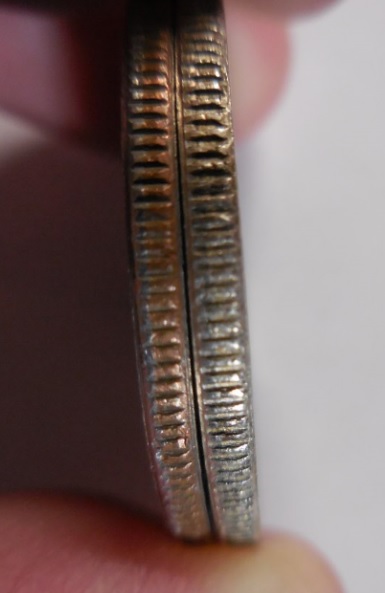 |
|
Pillar of the Community
United States
1538 Posts |
Still not the best pix in the world, but here's the reverse (w/ comparison to clad). 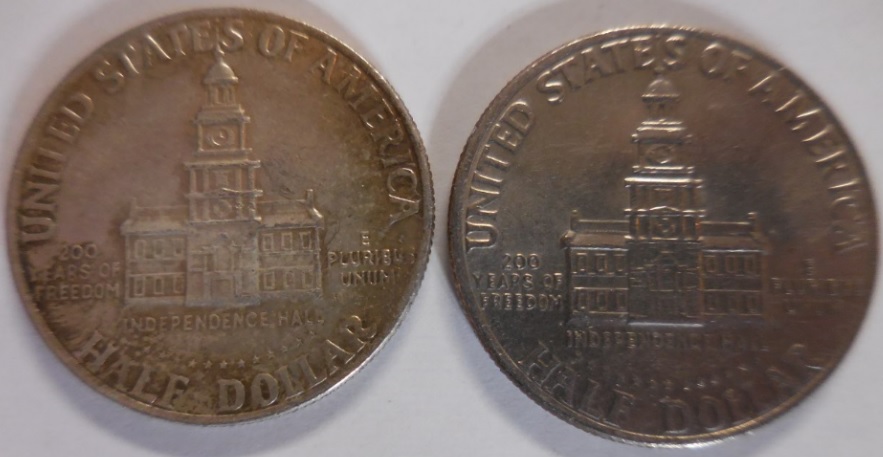 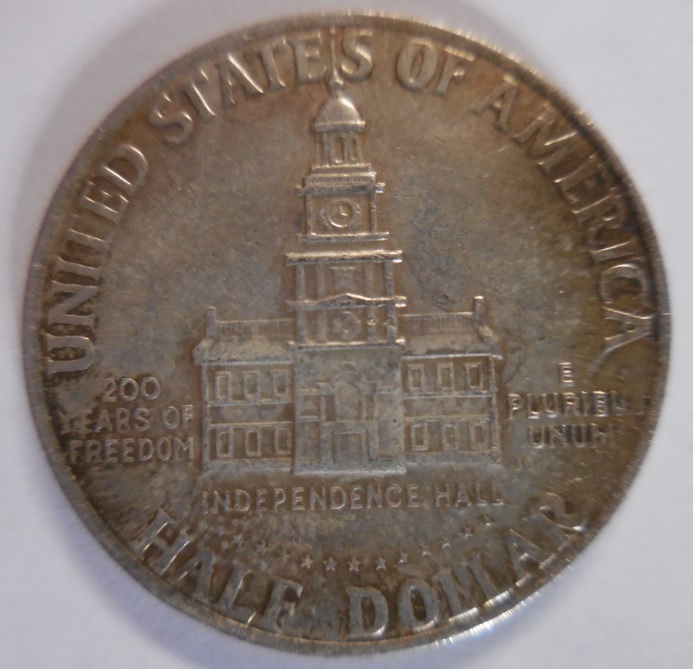 |
|
Pillar of the Community
United States
1538 Posts |
Still kinda lousy obverse shot... sorry. 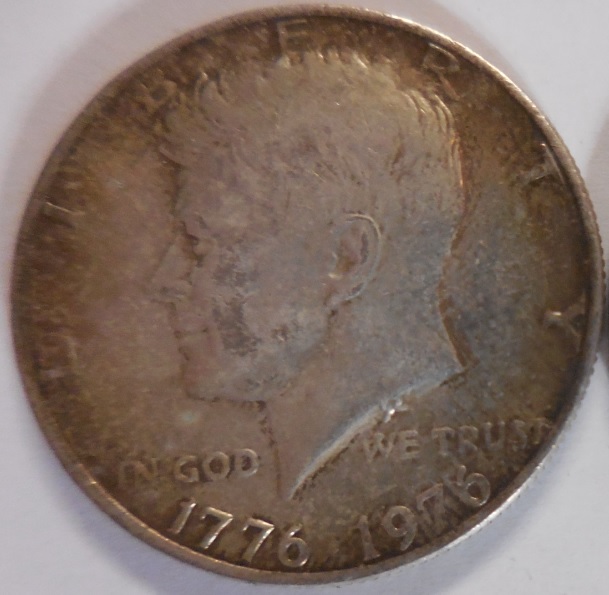 |
|
Bedrock of the Community
United States
17884 Posts |
Can't really tell anything from pictures, when you get the specific gravity or XRF test get back with us. Until then all it is a speculation.
|
|
Pillar of the Community
Canada
1747 Posts |
also have you done the ping test? silver coins are very distinctive when dropped, or even when you put one on top of another. Gather some clad ones and listen when you stack one on the other, do the same with some known silver coins, then add this suspect coin and see if you can hear the difference. There is also the tissue test. But realistically you need to find somewhere you can get this xrf (fancy x-ray) to determine the make up of the coin, no one on here can garuntee 100% you coin is silver or not with just pictures. ask your local coin shop or find a coin club and ask if someone local has one. |
|
Bedrock of the Community
United States
17884 Posts |
The ping test is inconclusive, and the tissue test although good, can be fooled by a plating. |
|
Page 2 of 2
|
Replies: 17 / Views: 9,461 |
Page 2 of 2
|








 First Page


 Posted 04/08/2018 10:29 pm


