First Page
 Previous Page


 with jbuck. BadDog your reading these as if they are black and white. Any contract or law or legislation has "loopholes" or clauses that seem straight forward but aren't. The one jbuck highlighted is not as straight forward as I am sure the writers and reviewers thought it might be. Or possibly they wrote to allow some flexibility on purpose.


 Posted 08/18/2018 1:08 pm


Well, I seem to be on my own on this one. Since you all feel the Mint is allowed to make a profit, what profit are they allowed to make? 5%? 10%? 100%?
It just doesn't work that way. When coins are authorized by specific legislation, the intent of the legislation is to provide the coins to the collecting public at no cost to the government. The legislation indicates what some of those costs may be. If there are others that aren't specifically identified then the Mint is allowed to recoup those as well, but it is not allowed to charge prices with the expectation of making a profit.
The price it does charge is of course an estimate that is designed to cover the cradle to grave cost of the product. I totally agree that it is prudent to charge a price that ensures the costs are recovered, with a SMALL margin. If you look at the Mint's annual reports, you'll see that the Mint is pretty good at this and typically makes a net margin (you'll notice they never call it a profit) of only a few percent.
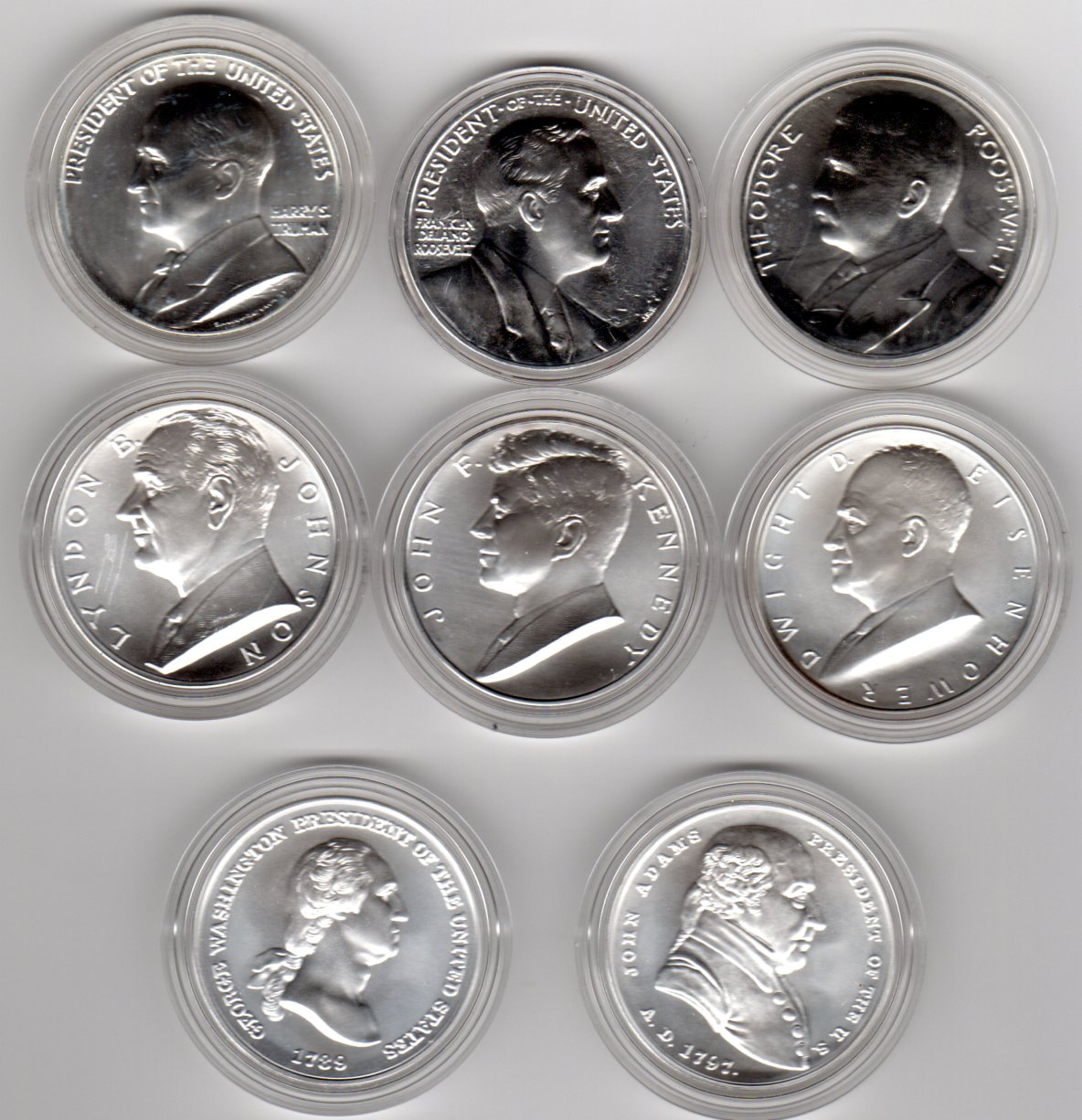
My point with the Presidential medals is that it is rare for the Mint to produce essentially the same product in two different metal contents. Because they are doing this, it allows you to pretty much directly compare the prices of the two products.
When I do this, I think that the costs of producing, marketing, distributing, etc of the two products should be fairly similar with the exception of the cost of the silver. The two products don't appear to be priced this way. Commems believes that the costs associated with the silver version of the medal are significantly greater than the costs associated with the bronze version. It is this dichotomy that I have difficulty believing/understanding.
Commems wanted to compare the ASE prices to the medal prices to justify the price of the medals. I believe a better comparison to look at is the regular proof set versus the silver proof set. Here once again the mint is producing the same product, just in different metal content. The prices are $27.95 for the proof set and $49.95 for the silver proof set, or a difference of $22. The silver proof set contains about 1 1/3 ozt of silver or about $22 of silver. The reverse silver proof set was priced at $5 more than the regular silver proof set. A reasonable increase to cover reasonable additional costs.
BTW, here is the Mint's policy on how they determine pricing. IMO the key quotes are:
It just doesn't work that way. When coins are authorized by specific legislation, the intent of the legislation is to provide the coins to the collecting public at no cost to the government. The legislation indicates what some of those costs may be. If there are others that aren't specifically identified then the Mint is allowed to recoup those as well, but it is not allowed to charge prices with the expectation of making a profit.
The price it does charge is of course an estimate that is designed to cover the cradle to grave cost of the product. I totally agree that it is prudent to charge a price that ensures the costs are recovered, with a SMALL margin. If you look at the Mint's annual reports, you'll see that the Mint is pretty good at this and typically makes a net margin (you'll notice they never call it a profit) of only a few percent.
My point with the Presidential medals is that it is rare for the Mint to produce essentially the same product in two different metal contents. Because they are doing this, it allows you to pretty much directly compare the prices of the two products.
When I do this, I think that the costs of producing, marketing, distributing, etc of the two products should be fairly similar with the exception of the cost of the silver. The two products don't appear to be priced this way. Commems believes that the costs associated with the silver version of the medal are significantly greater than the costs associated with the bronze version. It is this dichotomy that I have difficulty believing/understanding.
Commems wanted to compare the ASE prices to the medal prices to justify the price of the medals. I believe a better comparison to look at is the regular proof set versus the silver proof set. Here once again the mint is producing the same product, just in different metal content. The prices are $27.95 for the proof set and $49.95 for the silver proof set, or a difference of $22. The silver proof set contains about 1 1/3 ozt of silver or about $22 of silver. The reverse silver proof set was priced at $5 more than the regular silver proof set. A reasonable increase to cover reasonable additional costs.
BTW, here is the Mint's policy on how they determine pricing. IMO the key quotes are:
Quote:
The United States Mint works on a cost-recovery basis.
andThe United States Mint works on a cost-recovery basis.
Quote:
The United States Mint's numismatic programs are self-sustaining and operate at no cost to the taxpayer.
The United States Mint's numismatic programs are self-sustaining and operate at no cost to the taxpayer.
Edited by BadDog
08/18/2018 3:31 pm
08/18/2018 3:31 pm